
Sign up to save your podcasts
Or


<span data-mce-type="bookmark" style="display: inline-block; width: 0px; overflow: hidden; line-height: 0;" class="mce_SELRES_start"></span>
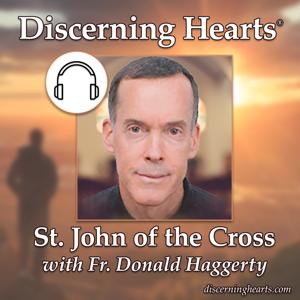
Fr. Haggerty and Kris McGregor discuss the interconnectedness of saints, using examples like St. Thérèse of Lisieux, who embraced St. John’s teachings, influencing others like St. Teresa of Calcutta. Pope St. John Paul II’s deep engagement with St. John’s work, particularly his doctoral dissertation on the experiential impact of faith, which explores how deeper prayer transforms our understanding of God’s presence and our relationship with Him.
Contemplative prayer leads to greater certitude in faith, even as it brings “darkness” to the intellect, requiring trust in God’s unseen presence. This shift often involves a loss of emotional consolations or insights but marks an entry into the mystery of God’s indwelling presence. He encourages integrating scripture into prayer to listen to God’s timeless word personally. As prayer life matures, it becomes simpler yet more profound, as seen in devotions like the Rosary.
The journey of contemplation, marked by silence, trust, and receptivity, deepens our love and union with God, transforming both prayer and life itself.
An excerpt from St. John of the Cross: Master of Contemplation
“What can be the reason for this experience in prayer? Saint John of the Cross affirms that supernatural faith, inasmuch as it places us in an immediate contact with God, affects the intellect in a strangely painful way with the onset of contemplative graces. The truths of revelation that the intellect embraces in faith now seem to surpass comprehension in a manner unlike any previous experience in prayer. A deeper understanding of theological faith can explain why this occurs. It is inadequate to conceive of our faith as simply an assent by our mind to truths that are then held securely with personal conviction. This is not at all the full picture. On a very personal level, in our relations with God himself, faith is a kind of real conduit into the actual mystery of God. As a theological virtue, it unites the intellect quite directly and immediately to the mystery of God. The effect of this union, depending on a soul’s closeness to God, is to stretch the intellect beyond what it can assimilate in its natural capacity. The result in the time of interior prayer is a painful experience of obscurity within the intellect toward the God of ultimate mystery known personally in faith. This is not an experience of dark doubts about God. Rather, it is as though a light has begun to shine too brightly, preventing our eyes from seeing what is there in front of us. The closer we approach the light of God, the more his presence blinds us. The ordinary act of comprehension in regard to natural objects of knowledge does not function in this way. But when the knowledge is of God himself in his immediate personal presence to the soul, the consequence is vastly different.”
Haggerty, Donald. Saint John of the Cross: Master of Contemplation (pp. 67-68). Ignatius Press. Kindle Edition.
The post SJC3 – Contemplative Faith: Certitude in Darkness – St. John of the Cross with Fr. Donald Haggerty – Discerning Hearts Podcast appeared first on Discerning Hearts Catholic Podcasts.
 View all episodes
 By Discerning Hearts Catholic Podcasts
<span data-mce-type="bookmark" style="display: inline-block; width: 0px; overflow: hidden; line-height: 0;" class="mce_SELRES_start"></span>
Fr. Haggerty and Kris McGregor discuss the interconnectedness of saints, using examples like St. Thérèse of Lisieux, who embraced St. John’s teachings, influencing others like St. Teresa of Calcutta. Pope St. John Paul II’s deep engagement with St. John’s work, particularly his doctoral dissertation on the experiential impact of faith, which explores how deeper prayer transforms our understanding of God’s presence and our relationship with Him.
Contemplative prayer leads to greater certitude in faith, even as it brings “darkness” to the intellect, requiring trust in God’s unseen presence. This shift often involves a loss of emotional consolations or insights but marks an entry into the mystery of God’s indwelling presence. He encourages integrating scripture into prayer to listen to God’s timeless word personally. As prayer life matures, it becomes simpler yet more profound, as seen in devotions like the Rosary.
The journey of contemplation, marked by silence, trust, and receptivity, deepens our love and union with God, transforming both prayer and life itself.
An excerpt from St. John of the Cross: Master of Contemplation
“What can be the reason for this experience in prayer? Saint John of the Cross affirms that supernatural faith, inasmuch as it places us in an immediate contact with God, affects the intellect in a strangely painful way with the onset of contemplative graces. The truths of revelation that the intellect embraces in faith now seem to surpass comprehension in a manner unlike any previous experience in prayer. A deeper understanding of theological faith can explain why this occurs. It is inadequate to conceive of our faith as simply an assent by our mind to truths that are then held securely with personal conviction. This is not at all the full picture. On a very personal level, in our relations with God himself, faith is a kind of real conduit into the actual mystery of God. As a theological virtue, it unites the intellect quite directly and immediately to the mystery of God. The effect of this union, depending on a soul’s closeness to God, is to stretch the intellect beyond what it can assimilate in its natural capacity. The result in the time of interior prayer is a painful experience of obscurity within the intellect toward the God of ultimate mystery known personally in faith. This is not an experience of dark doubts about God. Rather, it is as though a light has begun to shine too brightly, preventing our eyes from seeing what is there in front of us. The closer we approach the light of God, the more his presence blinds us. The ordinary act of comprehension in regard to natural objects of knowledge does not function in this way. But when the knowledge is of God himself in his immediate personal presence to the soul, the consequence is vastly different.”
Haggerty, Donald. Saint John of the Cross: Master of Contemplation (pp. 67-68). Ignatius Press. Kindle Edition.
The post SJC3 – Contemplative Faith: Certitude in Darkness – St. John of the Cross with Fr. Donald Haggerty – Discerning Hearts Podcast appeared first on Discerning Hearts Catholic Podcasts.