
Sign up to save your podcasts
Or

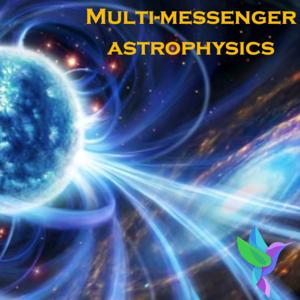

In this episode, we dive into the explosive world of Gamma-Ray Bursts (GRBs)—brief, intense pulses of sub-MeV gamma rays that are considered excellent laboratories for studying particle acceleration, capable of releasing up to $10^{51} - 10^{54}$ ergs of isotropic equivalent energy. We explore the newly published second H.E.S.S. gamma-ray burst catalogue, which details a massive 15-year observational campaign spanning from 2004 to 2019.
We discuss how the High Energy Stereoscopic System (H.E.S.S.) followed up on 89 different GRB alerts, yet found no *new* very-high-energy (VHE) signals beyond previously published detections. But as we will learn, a "non-detection" is actually a massive win for astrophysics! The resulting upper limits form the largest available dataset for GRBs at VHE. We break down why catching these signals is so incredibly difficult, exploring the technical challenge of rapidly repointing ground-based telescopes before the early afterglow fades and how Extragalactic Background Light (EBL) absorbs high-energy gamma rays from distant sources before they ever reach Earth.
We also unpack the standard Synchrotron Self-Compton (SSC) emission models and explain how the upper limits set by H.E.S.S. perfectly align with current physics, proving that VHE-detected GRBs are not a distinct, weird population of stars, but simply the ones that are closest to us and possess naturally luminous X-ray emission. Finally, we look to the future with the next-generation Cherenkov Telescope Array Observatory (CTAO), which features a lower energy threshold that will revolutionize our ability to detect fainter and more distant GRBs.
Reference:
Acharyya, A. et al., "The second H.E.S.S. gamma-ray burst catalogue: 15 years of observations with the H.E.S.S. telescopes." *Astronomy & Astrophysics*, accepted 2026.
Acknowledements: Podcast prepared with Google/NotebookLM. Illustration credits: H.E.S.S./Vikas Chander
 View all episodes
 By Astro-COLIBRI
In this episode, we dive into the explosive world of Gamma-Ray Bursts (GRBs)—brief, intense pulses of sub-MeV gamma rays that are considered excellent laboratories for studying particle acceleration, capable of releasing up to $10^{51} - 10^{54}$ ergs of isotropic equivalent energy. We explore the newly published second H.E.S.S. gamma-ray burst catalogue, which details a massive 15-year observational campaign spanning from 2004 to 2019.
We discuss how the High Energy Stereoscopic System (H.E.S.S.) followed up on 89 different GRB alerts, yet found no *new* very-high-energy (VHE) signals beyond previously published detections. But as we will learn, a "non-detection" is actually a massive win for astrophysics! The resulting upper limits form the largest available dataset for GRBs at VHE. We break down why catching these signals is so incredibly difficult, exploring the technical challenge of rapidly repointing ground-based telescopes before the early afterglow fades and how Extragalactic Background Light (EBL) absorbs high-energy gamma rays from distant sources before they ever reach Earth.
We also unpack the standard Synchrotron Self-Compton (SSC) emission models and explain how the upper limits set by H.E.S.S. perfectly align with current physics, proving that VHE-detected GRBs are not a distinct, weird population of stars, but simply the ones that are closest to us and possess naturally luminous X-ray emission. Finally, we look to the future with the next-generation Cherenkov Telescope Array Observatory (CTAO), which features a lower energy threshold that will revolutionize our ability to detect fainter and more distant GRBs.
Reference:
Acharyya, A. et al., "The second H.E.S.S. gamma-ray burst catalogue: 15 years of observations with the H.E.S.S. telescopes." *Astronomy & Astrophysics*, accepted 2026.
Acknowledements: Podcast prepared with Google/NotebookLM. Illustration credits: H.E.S.S./Vikas Chander