
Sign up to save your podcasts
Or

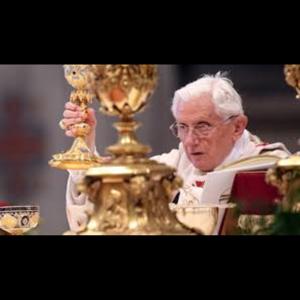

Following the Lord’s Prayer during Mass comes the Sign of Peace or the Rite of Peace. There are two places where instructions are given in the Roman Missal, once right in the Order of Mass and, before that, in the General Instruction of the Roman Missal, paragraph 82. It’s probably better to start with the paragraph from the GIRM.
Paragraph 82 mentions three things about the Sign of Peace: first, it is to be understood as a preparation for Holy Communion, a time for the faithful people in the pews to express to each other that we share an ecclesial communion (we are united - hopefully we are united - in our love for the Church and Her doctrine) and mutual charity toward one another; second, that the sign of peace to be given is established by the local conference of bishops and by local customs and cultures (in other words, what does the Sign of Peace actually look like in real time?); third, that the sign of peace is to be given in a sober manner and only to those nearest to each person. These are all very interesting points that could be expanded upon for pages, especially the third point, but we will leave it as a simple explanation for what we’re looking for at this point in Holy Mass. Before we get to that explanation, let’s take a look at the Order of Mass.
When you pay close attention to the priest during this part of Mass, you’ll notice that he is no longer speaking to the Father, as he does almost the entire Mass, but to Jesus the Son. “Lord Jesus Christ, you said to your apostles…” Some priests signify this shift in the Divine Subject by looking directly at the Eucharist, the living Body and Blood of the Lord. The priest acknowledges that it is Jesus who gives us His peace, which is supreme over any other type of peace that can be found. His peace is supernatural, while any other peace is merely natural. It’s this supernatural peace that we’re seeking. Jesus gave that peace in a number of places, but the specific reference here comes from John 14:27, which comes at the Last Supper. We can see that Jesus gave us the supreme gift of the Eucharist at the Last Supper, but he also gave us His peace, which is also an extraordinary gift to receive! When the priest has finished his prayer to Jesus, notice what he says to the congregation: “May the peace of the Lord be with you always.” Father is not offering you his natural peace, but the supernatural peace of Christ. And when he instructs those present to offer each other the sign of peace, it is the peace of Christ that we are supposed to be offering to those around us. Maybe this can help us see why it ought to be a sober moment rather than a chaotic one. Maybe this can also help us to see why this moment is not one for us to catch up with each other or comment to each other about the homily, but instead to focus exclusively on desiring the peace that surpasses all understanding to rest upon each person’s heart and mind. What a profound desire to share with each other!
The reason for offering the Sign of Peace during Mass comes from the Bible and history. Jesus gives instructions to his disciples during the Sermon on the Mount that we are to make peace with our brethren, to reconcile with them if possible, before offering our sacrifice on the altar. The Sign of Peace can act as a sign (or could be an acknowledgement) of such reconciliation. St. Paul also instructs the Christians in both Corinth and Rome to give each other a holy kiss of peace (Romans 16:16, 1 Cor 16:20). Historically speaking, we can look back to our old friend St. Justin Martyr, who wrote about the worship of 2nd century Christians while he was living in that time. He mentioned that the people would greet one another with a kiss [of peace]. Over time, the Sign of Peace has been “located” in different times of the Mass and has had different appearances, but it has always been included at least as an option. Even today, it’s not a strict requirement to include the large-scale sign of peace, but the priest at least has to offer the peace of Christ to the congregation with the proper response.
 View all episodes
 By Father Bryan Kujawa
Following the Lord’s Prayer during Mass comes the Sign of Peace or the Rite of Peace. There are two places where instructions are given in the Roman Missal, once right in the Order of Mass and, before that, in the General Instruction of the Roman Missal, paragraph 82. It’s probably better to start with the paragraph from the GIRM.
Paragraph 82 mentions three things about the Sign of Peace: first, it is to be understood as a preparation for Holy Communion, a time for the faithful people in the pews to express to each other that we share an ecclesial communion (we are united - hopefully we are united - in our love for the Church and Her doctrine) and mutual charity toward one another; second, that the sign of peace to be given is established by the local conference of bishops and by local customs and cultures (in other words, what does the Sign of Peace actually look like in real time?); third, that the sign of peace is to be given in a sober manner and only to those nearest to each person. These are all very interesting points that could be expanded upon for pages, especially the third point, but we will leave it as a simple explanation for what we’re looking for at this point in Holy Mass. Before we get to that explanation, let’s take a look at the Order of Mass.
When you pay close attention to the priest during this part of Mass, you’ll notice that he is no longer speaking to the Father, as he does almost the entire Mass, but to Jesus the Son. “Lord Jesus Christ, you said to your apostles…” Some priests signify this shift in the Divine Subject by looking directly at the Eucharist, the living Body and Blood of the Lord. The priest acknowledges that it is Jesus who gives us His peace, which is supreme over any other type of peace that can be found. His peace is supernatural, while any other peace is merely natural. It’s this supernatural peace that we’re seeking. Jesus gave that peace in a number of places, but the specific reference here comes from John 14:27, which comes at the Last Supper. We can see that Jesus gave us the supreme gift of the Eucharist at the Last Supper, but he also gave us His peace, which is also an extraordinary gift to receive! When the priest has finished his prayer to Jesus, notice what he says to the congregation: “May the peace of the Lord be with you always.” Father is not offering you his natural peace, but the supernatural peace of Christ. And when he instructs those present to offer each other the sign of peace, it is the peace of Christ that we are supposed to be offering to those around us. Maybe this can help us see why it ought to be a sober moment rather than a chaotic one. Maybe this can also help us to see why this moment is not one for us to catch up with each other or comment to each other about the homily, but instead to focus exclusively on desiring the peace that surpasses all understanding to rest upon each person’s heart and mind. What a profound desire to share with each other!
The reason for offering the Sign of Peace during Mass comes from the Bible and history. Jesus gives instructions to his disciples during the Sermon on the Mount that we are to make peace with our brethren, to reconcile with them if possible, before offering our sacrifice on the altar. The Sign of Peace can act as a sign (or could be an acknowledgement) of such reconciliation. St. Paul also instructs the Christians in both Corinth and Rome to give each other a holy kiss of peace (Romans 16:16, 1 Cor 16:20). Historically speaking, we can look back to our old friend St. Justin Martyr, who wrote about the worship of 2nd century Christians while he was living in that time. He mentioned that the people would greet one another with a kiss [of peace]. Over time, the Sign of Peace has been “located” in different times of the Mass and has had different appearances, but it has always been included at least as an option. Even today, it’s not a strict requirement to include the large-scale sign of peace, but the priest at least has to offer the peace of Christ to the congregation with the proper response.