
Sign up to save your podcasts
Or

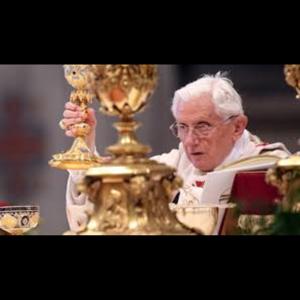

For this week’s Catholic Massterclass, we’re not going to move forward just yet. Instead, I want to focus on something that most people don’t notice during this part of the Mass. Even though it often goes unnoticed, it is a critical moment — not only for the priest, but for each member of the congregation. I hope it opens your eyes in a new way to your preparation for receiving Holy Communion.
Last week I spoke about the Lamb of God, the Fraction Rite, and the commingling of the Eucharistic Host and the Precious Blood of Christ. There is another part of that portion of the Mass that is easy to miss. While the Lamb of God is being sung, after the priest has commingled the Eucharistic species, he bows slightly and prays quietly until the Lamb of God has finished, or even a little after. What is he praying during that time? Is it worthwhile to know those prayers — and perhaps even to pray them yourself?
The Order of Mass in the Roman Missal provides two options for the priest:
(1) Lord Jesus Christ, Son of the Living God, who, by the will of the Father and the work of the Holy Spirit, through your Death gave life to the world, free me by this, your most holy Body and Blood, from all my sins and from every evil; keep me always faithful to your commandments, and never let me be parted from you.
or
(2) May the receiving of your Body and Blood, Lord Jesus Christ, not bring me to judgment and condemnation, but through your loving mercy be for me protection in mind and body and a healing remedy.
Up to this point in the Mass — and in what follows — the priest prays aloud on behalf of the people, standing in the Person of Christ. In this quiet moment, however, he prays personally. He bows before the Lord he is about to receive and recalls that he too is a man in need of mercy and protection. Scripture and Sacred Tradition remind us that religious leaders will be held to a higher standard, which makes these prayers especially important for the priest. He takes refuge in the power of the Death and Resurrection of Jesus, asking for fidelity, protection, and perseverance. Jesus says in the Gospel of John, “If you keep my commandments, you will abide in my love, just as I have kept my Father’s commandments and abide in his love” (Jn 15:10). The priest is asking for the grace to be faithful to the Lord’s commandments and, therefore, always remain with him.
There is another part to these prayers, however, that often goes unspoken. St. Paul writes to the Corinthians, “Whoever, therefore, eats the bread or drinks the cup of the Lord in an unworthy manner will be guilty of profaning the body and blood of the Lord. Let a man examine himself, and so eat of the bread and drink of the cup. For any one who eats and drinks without discerning the body eats and drinks judgment upon himself” (1 Corinthians 11:27-29). Receiving the Body and Blood of Christ is not casual. In this New Covenant sacrificial meal, we declare our allegiance to Christ. If we knowingly cling to grave sin, we contradict that allegiance. That is why St. Paul urges self-examination. The priest pauses here to examine his conscience and to beg the Lord’s mercy before approaching Holy Communion.
This seriousness, however, should not frighten us — it should steady us. The Eucharist is given as a remedy and a source of life. We simply must approach it honestly and reverently.
 View all episodes
 By Father Bryan Kujawa
For this week’s Catholic Massterclass, we’re not going to move forward just yet. Instead, I want to focus on something that most people don’t notice during this part of the Mass. Even though it often goes unnoticed, it is a critical moment — not only for the priest, but for each member of the congregation. I hope it opens your eyes in a new way to your preparation for receiving Holy Communion.
Last week I spoke about the Lamb of God, the Fraction Rite, and the commingling of the Eucharistic Host and the Precious Blood of Christ. There is another part of that portion of the Mass that is easy to miss. While the Lamb of God is being sung, after the priest has commingled the Eucharistic species, he bows slightly and prays quietly until the Lamb of God has finished, or even a little after. What is he praying during that time? Is it worthwhile to know those prayers — and perhaps even to pray them yourself?
The Order of Mass in the Roman Missal provides two options for the priest:
(1) Lord Jesus Christ, Son of the Living God, who, by the will of the Father and the work of the Holy Spirit, through your Death gave life to the world, free me by this, your most holy Body and Blood, from all my sins and from every evil; keep me always faithful to your commandments, and never let me be parted from you.
or
(2) May the receiving of your Body and Blood, Lord Jesus Christ, not bring me to judgment and condemnation, but through your loving mercy be for me protection in mind and body and a healing remedy.
Up to this point in the Mass — and in what follows — the priest prays aloud on behalf of the people, standing in the Person of Christ. In this quiet moment, however, he prays personally. He bows before the Lord he is about to receive and recalls that he too is a man in need of mercy and protection. Scripture and Sacred Tradition remind us that religious leaders will be held to a higher standard, which makes these prayers especially important for the priest. He takes refuge in the power of the Death and Resurrection of Jesus, asking for fidelity, protection, and perseverance. Jesus says in the Gospel of John, “If you keep my commandments, you will abide in my love, just as I have kept my Father’s commandments and abide in his love” (Jn 15:10). The priest is asking for the grace to be faithful to the Lord’s commandments and, therefore, always remain with him.
There is another part to these prayers, however, that often goes unspoken. St. Paul writes to the Corinthians, “Whoever, therefore, eats the bread or drinks the cup of the Lord in an unworthy manner will be guilty of profaning the body and blood of the Lord. Let a man examine himself, and so eat of the bread and drink of the cup. For any one who eats and drinks without discerning the body eats and drinks judgment upon himself” (1 Corinthians 11:27-29). Receiving the Body and Blood of Christ is not casual. In this New Covenant sacrificial meal, we declare our allegiance to Christ. If we knowingly cling to grave sin, we contradict that allegiance. That is why St. Paul urges self-examination. The priest pauses here to examine his conscience and to beg the Lord’s mercy before approaching Holy Communion.
This seriousness, however, should not frighten us — it should steady us. The Eucharist is given as a remedy and a source of life. We simply must approach it honestly and reverently.