
Sign up to save your podcasts
Or

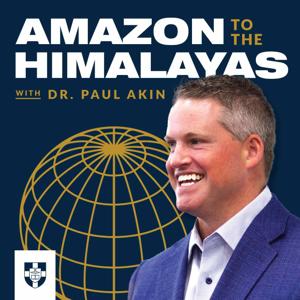


Host Paul Akin discusses the cost of discipleship and the cultural pressure not to stand out, including the story of a 19-year-old new believer who secretly jogged to church to worship before telling his parents. Jordan shares about ministry in a Southeast Asian city, where interest in learning English creates natural opportunities to build relationships and share the gospel. He recounts how an expat group began planning in 2016 and formed a doctrinally clear, elder-led, congregational Baptist church in 2017, growing from about 15 people meeting in a living room to nearly 90, split roughly between locals and expats. Jordan also discusses local-language discipleship, a new church plant preparing to launch nearby, and the challenge and encouragement of sending members—including his co-pastor—to reach other unengaged people groups.
Mentioned in this episode:
The Doctor of Ministry
https://www.sbts.edu/degree-programs/doctor-of-ministry/
Host Paul Akin introduces a conversation with Jordan, a Kentucky native who came to a fuller understanding of the gospel in college through a Romans Bible study and later developed a heart for the nations through church discipleship and international student outreach in Louisville. Jordan explains how he and his wife initially planned a short, three-year assignment but were led instead to Southeast Asia through a practical opportunity matching their skills, and 15 years later he has helped plant a healthy church preparing to send local believers to plant another. He describes a context with less than 1% evangelical Christians, a religious “veneer” of Buddhism over an animistic worldview marked by fear, ancestor veneration, and syncretism, alongside government pressure toward secularism. Major obstacles include government restrictions and cultural pressure to conform, which can cause some baptized members to withdraw.
Mentioned in this episode:
The Doctor of Ministry
https://www.sbts.edu/degree-programs/doctor-of-ministry/
Host Paul Akin reflects on a recent family trip to Nairobi, Kenya, reconnecting with former ministry partners after 17 years. He shares three reflections: encouragement from healthy churches, evidence of God’s work across Africa, and the continued need amid lostness, poverty, and the prosperity gospel. Along the way, he highlights formative experiences for his children, including time with refugees, prayer walking, and campus gospel conversations.
What happens when God meets a man in a prison cell? Jon Kelly joins Dr. Paul Akin to share how the Lord saved him in prison through His Word and ultimately called him to pastoral ministry in Chicago.
Mentioned in this episode:
The Doctor of Ministry
https://www.sbts.edu/degree-programs/doctor-of-ministry/
Host Paul Akin welcomes Pastor Chopo Mwanza of Faith Baptist Church Riverside in Kitwe, Zambia, for a conversation about gospel ministry and church life in Zambia. Mwanza introduces Zambia as a peaceful, diverse nation of more than 70 tribes and languages, where English serves as the official language and tribal divisions are often less pronounced in urban areas. He discusses Zambia’s identity as a “Christian nation,” highlighting both the opportunities it creates for gospel ministry and the challenges of nominal Christianity and syncretism. Mwanza also describes life in Kitwe, a Copperbelt mining city shaped by the rise and fall of the mining industry. Finally, he shares the story of Faith Baptist Church—from its founding by missionaries in 1993 to its transition to local leadership—and reflects on the challenges facing believers today, including syncretism, corruption, and the call to live with integrity.
Mentioned in this episode:
Doctorate of Missiology at Southern Seminary
Host Paul Akin interviews Jennifer Trafton about her book, If Only We Could See, highlighting missionary Lilias Trotter’s decades in North Africa and how she leveraged art and creativity for ministry. Trotter kept nearly daily illustrated journals for 40 years, shared them with supporters, and helped produce colorful Arabic publications shaped by the region’s visual language to help people “see” and therefore love and pray for the Arab people she loved. Trafton explains Trotter’s idea of a “beautiful possible life” marked by joyful adventure, surrender to the Spirit, and faithful, often hidden obedience rather than platform-driven success. The conversation emphasizes Trotter’s attentive compassion, her ability to dignify marginalized people by truly seeing them, and how studying her has shaped Trafton’s attentiveness, prayer for the Arab world, and perspective on calling.
Mentioned in this episode:
The Online PhD at Southern Seminary
https://www.sbts.edu/online-phd/
Her legacy was relational. Her legacy was people. People who felt seen and loved by her years later. Lilias Trotter lived what looked like a hidden and seemingly unsuccessful life, but she believed we are scattering seeds far beyond what we can see. ‘The harvest of the trivial and monotonous might lie out beyond the stars.’ We have no idea what God may do with our faithfulness long after our lifetime.
Mentioned in this episode:
The Doctor of Ministry
https://www.sbts.edu/degree-programs/doctor-of-ministry/
Host Paul Akin interviews missionary Michael about his journey from nominal Catholicism in Knoxville, Tennessee, to serving nearly 15 years overseas in Central Asia and Germany. Michael shares how God used prayer for unreached peoples to call his family to missions, the challenges and opportunities of church planting in post-Christian Germany, and the story behind their German-speaking church plant in Cologne. They also discuss international churches, missionary pastors, language learning, and the importance of healthy local churches in global missions.
Host Paul Akin talks with Matthew Ellison and Denny Spits about church–agency partnership in missions, arguing agencies should serve churches as facilitators, not replace them. Citing Steve Byrne, they stress churches as senders, warn against churches acting as their own agencies, and highlight the need for strong missionary care. They conclude that pastoral leadership is key to building a sending culture where missions shapes discipleship.
Mentioned in this episode:
Doctorate of Missiology at Southern Seminary
Host Paul Akin interviews Denny Spits and Matthew Ellison about their book The Sending Shepherd: Leading Churches to Disciple All Nations, arguing that shepherding and sending belong together in pastoral ministry. They highlight barriers to becoming a sending church—misdefined missions, risk-averse North American culture, and “missional living” that replaces cross-cultural sending—along with research from Barna Group showing strong support for missions but little emphasis on the unreached. They also outline marks of potential missionaries and urge pastors, following Acts 13, to send their best for the sake of the kingdom, offering a framework for assessing character, competency, compatibility, and calling within the local church.
Mentioned in this episode:
The NEW MDiv at Southern Seminary
From the publisher's feed

8,600 Listeners

3,936 Listeners

840 Listeners
720 Listeners
1,419 Listeners

2,185 Listeners

841 Listeners
208 Listeners
180 Listeners

641 Listeners

804 Listeners

130 Listeners
185 Listeners
366 Listeners
87 Listeners