
Sign up to save your podcasts
Or

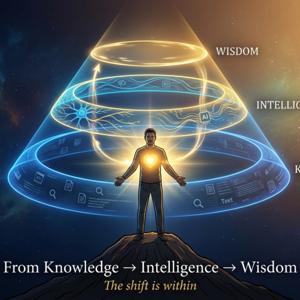

There is a quiet trade-off hidden in how intellect manages emotions.
It seeks stability.
So it moderates:
→ don’t get too excited
→ don’t get too disappointed
→ stay somewhere in the middle
And on the surface, this feels like balance.
But look closely…
What is being reduced is not just the lows.
It is the highs as well.
This is the subtle cost of emotional management through intellect:
To avoid falling too low,
you also stop rising too high.
Life becomes controlled.
Predictable.
Safe.
But also… flattened.
Integrated Intelligence does not manage emotion in this way.
It does not try to reduce intensity.
It stabilizes something deeper:
Your relationship to the experience.
This is the distinction:
Intellect says:
→ regulate the experience
Integrated Intelligence reveals:
→ anchor in awareness
So the highs can be fully experienced
without creating a dependence on them.
And the lows can be fully experienced
without collapsing into them.
This is the paradox:
You don’t avoid the lows
by suppressing the highs.
You transcend both
by becoming present to what is.
This is why your insight around the “now” becomes central again.
Because:
→ past pulls you down
→ future pulls you into anxiety
Only the present allows full experience
without distortion
And this is where creativity enters.
When you are not:
→ protecting yourself from the lows
→ or chasing the highs
Something opens up.
Expression becomes natural.
Not driven.
Not controlled.
Just emerging.
And this is precisely where the human-AI relationship becomes clear.
AI:
→ can amplify patterns
→ execute with precision
→ operate on memory
But it cannot:
→ be present
→ experience
→ create from awareness
So the real model is not:
Human + AI = more intelligence
It is:
Presence (human) → Creation
Execution (AI) → Amplification
Which brings this to a simple but powerful reflection:
Are you reducing your highs
to protect yourself from your lows?
Or
Are you present enough
to experience both fully… without being defined by either?
 View all episodes
 By Gaurav Vaid
There is a quiet trade-off hidden in how intellect manages emotions.
It seeks stability.
So it moderates:
→ don’t get too excited
→ don’t get too disappointed
→ stay somewhere in the middle
And on the surface, this feels like balance.
But look closely…
What is being reduced is not just the lows.
It is the highs as well.
This is the subtle cost of emotional management through intellect:
To avoid falling too low,
you also stop rising too high.
Life becomes controlled.
Predictable.
Safe.
But also… flattened.
Integrated Intelligence does not manage emotion in this way.
It does not try to reduce intensity.
It stabilizes something deeper:
Your relationship to the experience.
This is the distinction:
Intellect says:
→ regulate the experience
Integrated Intelligence reveals:
→ anchor in awareness
So the highs can be fully experienced
without creating a dependence on them.
And the lows can be fully experienced
without collapsing into them.
This is the paradox:
You don’t avoid the lows
by suppressing the highs.
You transcend both
by becoming present to what is.
This is why your insight around the “now” becomes central again.
Because:
→ past pulls you down
→ future pulls you into anxiety
Only the present allows full experience
without distortion
And this is where creativity enters.
When you are not:
→ protecting yourself from the lows
→ or chasing the highs
Something opens up.
Expression becomes natural.
Not driven.
Not controlled.
Just emerging.
And this is precisely where the human-AI relationship becomes clear.
AI:
→ can amplify patterns
→ execute with precision
→ operate on memory
But it cannot:
→ be present
→ experience
→ create from awareness
So the real model is not:
Human + AI = more intelligence
It is:
Presence (human) → Creation
Execution (AI) → Amplification
Which brings this to a simple but powerful reflection:
Are you reducing your highs
to protect yourself from your lows?
Or
Are you present enough
to experience both fully… without being defined by either?