
Sign up to save your podcasts
Or



In this episode of Autistic Standpoint Theory, Isha Snow is joined by AuDHD seminary student Willow Shirtz for a deeply personal conversation about autistic cognition, faith, identity and religious trauma.
Content note: This episode contains discussion of religious trauma, mental health, psychiatric treatment and difficult family experiences, as well as strong language.
Raised in a devout Mormon household, Willow reflects on entering missionary service with genuine belief and the experiences that eventually forced them to question both their faith and the expectations placed upon them. They discuss what it means to process belief, morality and contradiction through an autistic lens — particularly when the systems around you demand certainty and conformity.
Their conversation moves through missionary life, mental health, psychiatric treatment, family relationships, sexuality and gender, as Willow describes the difficult process of dismantling an inherited worldview and rebuilding a life beyond it.
Now identifying as an atheist while preparing for Unitarian Universalist ministry, Willow's story raises a bigger question at the heart of the series: when a system you were taught to trust stops making sense, what can your own way of knowing help you build in its place?
Autistic Standpoint Theory is part of the Autistic Culture Podcast Network.
🎧 Autistic Standpoint Theory is available on Spotify, Apple Podcasts, and all major platforms.
🌈 Celebrate autistic voices with early access, ad-free listening, and our full archive at AutisticCulturePlus.com
🌐 Visit www.autisticculturepodcastnetwork.com
📲 Follow us on Instagram: @autisticculturepodcast
Hosted on Acast. See acast.com/privacy for more information.
In this episode of Autistic Standpoint Theory, Isha Snow is joined by autistic advocate and technology professional Sam Farmer to explore what happens when autistic people are expected to navigate systems built around different ways of communicating, learning and relating to the world.
Drawing on Sam's career in technology and his experience as an autistic self-advocate, they discuss neurodiversity-affirming support, accommodations and the importance of involving autistic people in the development of tools and services intended for their community.
Together, Isha and Sam consider the enormous diversity within autism, why support needs aren't always visible, and whether some of what is described as autistic deficit might instead emerge from a mismatch between autistic people and the environments around them.
The conversation also turns to empathy, advocacy and Sam's opposition to aversive interventions, asking what our institutions could look like if autistic knowledge was treated as expertise rather than an afterthought.
Autistic Standpoint Theory is part of the Autistic Culture Podcast Network.
🎧 Autistic Standpoint Theory is available on Spotify, Apple Podcasts, and all major platforms.
🌈 Celebrate autistic voices with early access, ad-free listening, and our full archive at AutisticCulturePlus.com
🌐 Visit www.autisticculturepodcastnetwork.com
📲 Follow us on Instagram: @autisticculturepodcast
Hosted on Acast. See acast.com/privacy for more information.
In the first episode of Autistic Standpoint Theory, Isha Snow is joined by Dani Stephens to explore what changes when neurodivergent people begin to understand themselves — and are finally given the support they need to succeed.
Dani shares their journey through ADHD and autism identification, navigating university as a neurodivergent student, and the difference that access to accommodations has made to their education. Together, they discuss burnout, disability support, inaccessible systems and what happens when struggles previously understood as personal failings are viewed through a neurodivergent lens.
They also explore the importance of finding community. Inspired by Isha's own peer support work, Dani created a neurodivergent social group at Washington State University that became a registered student club.
From discovering a new understanding of yourself to building spaces where others can belong, this conversation asks what becomes possible when neurodivergent people are supported rather than expected to become someone else.
Autistic Standpoint Theory is part of the Autistic Culture Podcast Network.
🎧 Autistic Standpoint Theory is available on Spotify, Apple Podcasts, and all major platforms.
🌈 Celebrate autistic voices with early access, ad-free listening, and our full archive at AutisticCulturePlus.com
🌐 Visit www.autisticculturepodcastnetwork.com
📲 Follow us on Instagram: @autisticculturepodcast
Hosted on Acast. See acast.com/privacy for more information.
What changes when Autistic people aren't simply the subjects of knowledge — but the people producing it?
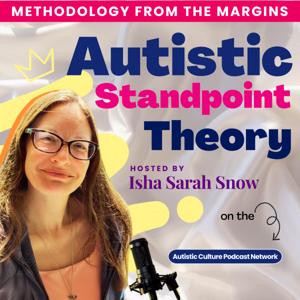
Autistic Standpoint Theory is a new podcast hosted by researcher and author Isha Snow, exploring how Autistic experience can offer a distinct way of understanding ourselves, each other and the systems around us.
Hosted by researcher and author Isha Snow, Isha is joined by Autistic thinkers, researchers and advocates for conversations spanning Autistic history, identity and culture, religious trauma, the Double Empathy Problem, epistemic injustice and the systems that shape whose knowledge gets recognised.
Drawing on decolonial theory, attachment science, and the Double Empathy Problem, the show builds a rigorous, accessible framework for understanding neurodivergence not as a deficit, but as a legitimate standpoint, for listeners who are done being explained and ready to explain.
🎧 Autistic Standpoint Theory is available on Spotify, Apple Podcasts, and all major platforms.
🌈 Celebrate autistic voices with early access, ad-free listening, and our full archive at AutisticCulturePlus.com
🌐 Visit www.autisticculturepodcastnetwork.com
📲 Follow us on Instagram: @autisticculturepodcast
Hosted on Acast. See acast.com/privacy for more information.
From the publisher's feed
Autistic Standpoint Theory is a collaborative deep dive for scholars, advocates, and Autistic thinkers who want to interrogate the systems that shape what we know.
Hosted by researcher…
Drawing on decolonial theory, attachment science, and the Double Empathy Problem, the show builds a rigorous, accessible framework for understanding neurodivergence not as a deficit, but as a legitimate standpoint, for listeners who are done being explained and ready to explain.
🎧 Autistic Standpoint Theory is available on Spotify, Apple Podcasts, and all major platforms.
🌈 Celebrate autistic voices with early access, ad-free listening, and our full archive at AutisticCulturePlus.com
🌐 Visit www.autisticculturepodcastnetwork.com
📲 Follow us on Instagram: @autisticculturepodcast
Hosted on Acast. See acast.com/privacy for more information.