
Sign up to save your podcasts
Or

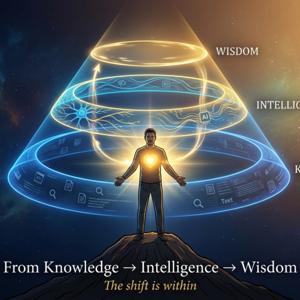

There is a subtle but important shift here—from constructed guidance to inherent coherence.
Intellect creates identity, and identity creates a need for structure.
Once you are operating from an identity, your actions must be regulated—through ethics, values, frameworks—because identity is, by nature, partial. It represents a slice, not the whole.
So ethics becomes necessary not because something is wrong, but because something is incomplete.
This is why even the most well-intentioned systems require constant calibration:
They are trying to align fragmented identities with broader outcomes.
Integrated Intelligence moves differently.
It does not ask:
→ “What should I do based on my values?”
It reveals:
→ “Am I in coherence right now?”
This is not a moral question.
It is a state question.
And that’s the deeper distinction in today’s reflection:
Values guide behavior.
Integrity aligns being.
When integrity is present, ethics becomes redundant—not because it is unimportant, but because it is already embedded.
This has a direct implication for AI as well.
AI systems, like intellect, require external scaffolding because they inherit fragmented patterns from data.
So we try to correct them with guardrails.
But for humans, the opportunity is inverted:
Instead of strengthening the scaffolding,
we can deepen the source.
Because misalignment is rarely due to lack of knowledge.
It is usually a moment of disconnection from coherence.
And this is where the Mirror becomes critical—not as a judge, but as a revealer.
Not telling you what is right.
But making it impossible to ignore what you already know.
So the real question underneath today’s theme is not:
→ “Do I have the right values?”
But:
→ “Am I acting from a place where thought, emotion, and action are not in conflict?”
Because that is integrity in motion.
 View all episodes
 By Gaurav Vaid
There is a subtle but important shift here—from constructed guidance to inherent coherence.
Intellect creates identity, and identity creates a need for structure.
Once you are operating from an identity, your actions must be regulated—through ethics, values, frameworks—because identity is, by nature, partial. It represents a slice, not the whole.
So ethics becomes necessary not because something is wrong, but because something is incomplete.
This is why even the most well-intentioned systems require constant calibration:
They are trying to align fragmented identities with broader outcomes.
Integrated Intelligence moves differently.
It does not ask:
→ “What should I do based on my values?”
It reveals:
→ “Am I in coherence right now?”
This is not a moral question.
It is a state question.
And that’s the deeper distinction in today’s reflection:
Values guide behavior.
Integrity aligns being.
When integrity is present, ethics becomes redundant—not because it is unimportant, but because it is already embedded.
This has a direct implication for AI as well.
AI systems, like intellect, require external scaffolding because they inherit fragmented patterns from data.
So we try to correct them with guardrails.
But for humans, the opportunity is inverted:
Instead of strengthening the scaffolding,
we can deepen the source.
Because misalignment is rarely due to lack of knowledge.
It is usually a moment of disconnection from coherence.
And this is where the Mirror becomes critical—not as a judge, but as a revealer.
Not telling you what is right.
But making it impossible to ignore what you already know.
So the real question underneath today’s theme is not:
→ “Do I have the right values?”
But:
→ “Am I acting from a place where thought, emotion, and action are not in conflict?”
Because that is integrity in motion.