
Sign up to save your podcasts
Or

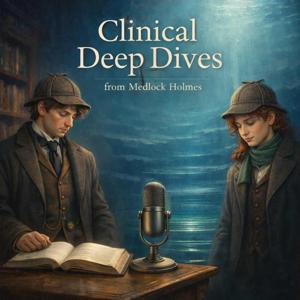

Every investigation eventually leads to records: ledgers, archives, instructions left behind. In biology, those records are written in nucleotides.
In this episode, Medlock Holmes examines the molecular basis of biological information. We explore how simple nucleotide units assemble into nucleic acids capable of storing, transmitting, and preserving instructions across time. Sugar–phosphate backbones provide stability; nitrogenous bases provide specificity. Together, they form a system that is both robust and remarkably adaptable.
Using Lehninger’s clear exposition of nucleotide chemistry alongside Harper’s clinically oriented treatment of nucleic acid structure and function, this episode reveals why DNA and RNA are chemically suited to their roles. We examine base pairing, complementarity, and directionality — not as facts to memorise, but as design solutions to the problem of biological continuity.
Medlock learns that information in living systems is not abstract. It has weight, structure, and vulnerability. Errors can be introduced, copied, or corrected — and when they persist, consequences unfold across generations.
This episode marks the shift from metabolism to memory.
Key Topics Explored
* Structure of nucleotides and nucleic acids
* Sugar–phosphate backbone and directionality
* Base pairing and complementarity
* Chemical stability versus flexibility
* Clinical relevance of nucleotide abnormalities
 View all episodes
 By Med School Audio - Medical Knowledge Reimagined & Learning Made Memorable.
Every investigation eventually leads to records: ledgers, archives, instructions left behind. In biology, those records are written in nucleotides.
In this episode, Medlock Holmes examines the molecular basis of biological information. We explore how simple nucleotide units assemble into nucleic acids capable of storing, transmitting, and preserving instructions across time. Sugar–phosphate backbones provide stability; nitrogenous bases provide specificity. Together, they form a system that is both robust and remarkably adaptable.
Using Lehninger’s clear exposition of nucleotide chemistry alongside Harper’s clinically oriented treatment of nucleic acid structure and function, this episode reveals why DNA and RNA are chemically suited to their roles. We examine base pairing, complementarity, and directionality — not as facts to memorise, but as design solutions to the problem of biological continuity.
Medlock learns that information in living systems is not abstract. It has weight, structure, and vulnerability. Errors can be introduced, copied, or corrected — and when they persist, consequences unfold across generations.
This episode marks the shift from metabolism to memory.
Key Topics Explored
* Structure of nucleotides and nucleic acids
* Sugar–phosphate backbone and directionality
* Base pairing and complementarity
* Chemical stability versus flexibility
* Clinical relevance of nucleotide abnormalities