The Blue Angels: A Legacy of Excellence in the Sky
The Blue Angels, the United States Navy's flight demonstration squadron, has been thrilling audiences and serving as a symbol of American military prowess for over 75 years. The squadron's origins can be traced back to the closing months of World War II, when Admiral Chester W. Nimitz, the Chief of Naval Operations, ordered the formation of a flight exhibition team to boost Navy morale, demonstrate naval air power, and generate public interest in naval aviation.
On April 24, 1946, the Navy Flight Exhibition Team, later known as the Blue Angels, was established at Naval Air Station (NAS) Jacksonville, Florida. Led by Lieutenant Commander Roy "Butch" Voris, the team initially consisted of four pilots flying Grumman F6F Hellcat fighter planes. The team's name was inspired by the Blue Angel nightclub in New York City, a popular venue frequented by pilots during World War II.
The Blue Angels performed their first flight demonstration on June 15, 1946, at Craig Field in Jacksonville, Florida. The team's original flight demonstration routine was a simple display of formation flying and aerobatic maneuvers, but it quickly evolved to include more complex and thrilling stunts.
In 1947, the Blue Angels transitioned to the Grumman F8F Bearcat, a more powerful and agile aircraft that allowed the team to perform more challenging maneuvers. The team also increased in size, adding a fifth pilot and a sixth aircraft to serve as a spare.
Throughout the late 1940s and early 1950s, the Blue Angels performed at air shows and special events across the United States, quickly gaining a reputation for their precise flying, tight formations, and exciting routines. The team's popularity soared, and they became a symbol of American excellence and military might.
In 1949, the Blue Angels made the transition to jet aircraft, becoming the first military flight demonstration team to do so. The team initially flew the Grumman F9F-2 Panther, a straight-wing jet fighter that posed new challenges for the pilots due to its increased speed and reduced visibility compared to propeller-driven aircraft.
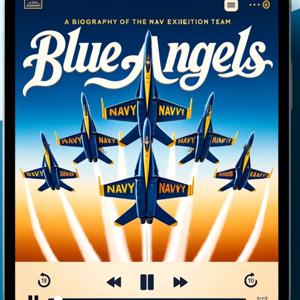
The 1950s saw the Blue Angels continue to evolve and expand. In 1950, the team adopted a new flight demonstration routine that included the famous "Diamond Formation," which would become a hallmark of the Blue Angels' performances. The Diamond Formation consists of four aircraft flying in close proximity, with the lead plane at the point of the diamond and the other three planes forming the sides and rear.
In 1954, the Blue Angels transitioned to the Grumman F9F-8 Cougar, an improved version of the Panther with swept wings and more powerful engines. The Cougar allowed the team to perform even more impressive maneuvers and fly at higher speeds.
The late 1950s brought significant changes to the Blue Angels. In 1957, the team began flying the Grumman F11F-1 Tiger, a supersonic fighter aircraft capable of reaching speeds of
This content was created in partnership and with the help of Artificial Intelligence AI.



 View all episodes
