
Sign up to save your podcasts
Or

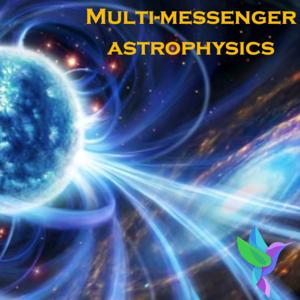

In this episode, we dive into a groundbreaking discovery in high-energy astrophysics: the detection of the blazar PKS 0346−27 at a redshift of $z = 0.991$. This makes it one of the most distant objects ever detected in very-high-energy (VHE) gamma-rays ($E > 100$ GeV). We explore how the H.E.S.S. (High Energy Stereoscopic System) telescopes in Namibia managed to capture this elusive signal despite the thick "fog" of Extragalactic Background Light (EBL) that usually absorbs such distant photons.
Key Discussion Points:
Technical Insight: The researchers found that a traditional leptonic model (based on electrons) would require "implausible" parameters, such as a Doppler factor exceeding 80, to explain the flare. This push toward hadronic models suggests that relativistic protons may play a much larger role in the most powerful jets in the universe than previously confirmed.
Featured Article: H.E.S.S. Collaboration, et al. (2026). "H.E.S.S. detection and multi-wavelength study of the $z \sim 1$ blazar PKS 0346−27." Astronomy & Astrophysics manuscript no. 0346.
Acknowledements: Podcast prepared with Google/NotebookLM. Illustration credits: Stefan Schwarzburg
 View all episodes
 By Astro-COLIBRI
In this episode, we dive into a groundbreaking discovery in high-energy astrophysics: the detection of the blazar PKS 0346−27 at a redshift of $z = 0.991$. This makes it one of the most distant objects ever detected in very-high-energy (VHE) gamma-rays ($E > 100$ GeV). We explore how the H.E.S.S. (High Energy Stereoscopic System) telescopes in Namibia managed to capture this elusive signal despite the thick "fog" of Extragalactic Background Light (EBL) that usually absorbs such distant photons.
Key Discussion Points:
Technical Insight: The researchers found that a traditional leptonic model (based on electrons) would require "implausible" parameters, such as a Doppler factor exceeding 80, to explain the flare. This push toward hadronic models suggests that relativistic protons may play a much larger role in the most powerful jets in the universe than previously confirmed.
Featured Article: H.E.S.S. Collaboration, et al. (2026). "H.E.S.S. detection and multi-wavelength study of the $z \sim 1$ blazar PKS 0346−27." Astronomy & Astrophysics manuscript no. 0346.
Acknowledements: Podcast prepared with Google/NotebookLM. Illustration credits: Stefan Schwarzburg