This is your Silicon Siege: China's Tech Offensive podcast.
Name’s Ting. Let’s jack straight into Silicon Siege.
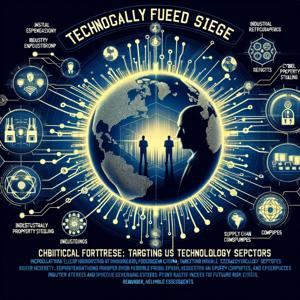
Over the past two weeks, US tech has basically been playing cyber Whac‑A‑Mole with China-linked crews, with Microsoft’s threat intel team warning that groups like Volt Typhoon and Flax Typhoon are pivoting hard from classic government spying into deeper industrial espionage against cloud, chip, and AI companies. Microsoft analysts have been telling policy folks that these operators are quietly burrowing into identity systems and DevOps tooling instead of just smashing the front door, aiming to live off the land inside Fortune 500 networks.
According to recent coverage in Politico’s digital and AI reporting, US officials are increasingly worried about Beijing getting access to frontier AI models that can autonomously find software vulnerabilities, essentially turning Chinese cyber teams into bug-hunting factories aimed straight at Silicon Valley infrastructure and code bases. Industry experts quoted there are saying the window before China fields Mythos‑class offensive AI is shrinking from years to months, which makes every current intrusion feel like pre‑season training for something much bigger.
In the supply chain, threat reports shared across semiconductor and cloud vendors describe Chinese-linked actors shifting from targeting finished products to hitting design partners, firmware vendors, and smaller regional data-center operators. Think: compromise the third‑party that handles your baseboard management controller updates, and suddenly that shiny server farm in Northern Virginia or Austin becomes a listening post. Cyber strategists from firms like Mandiant and CrowdStrike have been flagging repeated probes against code-signing infrastructure and build pipelines, explicitly warning about SolarWinds‑style scenarios tuned for AI accelerators and networking gear.
On the IP front, FBI and CISA briefings to security leaders in places like San Jose and Seattle have focused on stealthy credential theft against engineers working on GPUs, advanced packaging, and model-optimization software. Instead of smashing repositories, these campaigns quietly exfiltrate specific branches, design docs, and training scripts, then disappear. One senior analyst at a major US cloud provider recently described it as “continuous leakage, not smash-and-grab,” where losing a single proprietary optimizer for AI inference could erase years of competitive edge.
Strategically, people like former NSA cyber experts now in private sector roles are warning that this is not just about stealing blueprints; it’s about building long‑term access so that, in a crisis over Taiwan or the South China Sea, Beijing can threaten to scramble logistics platforms, chip fabrication scheduling, or even patch pipelines for critical operating systems. The goal isn’t to turn off the lights; it’s to make every US tech decision happen under a quiet Chinese veto.
Looking ahead, most serious risk assessments say: assume more automation, more AI‑assisted exploit discovery, and deeper compromises of identity providers and CI/CD pipelines. If you’re in AI, semiconductors, cloud, or telecom, the siege has already started; the only real question is whether you detect the tunneling before the drawbridge drops.
Thanks for tuning in, listeners, and don’t forget to subscribe for more deep dives with me, Ting. This has been a quiet please production, for more check out quiet please dot ai.
For more http://www.quietplease.ai
Get the best deals https://amzn.to/3ODvOta



 View all episodes
