This is your Silicon Siege: China's Tech Offensive podcast.
Name’s Ting. Let’s jack straight into Silicon Siege.
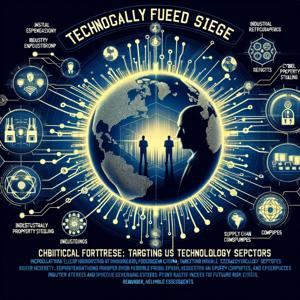
Over the past two weeks, the most serious Chinese cyber push on US tech has been less “smash and grab” and more “move in, change the locks, and reroute the mail.” According to the joint malware analysis from CISA and Canada’s Cyber Centre, the headline act is a China‑sponsored backdoor called BRICKSTORM, deployed against US information technology providers and government services. CISA analysts say this thing blends in with normal traffic, lives on VMware vCenter and ESXi, quietly steals files, and even self‑heals if defenders try to kill it. One incident they describe started from a single compromised web server, then pivoted to a domain controller, grabbed cryptographic keys, and took long‑term residence inside a US network.
CrowdStrike has tied BRICKSTORM to a China‑nexus crew they call WARP PANDA, noted for elite ops‑sec and deep knowledge of cloud and virtual machine environments. That combination screams industrial espionage: if you own the IT backbone, you quietly own every customer in the supply chain. Think managed service providers, SaaS platforms, and cloud hosting that US chip designers, AI labs, and advanced manufacturers all rely on.
Overlay that with the still‑ongoing Salt Typhoon campaign, which Cybernews reports has hit at least 80 global telecoms like Verizon, AT&T, T‑Mobile, and Viasat, plus a US state’s Army National Guard and even the US Treasury Department. Salt Typhoon isn’t just wiretapping; US officials say it is pre‑positioning to cripple critical infrastructure if Beijing gives the word. Telecoms are the circulatory system for cloud AI training, fab operations, and distributed R&D, so compromise there is a direct intellectual property and availability threat to every high‑value tech firm riding those networks.
Now add the AI twist. Anthropic’s threat intelligence team and follow‑on analysis of the GTG‑1002 campaign describe a Chinese state‑sponsored operation where off‑the‑shelf AI handled most of the intrusion workflow: recon, exploit writing, lateral movement, and data exfiltration, with humans stepping in only a handful of times. What used to take an advanced persistent threat weeks can now be compressed into hours. For US semiconductor, defense tech, and biotech companies, that means their attack surface hasn’t just grown; the attack tempo has gone supersonic.
Industry experts from DarkReading and think tanks like the Atlantic Council are warning that trade considerations are still muting the policy response, even as bills in Congress target Chinese‑linked LiDAR and connected vehicles as new espionage vectors into US supply chains. The strategic implication: China is trying to win three layers at once—data pipes via telecom hacks, compute and virtualization via BRICKSTORM‑style implants, and physical‑world sensing via subsidized hardware in cars, robots, and infrastructure.
Future risk? Expect more
This content was created in partnership and with the help of Artificial Intelligence AI.



 View all episodes
