
Sign up to save your podcasts
Or

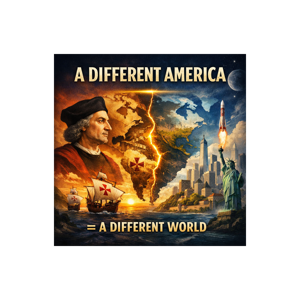

What if the discovery of America had not belonged to Spain—but to the emerging commercial world of the Netherlands?
In this episode, we explore a bold alternative scenario in which both Portugal and Spain reject Christopher Columbus, and his voyage is ultimately financed by the merchant-driven environment of the Low Countries. Instead of a royal and religious project under the Spanish Crown, the New World becomes the foundation of a Dutch-style Atlantic system—built on trade, capital, ports, and contracts.
This shift would not simply change who “discovered” America. It would transform the entire logic of colonization. Rather than vast centralized empires ruled by kings and viceroys, we might see a network of commercial hubs, trading companies, maritime cities, and financial institutions shaping the early Atlantic world. The Caribbean and American coasts would emerge not as extensions of royal authority, but as dynamic centers of commerce, experimentation, and competition.
What would this mean for Europe? Spain would lose its path to global dominance. Portugal would double down on its eastern ambitions. France and England would be forced to react much earlier to a powerful northern rival. And the Netherlands—long before its historical Golden Age—might rise as the central force of a new Atlantic economy.
Beyond politics, the consequences would reach even deeper. The cultural and linguistic map of America could become far more diverse, shaped by trade and migration rather than uniform imperial rule. Religion might be less centralized. Urban life, contracts, and financial systems could define society more than aristocratic hierarchies. Even the foundations of modern capitalism might emerge earlier and in a different form.
This episode follows that transformation step by step—from late medieval Europe, through the first voyage, to the rise of a Dutch Atlantic world and its long-term consequences. Because if one decision had been different—if one “yes” had come from a port instead of a palace—the modern world might have been built not on empire, but on commerce.
 View all episodes
 By Alan Maldam
What if the discovery of America had not belonged to Spain—but to the emerging commercial world of the Netherlands?
In this episode, we explore a bold alternative scenario in which both Portugal and Spain reject Christopher Columbus, and his voyage is ultimately financed by the merchant-driven environment of the Low Countries. Instead of a royal and religious project under the Spanish Crown, the New World becomes the foundation of a Dutch-style Atlantic system—built on trade, capital, ports, and contracts.
This shift would not simply change who “discovered” America. It would transform the entire logic of colonization. Rather than vast centralized empires ruled by kings and viceroys, we might see a network of commercial hubs, trading companies, maritime cities, and financial institutions shaping the early Atlantic world. The Caribbean and American coasts would emerge not as extensions of royal authority, but as dynamic centers of commerce, experimentation, and competition.
What would this mean for Europe? Spain would lose its path to global dominance. Portugal would double down on its eastern ambitions. France and England would be forced to react much earlier to a powerful northern rival. And the Netherlands—long before its historical Golden Age—might rise as the central force of a new Atlantic economy.
Beyond politics, the consequences would reach even deeper. The cultural and linguistic map of America could become far more diverse, shaped by trade and migration rather than uniform imperial rule. Religion might be less centralized. Urban life, contracts, and financial systems could define society more than aristocratic hierarchies. Even the foundations of modern capitalism might emerge earlier and in a different form.
This episode follows that transformation step by step—from late medieval Europe, through the first voyage, to the rise of a Dutch Atlantic world and its long-term consequences. Because if one decision had been different—if one “yes” had come from a port instead of a palace—the modern world might have been built not on empire, but on commerce.