
Sign up to save your podcasts
Or

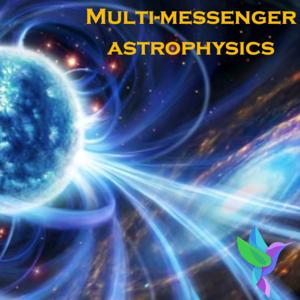

In this episode, we dive into the extreme and fascinating world of microquasars—binary systems where a compact object, like a black hole, feeds off a companion star and launches powerful, relativistic jets. Our spotlight is on GRS 1915+105, one of the most dynamic and powerful microquasars known in the Milky Way.
Recent groundbreaking observations from the LHAASO and Fermi-LAT observatories have mapped broadband gamma-ray emissions from this system, revealing that it operates as an extreme "PeVatron"—an accelerator capable of pushing particles to multi-PeV (peta-electron volt) energies. We break down the evidence pointing to a "hadronic scenario," which suggests that these mind-boggling energies are produced when highly accelerated protons from the jet smash into the dense ambient gas surrounding the system.
Join us as we discuss how this discovery proves that microquasars are exceptionally efficient particle accelerators and how they might be the missing link to understanding the origins of the most energetic cosmic rays in our galaxy.
Key Takeaways:
Reference:
Cao, Z., Aharonian, F., Bai, Y.X., et al. (The LHAASO Collaboration). "Extreme PeV accelerator associated with GRS 1915+105." (Preprint: 2606.25054v1).
Acknowledements: Podcast prepared with Google/NotebookLM. Illustration credits: NASA/CXC/A.Hobart
 View all episodes
 By Astro-COLIBRI
In this episode, we dive into the extreme and fascinating world of microquasars—binary systems where a compact object, like a black hole, feeds off a companion star and launches powerful, relativistic jets. Our spotlight is on GRS 1915+105, one of the most dynamic and powerful microquasars known in the Milky Way.
Recent groundbreaking observations from the LHAASO and Fermi-LAT observatories have mapped broadband gamma-ray emissions from this system, revealing that it operates as an extreme "PeVatron"—an accelerator capable of pushing particles to multi-PeV (peta-electron volt) energies. We break down the evidence pointing to a "hadronic scenario," which suggests that these mind-boggling energies are produced when highly accelerated protons from the jet smash into the dense ambient gas surrounding the system.
Join us as we discuss how this discovery proves that microquasars are exceptionally efficient particle accelerators and how they might be the missing link to understanding the origins of the most energetic cosmic rays in our galaxy.
Key Takeaways:
Reference:
Cao, Z., Aharonian, F., Bai, Y.X., et al. (The LHAASO Collaboration). "Extreme PeV accelerator associated with GRS 1915+105." (Preprint: 2606.25054v1).
Acknowledements: Podcast prepared with Google/NotebookLM. Illustration credits: NASA/CXC/A.Hobart