
Sign up to save your podcasts
Or



How finance underpins all sector transitions—and how we fix the flow
The finance system underpins almost every major transition underway, acting both as a root cause of past systemic failures and as the ultimate lever for future solutions. In this episode, Wayne and Sally explore how to unlock financial flows to accelerate transitions across energy, food, nature, and health—despite political headwinds, market backlashes, and regulatory hurdles.
Guests
What We Cover
Key Quotes
"We need to reframe the policy maker as the policy collaborator... to unleash the investment which will give us clean and more wealthy societies." — Paul Dickinson
"Our vision is for nature to become an investable asset... creating the product and the customer so that nature yields a return." — Claudine Blamey
References
This Episode's Dance
Techno meets Ballet — Techno for its compulsive, irresistible beat and our hyper-fixation on money; Ballet for the discipline, choreography, and strength required when finance is orchestrated right.
Next episode
The Health System Transition
The food system is full of big numbers — and even bigger tensions.
In this episode, Wayne and Sally dive deep into one of our most culturally embedded and vital global systems. From soil health and water usage to biodiversity and the power of food to bring people together, the food system connects deeply to human health, culture, and planetary boundaries. But with food accounting for a third of global greenhouse gas emissions and millions facing acute hunger or unaffordable healthy diets, the need for a transition toward regenerative agriculture and systemic change has never been more urgent.
Is regenerative agriculture the ultimate solution? How can we empower farmers at the center of this shift? And what does it take to transform a system from the inside out? Wayne and Sally explore these questions alongside three key leaders transforming the food landscape.
Guests
What We Cover
Key Quotes
"Farming is a long-term business... If we want to give people the courage to embrace change, what you don't want is a scheme that stops and starts." — Andy Cato"Technology in the service of biology — that’s the kind of technology we need." — Andy Cato"Our purpose is that we blend care and creativity to nourish the world. This is our clarion call." — Brian Griffith"Food is something that brings people together and can facilitate change... If you can show people a better way through something accessible, you can plant seeds of change." — Chantelle NicholsonReferences
This Episode's Dance
Like a Tango, the food system involves equal and opposing forces — between business, government, farmers, and consumers. Navigating the transition requires a delicate, coordinated dance between culture, economics, policy, and nature to choreograph real systemic change.
AI and clean tech are converging to influence the pace and nature of
key systems transition.
AI is the great accelerator — but accelerating in the wrong direction is still the wrong direction. In this episode, Wayne and Sally explore the double-edged nature of technology: a powerful enabler of every other systems transition, and a sector with its own rapidly growing footprint. The question isn't whether AI is good or bad — it's what we point it at.
Guests
Joel Makower — Chair & Co-founder, Trellis Group (formerly GreenBiz); Strategy Director, Music Sustainability Alliance; lead author, State of Green Business
Anna Lerner Nesbitt — CEO, Climate Collective; former senior leader at Meta, the World Bank Group, and the Global Environment Facility
What We Cover
Key Quotes
"We can now measure emissions and planetary impact far better than we can reduce them." — Joel Makower
"AI will be good, AI could be really positive for whatever we point it towards." — Anna Lerner Nesbitt
"Why can't I know where my AI was processed? Technically, it's totally possible." — Anna Lerner Nesbitt
References
This Episode's Dance
The Paso Doble — a dance of raw power, with the bull and the matador both charging. Who wins? That's the question playing out right now between the hyperscalers, communities, and policymakers.
Next episode: The Food System Transition
Why the energy transition might already be unstoppable.
The energy transition isn't coming — it's already here. In our first episode, Wayne and Sally unpack why the shift to renewables has passed the point of no return, who's leading the charge globally, and what a truly fair transition looks like in practice.
Guests
Kingsmill Bond — Senior Principal, Ember
Rhian Kelly — Chief Sustainability Officer, SSE
What We Cover
Key Quotes
"We are past the tipping point. Fossil fuel demand has peaked and will be clearly in decline by the end of the decade." — Kingsmill Bond
"Speed is justice. Those who stick with the old system are going to be left behind." — Kingsmill Bond
"Little steps are as important as big steps." — Rhian Kelly
References
This Episode's Dance
The Quickstep — fast, well-choreographed, and flying across the floor. With a dash of Breakdancing for good measure, because this transition has to be community-led from the ground up.
Next episode
The Technology System Transition
From the publisher's feed
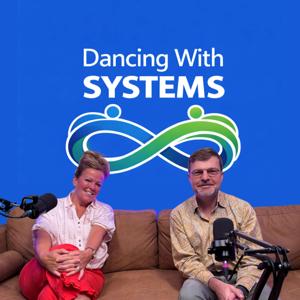
Dancing with Systems (co-hosted by Dr Sally Uren and Prof. Dr Wayne Visser) aims to help change agents from across the spectrum - in business, government, academia, and civil society -…
This debut season will explore how six key systems - energy, food, finance, technology, nature and health - are evolving, examine where the key sticking points to transformation lie, and ask what actions will help unlock meaningful systems change.