
Sign up to save your podcasts
Or

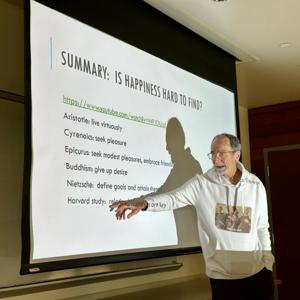


ChatGPT tells us... Nietzsche thinks life is basically a cosmic talent show where nobody knows the rules, the judges are drunk, and the prize is… well, unclear. He tells you to stop whining, embrace chaos, and become the “Übermensch,” which is not a superhero but more like someone who finally reads the HOA bylaws and decides to ignore them. He insists God is dead, but mostly because people kept using Him as an excuse for bad decisions. The abyss? It’s just life staring back at you like a cat judging your choices. Nietzsche wants you to dance anyway — preferably with dramatic flair.
Here we ask Google's Gemini AI what the meaning of life is. And the answer is... quite good!
In this episode, I asked Microsoft CoPilot what is the meaning of life, and to make it funny. I thought I would ask different AI packages, and see what insights I can get...
Essentialism: “You’re born with a fixed nature. A knife is for cutting, an oak is meant to be an oak, and you have a predefined purpose. Good luck living up to it.”
Existentialism: “Nope. You show up first, then figure out who you are. There’s no cosmic instruction manual. Good luck making it up as you go.”
In this episode, Chatgpt tells us about the meaning of life. It's a long episode, but way worth it. Again, this is an AI's view of life, told with humor and snark. It's absolutely amazing!
What if ignorance isn't just an accident? What if it's a product?
In this episode, we explore agnotology—the deliberate manufacture, packaging, and sale of ignorance for profit and power. From the tobacco industry's campaign to create doubt about smoking, to plastic recycling, climate change, and modern politics, you'll discover how false beliefs can be engineered, marketed, and spread. Along the way, we'll meet another ancient Greek idea—amathia—the dangerous confidence that we understand things we really don't.
The most unsettling question isn't whether other people have been manipulated.
It's whether any of us have.
Welcome to the surprisingly profitable business of selling ignorance.
We've all heard the phrase, "Ignorance is bliss." But philosophers have spent over 2,000 years arguing that ignorance is far more complicated than simply not knowing. In this episode, Cheap Bastard Dave explores the many faces of ignorance, from the ancient Greek concept of amathia to Plato's Cave, agnotology, and Robert DeNicola's modern "Cave of Ignorance." Along the way, we'll discover why certainty can be more dangerous than ignorance, how misinformation is sometimes manufactured, and why the internet may have become Plato's cave with better Wi-Fi. Equal parts philosophy, history, and sarcastic humor, this episode asks a simple question: How do you know you're not the one still living in the cave?
Libertarianism begins with an irresistible promise: no bureaucrats, no permits, no taxes, and no guy named Carl telling you your shed violates subsection 14.3. Inspired by Robert Nozick's skepticism of government, our journey starts as a love story about freedom and self-ownership. Unfortunately, it soon collides with reality. Roads become subscription services, fire departments offer Bronze and Gold protection packages, and the Army develops a customer support line. Into this chaos steps Chad, a billionaire who solves everything by buying everything. What follows is a hilarious descent from liberty to oligarchy, culminating in a meeting of billionaires, the arrival of John Rawls, and a surprising effort to use the Veil of Ignorance to protect the billionaire class from the terrifying threat of future billionaires. In the end, government is abolished, kings are abolished, and somehow medieval Europe returns anyway... only with better branding.
In this completely serious and academically rigorous yet parody episode, we explore the true origin of John Rawls’ famous Veil of Ignorance. It begins with a puppy named Jeremy Bentham, wanders through moral philosophy, andsomehow ends inside a Victoria’s Secret near a food court. Along the way, we learn Rawls’ powerful idea: if you had to design society without knowing whether you’d be rich or poor, healthy or sick, lucky or unlucky, what kind ofworld would you build? Expect puppies, philosophers, confused retail employees, and an alarming amount of political theory. It’s one part philosophy, one partabsurd comedy, and one hundred percent more Victoria’s Secret than most discussions of justice.
In this completely serious and academically rigorous episode, we explore the true origin of John Rawls’ famous Veil of Ignorance. It begins with a puppy named Jeremy Bentham, wanders through moral philosophy, and somehow ends inside a Victoria’s Secret near a food court. Along the way, we learn Rawls’ powerful idea: if you had to design society without knowing whether you’d be rich or poor, healthy or sick, lucky or unlucky, what kind of world would you build? Expect puppies, philosophers, confused retail employees, and an alarming amount of political theory. It’s one part philosophy, one part absurd comedy, and one hundred percent more Victoria’s Secret than most discussions of justice.