
Sign up to save your podcasts
Or

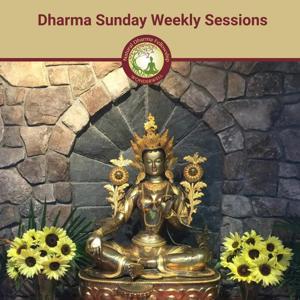


This Dharma Sunday session begins with a Refuge Prayer and a guided meditation that grounds the body and expands into open awareness. Lama Liz then dives into the core question: How do we return to our true nature? She challenges the modern materialist mentality and explores how to move beyond the contracted "self" to access a vaster field of interbeing—the ancient, interconnected source that redefines our relationship with the living world.
The “Four Empowerments” characterize the essence of the tantric Buddhist path. We will explore the internal structure of these four initiations and how we can relate with them as practitioners. Central to this exploration is the idea that initiation is an organic part of human experience. What seems esoteric, foreign, and unknown, is from another perspective natural and genuine. We will explore these tensions and also discuss initiation as a perennial human rite of passage.
The Dharma Sunday session begins with guided meditation practices followed by a teaching on eco-Dharma and the concept of becoming a disciple of Gaia. Lama Willa explores how environmental issues have become a critical focus in the present moment and proposed expanding the traditional Buddhist concept of taking refuge to include Gaia as a teacher. The session concludes with discussions on deep listening to nature, the importance of slowing down in a fast-paced world, and the need for dialogue between activists and spiritual practitioners to address ecological and spiritual crises.
This Dharma Sunday teaching combines body-oriented meditation practice with a Feldenkrais Awareness Through Movement® lesson, the brilliant sensory-motor approach to gently and wisely re-educating the neuro-muscular system. Alternating meditation, a Feldenkrais movement lesson and discussion will allow the techniques to complement and empower each other and to enhance mind-body connections and general well-being.
This session features a deep dive into the meaning of Refuge—understanding our own awakened heart as the ultimate source of peace. Lama Liz then guides a powerful meditation practice, moving from grounding the body to cultivating open awareness and interconnectedness. Following the meditation, she introduces her "Forest Teachings" series, exploring the universal truth of Dharma and answering the profound question: How do we return to our true nature? Discover the ease and wholeness that emerge when we release the tension of the separate self.
This creative and inspirational Dharma Sunday will begin with an introduction to Buddhist art that locates Buddhist images within a contemplative practice. The teachings will seek to move artists and practitioners towards basic visual literacy. This will be followed by a guided tour – both online and onsite – of an exhibition of earth-based Buddhist art created by Latin American Buddhists. We will conclude with a meditation inspired by a prize-winning painting of Tara by a young Mexican artist as our focus, as an example of how art can open pathways in our spiritual practice.
In this Dharma Sunday teaching, the Third of Four teachings on "Mycelial Wisdom", Lama Willa Blythe Baker, founder of Natural Dharma Fellowship, and visiting teacher, Zoe Logan Morris, discuss The Myth of Transcendence.
Using the metaphor of a mycelial network—the "wood wide web"—the teaching suggests that spiritual awakening isn't a "vertical exit" from suffering but a process of grounded engagement with the world. True enlightenment, or Bodhi, is about recognizing our profound interconnectedness with all life. The path is not about changing who you are or escaping the present moment, but about coming home to your innate nature and embracing your place in the web of life.
This Dharma Sunday teaching combines body-oriented meditation practice with a Feldenkrais Awareness Through Movement® lesson, the brilliant sensory-motor approach to gently and wisely re-educating the neuro-muscular system. Alternating meditation, a Feldenkrais movement lesson and discussion will allow the techniques to complement and empower each other and to enhance mind-body connections and general well-being.
Many new and long-time meditators discover that Feldenkrais practices can help them feel greater physical ease and less pain, both in meditation and in everyday activities, by freeing up habitual patterns embedded in the neuromuscular system. This can also help incorporate the body’s natural intelligence into the process of spiritual inquiry and more fully embodied presence.
In this Dharma Sunday teaching we will be exploring the ways that our personalities and styles of interaction
By recognizing our own patterns of behavior and styles of manifesting in the world, we can use that awareness to go beyond judgment which keep us bound to cycles and limited perspective in our lives; and thus touch the insight of loving pervasive awareness.
In this Dharma Sunday teaching, the Second of Four teachings on "Mycelial Wisdom", Lama Willa Blythe Baker, founder of Natural Dharma Fellowship, explores the profound concept of "Anatman" (no-self).
The central teaching expands on "mycelial wisdom," drawing parallels between extensive, hidden mycelial networks (described as "the neurological network of nature") and the Buddhist principle of interdependent connection. Lama Willa explains that the Buddha's teaching of "Anatman" (no-self) challenges the deeply held belief in a solid, independent self. Instead, it posits that the self is a conceptual construction and a fluid "node in a communicative web," much like a mushroom is merely the "fruiting body" of a larger, interconnected mycelial matrix.