
Sign up to save your podcasts
Or

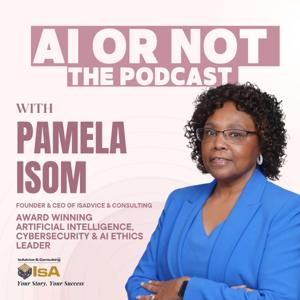

Welcome to "AI or Not," the podcast where we explore the intersection of digital transformation and real-world wisdom, hosted by the accomplished Pamela Isom. With over 25 years of experience guiding leaders in corporate, public, and private sectors, Pamela, the CEO and Founder of IsAdvice & Consulting LLC, is a veteran in successfully navigating the complex realms of artificial intelligence, innovation, cyber issues, governance, data management, and ethical decision-making.
A bid protest can look like a fight over a contract award, but it’s also one of the few tools that keeps federal procurement transparent, competitive, and less vulnerable to bad decisions. We sit down with David Timm, a claims and bid protest partner at Burr & Forman, to unpack how protests work at the agency level, the GAO, and the Court of Federal Claims and why the smartest “win” often happens before proposals are even due.
We get practical about the pre-award phase: using RFIs and solicitation Q&A to resolve ambiguities, challenge overly restrictive requirements, and raise set-aside concerns like the rule of two. David explains why early engagement can save money, reduce contention, and improve your chances of award, especially if you’re a small business navigating the FAR and tight proposal timelines.
Then we tackle the fast-growing collision between government contracting and generative AI. David shares what he’s seeing in procurement tribunals: hallucinated case law, misstated holdings, and filings that trigger warnings or sanctions, including monetary penalties and dismissed cases. We also explore a new frontier for proposal strategy, including solicitations that disclose AI-assisted evaluation, what contractors should ask about which large language model is used, and why AI summaries can create compliance failures through the “lost in the middle” problem.
We close with two tools you can use immediately: submit early and confirm receipt to avoid “late is late” landmines, and build a simple risk-versus-importance matrix to decide when AI is worth it. Where does AI help your proposals most, and where is it too risky?
For more information, please see this resource:
https://www.burr.com/government-contracting/gen-ai-misuse-in-procurement-litigation
 View all episodes
 By Pamela Isom
Welcome to "AI or Not," the podcast where we explore the intersection of digital transformation and real-world wisdom, hosted by the accomplished Pamela Isom. With over 25 years of experience guiding leaders in corporate, public, and private sectors, Pamela, the CEO and Founder of IsAdvice & Consulting LLC, is a veteran in successfully navigating the complex realms of artificial intelligence, innovation, cyber issues, governance, data management, and ethical decision-making.
A bid protest can look like a fight over a contract award, but it’s also one of the few tools that keeps federal procurement transparent, competitive, and less vulnerable to bad decisions. We sit down with David Timm, a claims and bid protest partner at Burr & Forman, to unpack how protests work at the agency level, the GAO, and the Court of Federal Claims and why the smartest “win” often happens before proposals are even due.
We get practical about the pre-award phase: using RFIs and solicitation Q&A to resolve ambiguities, challenge overly restrictive requirements, and raise set-aside concerns like the rule of two. David explains why early engagement can save money, reduce contention, and improve your chances of award, especially if you’re a small business navigating the FAR and tight proposal timelines.
Then we tackle the fast-growing collision between government contracting and generative AI. David shares what he’s seeing in procurement tribunals: hallucinated case law, misstated holdings, and filings that trigger warnings or sanctions, including monetary penalties and dismissed cases. We also explore a new frontier for proposal strategy, including solicitations that disclose AI-assisted evaluation, what contractors should ask about which large language model is used, and why AI summaries can create compliance failures through the “lost in the middle” problem.
We close with two tools you can use immediately: submit early and confirm receipt to avoid “late is late” landmines, and build a simple risk-versus-importance matrix to decide when AI is worth it. Where does AI help your proposals most, and where is it too risky?
For more information, please see this resource:
https://www.burr.com/government-contracting/gen-ai-misuse-in-procurement-litigation