
Sign up to save your podcasts
Or


The sun god Sūrya — and his mother has an MN sound in her name, which is amazing. Saraṇyū is her name, and she is of Tvaṣṭṛ, which is interesting as well. We’ve got Tuisto in the Germanic and Tvaṣṭṛ in the Indic. She and the sun have three children. There are stories about how she got really hot from being burnt by the sun — a play on words which transmits and transfers between languages and meanings and sounds, which I’m not going to go into today.
She has three children: Manu, Yama, and Yamī. Many scholars think Yamī, who’s female, is a later transposition. But Manu and Yama are the most fundamental and ancient in the Indic tradition. Manu is the first man, the first human. Yama, the twin, is the first monarch, the first self-sacrificing king.
Odin performs the same function in the Germanic tradition. Odin gave himself to himself, according to the ancient Hávamál text, and hung himself on the ash tree by the Royal Mound in Uppsala in Sweden. Woden’s Day commemorates Odin’s self-sacrifice. In the early pre-Christian Irish tradition, Donn is the Lord of Death who performs the same function — note the DN sound in both Odin and Donn. They are the first self-sacrificing monarchs to die, and after them they lead mortals to the afterlife. In the Indic tradition, Yama is the first self-sacrificing monarch, the first to die.
Yama means a lot to me as a Buddhist, because Yama is the lord of death in Buddhism, which is one of the reasons I started paying attention to these monikers, these same sounds — Yama, Yamī, Yima in the Iranian tradition, Emir in the Germanic and Arabic traditions. Emir in the Arabic tradition is a king, and that comes across from the early Iranian, the Indo-European. I paid attention because Yama is quite important in the daily practice of many Mahāyāna — again MN — Buddhists who follow the Mañjuśrī tradition, the Tibetan tradition. But I won’t go into that today.
We’ve got Manu and Mannus, and they have twins. In the Germanic tradition, Mannus is the son of Tuisto, twin. In the Indic tradition, Manu is the brother of the twin. We get this phenomenon — a bit of a muddle, like mixing puzzle pieces up. But the names, the sounds of the names are similar, and the function is the same. They’re mythological founders of a tradition.
Manu in the Indic tradition is the first sacrificer. He is the first to sacrifice an animal, and the Brahmin who recreate this sacrifice through the Soma ritual — a substance some believe comes from the fly agaric mushroom, but I won’t go into that here. All we need to know is that the first sacrificer, Manu, is the brother of Yama and the mythological founder of the tradition. The mythological founder of the Germanic tradition is Mannus.
In Irish tradition, the pre-Christian supreme deity is Manannán. In Wales, Manawydan. In the Iranian tradition, Aryaman — so Arya-Yaman, with MN in there. Yaman becomes Manu in India. The Arya element means something close to “area” in English, the centre. Aryaman was literally the treasurer in the royal household, which then became celestialised, goes up to the sky and becomes the symbolic treasurer, the king — a combination of the Manu and the Yama elements.
Geographically, the Indo-Europeans who populated India and Iran are descendants of the same community I mentioned before, coming from the Sintashta. We have the same sound, same meaning, same mythological founders, same kinds of stories in these different traditions.
It’s Manu in the Indic tradition who makes a deal with sky father — with Indra and Varuṇa, the supreme deities. If Manu sacrifices — first an animal, then substituted with the Soma sacrifice — like in Christianity where wine is supposed to be the blood of Christ, a placeholder for a true sacrifice. So it’s a development and evolution. In the Indic tradition, it’s the Soma sacrifice. They come from the same root. I’ve written before about the Indo-European roots in Christianity, a topic I will return to.
If Manu makes a deal with sky father, Dyaus Pitā, with Indra and Varuṇa, who represent the sovereignty function — if Manu, as the man, the human, makes a sacrifice, then sovereignty, security, and prosperity, the fertility of the community, will be protected. Manu is the first sacrificer. Yama, his brother, his twin — in Germanic, you have a slightly different iteration, which you’d expect in different cultures, but the structure and the nomenclature are the same.
We even have Ymir in Germanic culture, the primordial giant. And the sound of Hymir — a genuine thunder god, killed or perhaps only wounded. He went out in a boat with the giant Hymir on the outer sea and fished for a monster using an ox’s head as bait. Yima is in the Iranian tradition, in the Avesta, the ancient Iranian holy text — an equivalent of the Rigveda but written down much later, though thought to be just as ancient.
Aryaman, as I mentioned, is a functionary in charge of the house, its hospitality, and in charge of the treasury of the nmāna. Mana meaning house, domain in ancient Iranian — mansion in English. We have that MN in all of these monikers meaning quite similar things.
With all these continuities — same sounds, same monikers, same functions — today we’re focusing on Mannus and Manu because they’re so primary, but as I’ve floated around different Indo-European linguistic and religious traditions, all from the same common source, we have the same moniker, same function, same level. By level, I mean mythological founders of entire cultures. These aren’t founders of a village or one particular family. They are the founders of entire cultures which still persist today — in the case of India, comprising the one billion Indians who are Hindu and come from this tradition. I’m leaving out the 400 million other Indians, though many of those from the Muslim tradition are also Indo-Europeans. But there are many bifurcations and roads off, some of which I’ve dealt with and some I will. For now, we stay focused on Manu and Mannus.
We know that Germany and German culture did not have very much or any contact with Indian culture, and vice versa. At the time of Tacitus, yes, Alexander the so-called Great from Greek culture had been to India. He had replaced the Achaemenid Empire, the ancient Iranian empire founded by Darius the Great — again MN in Achaemenid. But Tacitus didn’t necessarily have much command of this. Very few people until Sir William Jones, the Welsh scholar of Sanskrit, ancient Iranian, Celtic, Latin, and Greek, who became a Supreme Court justice in India and learned Sanskrit in order to translate the Laws of Manu — the Manusmriti, which contains this MN sound and the RT sound — which contemporary scholars believe is actually from about 600 CE but is named for Manu, the first human.
In order to exercise jurisdiction over Indians, William Jones, living in Kolkata, decided to learn Sanskrit. Because he had already written the first Persian grammar in the English language and was a very skilled linguist from a young age, speaking many different languages, it was he who spotted that the roots of the grammar and the roots of verbs were so similar in structure that they could not have arisen by coincidence. He said that all of these languages must come from a common source, which perhaps no longer exists.
That began a centuries-long journey to determine which came first. Was it the Indian? The German? The Scandinavian? The Irish? The Iranian? That journey brings us to the present, and one of the big breakthroughs has been the ancient DNA evidence published in 2015 and 2019, demonstrating that the Brahmin caste in India had, by around 1000 BCE, about 50% steppe ancestry from ancient Ukraine.
We had all the cultural and linguistic artifacts, and then we find the ancient DNA. But I’m not tracing the ancient DNA or the cultural and linguistic artifacts — I’m tracing the MN sound through all these different cultures, a separate trajectory of evidence.
It’s not just a question of one German visiting India, hearing the story of Manu and Yama written down in the Rigveda, returning to Germany, and convincing their mates. Perhaps they’re a poet, they visit India for a few months or years, then come back and convince one monarch: let’s adopt this story as our own. This is just not plausible. To become embedded as a mythological founder of a culture is really difficult. This is the primary story — it’s not one of millions of sub-stories. Here we have Manu as the first human and Mannus as the first human. The chances of one person going from Germany to India, hearing the story, going all the way back, and convincing everyone to replace their foundation myth — or the other way around, an Indian going to Germany, for which we have zero evidence — are very low.
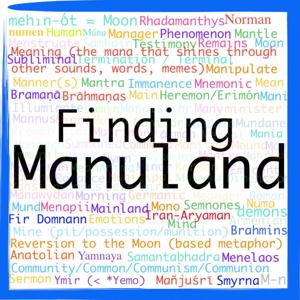
Of course, this is exactly what I’m trying to do: I’m trying to convince you that the mythological founders of all the Indo-European peoples have an MN sound in their names, and I believe this comes from the sound menyot, which means moon, coming from meh1, meaning measure — the moon as a measure of time. The idea of light shining through the moon is like the mind shining through a human. This core metaphor, the reversion to the moon-based metaphor, distinguishes all sentient beings from non-sentient things, stones from humans. We’ll see if in a thousand years’ time our entire Indo-European culture accepts Finding Manuland’s story as its foundational myth. But at least you see what I’m talking about.
The idea of a German going to India and saying, our mythological founder is Mannus, why don’t you adopt that — or vice versa — doesn’t explain why we end up with Aryaman in the ancient Iranian tradition, or Manannán in the Celtic Irish tradition, which comes down as the pre-Christian supreme deity in Ireland. Many of those Celts probably came to Ireland via the Menapii — the MN in Menapii. Perhaps that explains the Irish case. But what we can say for sure, from empirical evidence, is that this MN sound is absolutely everywhere we look.
We have heaps of archaeological, cultural, and mythological stories about structural similarities between the Rigveda and the Mahābhārata, another collection of ancient stories, not quite as anciently written down but very ancient. These have the same structure, the same names, the same sounds as the story written down by Tacitus in the first century CE. Now we have genomic evidence demonstrating ancient Ukrainian steppe ancestry in Ireland, on the island of Britain, across western Europe west of Ukraine, and east of Ukraine through the Sintashta, across the Andronovo horizon, across Central Asia.
Here I’m trying to provoke in your mind this geographical journey — through to Afghanistan, down into Turkey and Anatolia, through Armenia, through Iran, across from Afghanistan into Pakistan, and into the Indus River Valley where the culture was seeded. Into the Brahmin caste, and they take over the whole of the Indian subcontinent down to a point near Bengaluru, where I’ve spent time, where we have the Dravidian line — the Telugu culture. Dravidian is the pre-Indo-European Indian culture which has survived. But we have this Indo-European layer, which brought Indra, who starts life in Iran as Zarathustra’s nemesis. By the time this deity gets to India, it becomes renamed as Indra, and India is named for Indra, this sovereign deity related to Manu, representing the Indo-European transformation of the Indian subcontinent.
The stories, the names, and the sounds of these deities are in our minds today as the names of continents and countries. Iran takes its name from the Arya root, connected to Aryaman. And Éremón is the first high king of all Ireland, which some scholars, including me, believe is cognate with Aryaman. Éremón comes down as the name of the first high king from the mythological record, first written down around 1100 CE, long before we knew any of the rest of this — that Indo-European cultures existed, or that Celtic was a separate culture from Germanic.
We have these separate vectors of evidence all pointing to a common source. And of course, the MN sound is in Éremón, the first high king of Ireland. Beyond all reasonable doubt, we have this steppe ancestry spread across Manuland, and the MN sound immanent in the mythological founders of all these cultures, from Ireland to India.
Continued:
Continued from:
First in series:
 View all episodes
 By Decoding Trolls
The sun god Sūrya — and his mother has an MN sound in her name, which is amazing. Saraṇyū is her name, and she is of Tvaṣṭṛ, which is interesting as well. We’ve got Tuisto in the Germanic and Tvaṣṭṛ in the Indic. She and the sun have three children. There are stories about how she got really hot from being burnt by the sun — a play on words which transmits and transfers between languages and meanings and sounds, which I’m not going to go into today.
She has three children: Manu, Yama, and Yamī. Many scholars think Yamī, who’s female, is a later transposition. But Manu and Yama are the most fundamental and ancient in the Indic tradition. Manu is the first man, the first human. Yama, the twin, is the first monarch, the first self-sacrificing king.
Odin performs the same function in the Germanic tradition. Odin gave himself to himself, according to the ancient Hávamál text, and hung himself on the ash tree by the Royal Mound in Uppsala in Sweden. Woden’s Day commemorates Odin’s self-sacrifice. In the early pre-Christian Irish tradition, Donn is the Lord of Death who performs the same function — note the DN sound in both Odin and Donn. They are the first self-sacrificing monarchs to die, and after them they lead mortals to the afterlife. In the Indic tradition, Yama is the first self-sacrificing monarch, the first to die.
Yama means a lot to me as a Buddhist, because Yama is the lord of death in Buddhism, which is one of the reasons I started paying attention to these monikers, these same sounds — Yama, Yamī, Yima in the Iranian tradition, Emir in the Germanic and Arabic traditions. Emir in the Arabic tradition is a king, and that comes across from the early Iranian, the Indo-European. I paid attention because Yama is quite important in the daily practice of many Mahāyāna — again MN — Buddhists who follow the Mañjuśrī tradition, the Tibetan tradition. But I won’t go into that today.
We’ve got Manu and Mannus, and they have twins. In the Germanic tradition, Mannus is the son of Tuisto, twin. In the Indic tradition, Manu is the brother of the twin. We get this phenomenon — a bit of a muddle, like mixing puzzle pieces up. But the names, the sounds of the names are similar, and the function is the same. They’re mythological founders of a tradition.
Manu in the Indic tradition is the first sacrificer. He is the first to sacrifice an animal, and the Brahmin who recreate this sacrifice through the Soma ritual — a substance some believe comes from the fly agaric mushroom, but I won’t go into that here. All we need to know is that the first sacrificer, Manu, is the brother of Yama and the mythological founder of the tradition. The mythological founder of the Germanic tradition is Mannus.
In Irish tradition, the pre-Christian supreme deity is Manannán. In Wales, Manawydan. In the Iranian tradition, Aryaman — so Arya-Yaman, with MN in there. Yaman becomes Manu in India. The Arya element means something close to “area” in English, the centre. Aryaman was literally the treasurer in the royal household, which then became celestialised, goes up to the sky and becomes the symbolic treasurer, the king — a combination of the Manu and the Yama elements.
Geographically, the Indo-Europeans who populated India and Iran are descendants of the same community I mentioned before, coming from the Sintashta. We have the same sound, same meaning, same mythological founders, same kinds of stories in these different traditions.
It’s Manu in the Indic tradition who makes a deal with sky father — with Indra and Varuṇa, the supreme deities. If Manu sacrifices — first an animal, then substituted with the Soma sacrifice — like in Christianity where wine is supposed to be the blood of Christ, a placeholder for a true sacrifice. So it’s a development and evolution. In the Indic tradition, it’s the Soma sacrifice. They come from the same root. I’ve written before about the Indo-European roots in Christianity, a topic I will return to.
If Manu makes a deal with sky father, Dyaus Pitā, with Indra and Varuṇa, who represent the sovereignty function — if Manu, as the man, the human, makes a sacrifice, then sovereignty, security, and prosperity, the fertility of the community, will be protected. Manu is the first sacrificer. Yama, his brother, his twin — in Germanic, you have a slightly different iteration, which you’d expect in different cultures, but the structure and the nomenclature are the same.
We even have Ymir in Germanic culture, the primordial giant. And the sound of Hymir — a genuine thunder god, killed or perhaps only wounded. He went out in a boat with the giant Hymir on the outer sea and fished for a monster using an ox’s head as bait. Yima is in the Iranian tradition, in the Avesta, the ancient Iranian holy text — an equivalent of the Rigveda but written down much later, though thought to be just as ancient.
Aryaman, as I mentioned, is a functionary in charge of the house, its hospitality, and in charge of the treasury of the nmāna. Mana meaning house, domain in ancient Iranian — mansion in English. We have that MN in all of these monikers meaning quite similar things.
With all these continuities — same sounds, same monikers, same functions — today we’re focusing on Mannus and Manu because they’re so primary, but as I’ve floated around different Indo-European linguistic and religious traditions, all from the same common source, we have the same moniker, same function, same level. By level, I mean mythological founders of entire cultures. These aren’t founders of a village or one particular family. They are the founders of entire cultures which still persist today — in the case of India, comprising the one billion Indians who are Hindu and come from this tradition. I’m leaving out the 400 million other Indians, though many of those from the Muslim tradition are also Indo-Europeans. But there are many bifurcations and roads off, some of which I’ve dealt with and some I will. For now, we stay focused on Manu and Mannus.
We know that Germany and German culture did not have very much or any contact with Indian culture, and vice versa. At the time of Tacitus, yes, Alexander the so-called Great from Greek culture had been to India. He had replaced the Achaemenid Empire, the ancient Iranian empire founded by Darius the Great — again MN in Achaemenid. But Tacitus didn’t necessarily have much command of this. Very few people until Sir William Jones, the Welsh scholar of Sanskrit, ancient Iranian, Celtic, Latin, and Greek, who became a Supreme Court justice in India and learned Sanskrit in order to translate the Laws of Manu — the Manusmriti, which contains this MN sound and the RT sound — which contemporary scholars believe is actually from about 600 CE but is named for Manu, the first human.
In order to exercise jurisdiction over Indians, William Jones, living in Kolkata, decided to learn Sanskrit. Because he had already written the first Persian grammar in the English language and was a very skilled linguist from a young age, speaking many different languages, it was he who spotted that the roots of the grammar and the roots of verbs were so similar in structure that they could not have arisen by coincidence. He said that all of these languages must come from a common source, which perhaps no longer exists.
That began a centuries-long journey to determine which came first. Was it the Indian? The German? The Scandinavian? The Irish? The Iranian? That journey brings us to the present, and one of the big breakthroughs has been the ancient DNA evidence published in 2015 and 2019, demonstrating that the Brahmin caste in India had, by around 1000 BCE, about 50% steppe ancestry from ancient Ukraine.
We had all the cultural and linguistic artifacts, and then we find the ancient DNA. But I’m not tracing the ancient DNA or the cultural and linguistic artifacts — I’m tracing the MN sound through all these different cultures, a separate trajectory of evidence.
It’s not just a question of one German visiting India, hearing the story of Manu and Yama written down in the Rigveda, returning to Germany, and convincing their mates. Perhaps they’re a poet, they visit India for a few months or years, then come back and convince one monarch: let’s adopt this story as our own. This is just not plausible. To become embedded as a mythological founder of a culture is really difficult. This is the primary story — it’s not one of millions of sub-stories. Here we have Manu as the first human and Mannus as the first human. The chances of one person going from Germany to India, hearing the story, going all the way back, and convincing everyone to replace their foundation myth — or the other way around, an Indian going to Germany, for which we have zero evidence — are very low.
Of course, this is exactly what I’m trying to do: I’m trying to convince you that the mythological founders of all the Indo-European peoples have an MN sound in their names, and I believe this comes from the sound menyot, which means moon, coming from meh1, meaning measure — the moon as a measure of time. The idea of light shining through the moon is like the mind shining through a human. This core metaphor, the reversion to the moon-based metaphor, distinguishes all sentient beings from non-sentient things, stones from humans. We’ll see if in a thousand years’ time our entire Indo-European culture accepts Finding Manuland’s story as its foundational myth. But at least you see what I’m talking about.
The idea of a German going to India and saying, our mythological founder is Mannus, why don’t you adopt that — or vice versa — doesn’t explain why we end up with Aryaman in the ancient Iranian tradition, or Manannán in the Celtic Irish tradition, which comes down as the pre-Christian supreme deity in Ireland. Many of those Celts probably came to Ireland via the Menapii — the MN in Menapii. Perhaps that explains the Irish case. But what we can say for sure, from empirical evidence, is that this MN sound is absolutely everywhere we look.
We have heaps of archaeological, cultural, and mythological stories about structural similarities between the Rigveda and the Mahābhārata, another collection of ancient stories, not quite as anciently written down but very ancient. These have the same structure, the same names, the same sounds as the story written down by Tacitus in the first century CE. Now we have genomic evidence demonstrating ancient Ukrainian steppe ancestry in Ireland, on the island of Britain, across western Europe west of Ukraine, and east of Ukraine through the Sintashta, across the Andronovo horizon, across Central Asia.
Here I’m trying to provoke in your mind this geographical journey — through to Afghanistan, down into Turkey and Anatolia, through Armenia, through Iran, across from Afghanistan into Pakistan, and into the Indus River Valley where the culture was seeded. Into the Brahmin caste, and they take over the whole of the Indian subcontinent down to a point near Bengaluru, where I’ve spent time, where we have the Dravidian line — the Telugu culture. Dravidian is the pre-Indo-European Indian culture which has survived. But we have this Indo-European layer, which brought Indra, who starts life in Iran as Zarathustra’s nemesis. By the time this deity gets to India, it becomes renamed as Indra, and India is named for Indra, this sovereign deity related to Manu, representing the Indo-European transformation of the Indian subcontinent.
The stories, the names, and the sounds of these deities are in our minds today as the names of continents and countries. Iran takes its name from the Arya root, connected to Aryaman. And Éremón is the first high king of all Ireland, which some scholars, including me, believe is cognate with Aryaman. Éremón comes down as the name of the first high king from the mythological record, first written down around 1100 CE, long before we knew any of the rest of this — that Indo-European cultures existed, or that Celtic was a separate culture from Germanic.
We have these separate vectors of evidence all pointing to a common source. And of course, the MN sound is in Éremón, the first high king of Ireland. Beyond all reasonable doubt, we have this steppe ancestry spread across Manuland, and the MN sound immanent in the mythological founders of all these cultures, from Ireland to India.
Continued:
Continued from:
First in series: