
Sign up to save your podcasts
Or

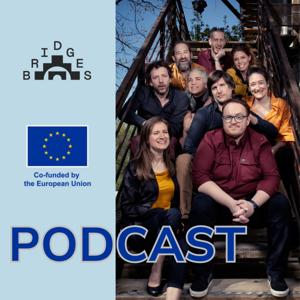

In this episode of the Bridges Podcast, we explore the creative challenges and opportunities of multilingual improvisation.
Improvisers from different countries share their experiences of performing and collaborating across languages. They discuss how improvisation itself can function as a kind of shared language — built on principles like listening, acceptance, and co-creation — even when the spoken words differ.
The conversation touches on practical tools used in the Bridges project, such as gibberish scenes, silent scenes, and exercises where performers each speak their own language while pretending to understand each other. The guests also reflect on the importance of physical storytelling, body language, and embodied listening, showing how movement, rhythm, and spatial relationships can communicate meaning without relying on words.
We also discuss soundpainting, improvisational conducting techniques, and the challenge of creating performances that remain accessible to audiences who may not speak English or who are new to theatre. Finally, the episode highlights how improvisation can help people embrace mistakes, overcome the fear of speaking foreign languages, and build connections across cultures.
Guests: Lucie Vokrouhlíková, Brigitta Arany and Ophélie Trichard
Bridges Academy: https://www.bridgesimpro.eu/academy
 View all episodes
 By Bridges Impro
In this episode of the Bridges Podcast, we explore the creative challenges and opportunities of multilingual improvisation.
Improvisers from different countries share their experiences of performing and collaborating across languages. They discuss how improvisation itself can function as a kind of shared language — built on principles like listening, acceptance, and co-creation — even when the spoken words differ.
The conversation touches on practical tools used in the Bridges project, such as gibberish scenes, silent scenes, and exercises where performers each speak their own language while pretending to understand each other. The guests also reflect on the importance of physical storytelling, body language, and embodied listening, showing how movement, rhythm, and spatial relationships can communicate meaning without relying on words.
We also discuss soundpainting, improvisational conducting techniques, and the challenge of creating performances that remain accessible to audiences who may not speak English or who are new to theatre. Finally, the episode highlights how improvisation can help people embrace mistakes, overcome the fear of speaking foreign languages, and build connections across cultures.
Guests: Lucie Vokrouhlíková, Brigitta Arany and Ophélie Trichard
Bridges Academy: https://www.bridgesimpro.eu/academy