
Sign up to save your podcasts
Or



How can you use evaluation to do more than report outcomes—to make better decisions, adapt your strategy, and strengthen your work? In this replay of our live 2026 NAAEE Brightspot session, Earth Force and Data+Soul share practical examples of using Emergent Learning to build evaluation capacity and turn what you learn into action. We'll talk about how to move from observations to insights, test assumptions with partners, and develop evaluation strategies that are more responsive to the people and communities you serve.
How can a local environmental project create lasting, systemic change? SJ, Earth Force’s District Strategy Lead, brings together Yannos Misitzis, a Special Education educator at Longfellow Middle School; Kate Carey, a parent and naturalist club leader; Wendy Cohen, Virginia Master Naturalist Volunteer, Fairfax Chapter and Fairfax Tree Steward, and Aleko, a student leader, to share how invasive plant removal and native plant restoration grew into broader community advocacy and policy change in Fairfax County, Virginia.
Their story is a real-world example of ripple effect mapping—tracing how an initial action builds relationships, activates community assets, inspires others, and leads to broader outcomes. Tune in to hear how youth-adult partnerships can look in your community!
00:00 — SJ introduces the guests and the Longfellow Middle School community
01:20 — Kate shares how park restoration and native plant projects got started
05:20 — Educator Yannos and student Aleko discuss school projects and youth leadership
10:20 — Connecting local environmental action to broader systems change
17:00 — Exploring the ripple effects of community involvement and invasive plant removal
21:30 — Community partnerships, asset mapping, and sustaining change
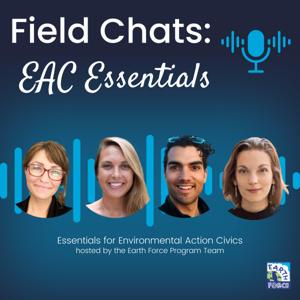
What is Environmental Applied Civics—and what isn’t it? In this episode, members of Earth Force's Program Team SJ, Taylor, and Alyssa explain what EAC is, how it works, and what sets it apart. Listeners will learn how young people investigate local environmental issues, work with community members and decision-makers, and use science, civic skills, and lived experience to create change. They also share real examples and do a rapid-fire myth busting of common misconceptions about EAC.
0:00: Intro
2:45: What is Environmental Applied Civics
5:27: Rapid-fire myth busting
7:10: What puts the ‘civic’ in Environmental Applied Civics?
8:16: Real examples of EAC in action
Krysten Dorfman and Taylor Ruffin welcome back Cedar Barg of The Wild Center to talk about the evolution of Climate Action Planning (CAP) resources and their collaboration with Earth Force. They explore how Earth Force tools—including community inventories, root cause analysis, and power mapping—have been integrated into Youth Climate Summits, how facilitators are adapting the process for different settings, and what happens when young people take on leadership roles themselves. The conversation highlights a central theme throughout EAC: effective climate action is iterative, adaptable, and shaped by the communities and young people doing the work.
00:17 — Welcome & Check-In
02:43 — The Evolution of Climate Action Planning
04:23 — CAP at Youth Climate Summits
08:36 — Community Inventories & Starting With Strengths
17:42 — Adapting CAP for Different Summits
20:20 — Key Takeaway: Embrace Iteration
In this episode of Field Chats, Alyssa McConkey and Vince Meldrum dig into what the data reveals about changes in educators, student confidence and skills, and young people’s ability to participate in local environmental decision-making. They also share a powerful story about fourth graders who helped their community identify a problem adults had overlooked—and sparked action to address it.
00:00 — Welcome to Field Chats
02:50 — What 20+ Years of Evaluation Data Reveals
05:50 — How Environmental Applied Civics Changes Educators
12:05 — What the Data Tells Us About Young People
15:55 — Building Confidence to Take Action
20:00 — The Stories Behind the Data
25:55 — The Big Takeaway: It Works
How can educators use community inventories to help students investigate local environmental issues? In this episode of Field Chats: Environmental Applied Civics Essentials, the Earth Force Program Team explores practical ways to use inventories as part of Environmental Applied Civics (EAC) and project-based learning.
Learn how students can use data collection, surveys, interviews, maps, nature journaling, and appreciative inquiry to investigate their communities, identify environmental strengths and concerns, and develop meaningful questions for further inquiry. The team also discusses place-based learning, traditional ecological knowledge, student choice, and how to adapt inventories to different classroom settings and time constraints.
Resource: Inventory Ideas
00:00 Introduction
00:19 What Are Community Inventories?
02:40 Inventories in Step One of the Earth Force Process
04:49 Community Inventory Examples: Data, Surveys, Interviews & Maps
07:14 Nature Journaling, Observation & Appreciative Inquiry
08:49 Traditional Ecological Knowledge & Place-Based Learning
11:19 How to Get Started With Student Inventories
12:49 Adapting Inventories to Classroom Time & Constraints
15:09 Key Takeaways: Community Strengths, Concerns & Student Choice
Explore Earth Force’s new Environmental Applied Civics (EAC) Educator Guide in this visual walkthrough. The guide is a comprehensive resource for educators who want to engage young people in authentic, community-based learning through youth-adult partnerships and environmental civic action.
In this episode of Field Chats, we walk through the updated guide and highlight its new EAC roadmap, three essential experiences, four practitioner competencies, pacing guide, step-by-step resources, script starters, guiding questions, reflection prompts, standards alignments, and accessibility features.
Join the Community of Practice!
00:00 Welcome to Season 4
00:50 What we're thinking about at Earth Force
02:09 Introducing the new Educator Guide
02:20 Earth Force's new look and Environmental Applied Civics
04:37 What's new in the Educator Guide
05:27 EAC glossary, roadmap & essential experiences
05:44 Practitioner competencies
06:13 Pacing guide
06:42 Six-step EAC process and new resources
08:35 Accessibility features
09:23 How to access the Educator Guide
We're in the field for an update on a crowd favorite Environmental Applied Civics legacy project at Katherine Johnson Middle School! Young people set up a closed-loop food system - reducing landfill trash from school lunches by 75% thanks to chickens. Tune in to hear directly from young people and their teacher Ms. Alam on how they intend to ensure project sustainability, what they've learned, and how this work has affected their community.
In this episode, Earth Force CEO Vince Meldrum talks with Leia Lowery, Founder and CEO of The Climate Initiative (TCI). Leia shares how TCI grounds massive global climate issues at the local level to give students direct access to community action. They discuss the power of place-based education, how environmental action combats loneliness, and why students who struggle in traditional classrooms often shine the brightest when taking action.
This episode explores the Water Education Exemplars Project, a Colorado initiative bridging the gap between state water policy and youth engagement. Earth Force's Alyssa McConkey speaks with veteran environmental educator Donny Roush and CSU student Maya about the urgent need to meet the 2050 Colorado Water Plan goals. By training and compensating young people to serve as professional evaluators, the project ensures that environmental education in Colorado is both high-quality and impactful. Maya shares how the experience transformed her from a student to a respected collaborator, emphasizing the power of youth-adult partnerships in building a sustainable and water-conscious future.
From the publisher's feed