This is your Silicon Siege: China's Tech Offensive podcast.
Name’s Ting, and listeners, the Silicon Siege is very much live-fire right now, so let’s jack straight into the last two weeks.
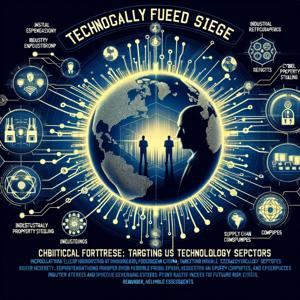
Picture this: a U.S. fabless chip startup in Austin wakes up to a “routine” Okta login alert. Nothing wild… until the SOC team notices the login originates from a leased virtual private server in Kuala Lumpur that Microsoft’s threat intel team has previously tied to the Chinese state‑backed group Volt Typhoon. According to Microsoft’s recent reporting on that cluster, these crews love living off the land, blending in with normal admin traffic while quietly spidering through source‑code repos and design vaults. Security engineers later find exfiltration of HDL files for a next‑gen AI accelerator, zipped, chunked, and hidden in what looks like harmless backup traffic.
Same week, a West Coast quantum‑computing company notices a “firmware update” pushed to a supplier’s baseboard management controller in Taiwan. Turns out, that update was trojanized by a threat group matching the profile of the APT that Mandiant has historically tracked as APT41: dual‑use, state‑aligned, laser‑focused on IP and long‑term access. The malicious firmware doesn’t smash systems; it just quietly mirrors internal Git traffic to an outbound TLS tunnel pinned to a bulletproof host in Hong Kong.
Industrial espionage has gone fully cloud‑native too. A major U.S. autonomous‑vehicle firm working with an Asian lidar supplier discovers that their shared Jira instance hosted in Singapore has a stealth admin account created six months ago. CrowdStrike‑style telemetry flags repeated queries against tickets tagged “proprietary algorithm” and “sensor fusion models.” The attacker scripts GraphQL calls to pull entire attachment histories, including simulation data and safety edge‑case scenarios.
Supply chains? Think Russian dolls. A Texas‑based IIoT manufacturer finds that a seemingly innocuous logging library, maintained by a small dev shop in Chengdu and bundled deep inside its firmware toolchain, contains an update mechanism that checks in to a command server registered through a registrar in Shenzhen. Once activated, it enumerates build servers for signing keys, the golden goose for pushing malicious updates to thousands of industrial gateways across U.S. power, water, and manufacturing.
Industry experts are not mincing words. A former NSA cyber operator now at a big‑four consultancy is telling clients that Chinese operations are shifting from smash‑and‑grab data theft to “strategic pre‑positioning,” meaning persistent access across chips, code, and cloud so Beijing can both accelerate its own tech and hold a hand on the kill switch in a crisis. Policy analysts at think tanks in Washington are warning that dominance in AI, quantum, and advanced manufacturing could tilt not just markets but deterrence itself, because whoever controls the silicon stack controls the speed and reliability of everything from drones to dollar‑clearing.
Looking ahead, listeners, expect three escalations: more compromises of design tools like EDA and firmware SDKs, heavier targeting of AI model‑training pipelines, and even deeper infiltration of managed service providers that sit between small innovators and big clouds. The game is no longer “protect the perimeter”; it’s “assume the compiler, the driver, and the update server are all potential battlefields.”
Thanks for tuning in, and don’t forget to subscribe so you don’t miss the next decode of China’s cyber playbook. This has been a quiet please production, for more check out quiet please dot ai.
For more http://www.quietplease.ai
Get the best deals https://amzn.to/3ODvOta



 View all episodes
