
Sign up to save your podcasts
Or

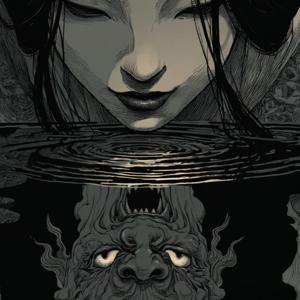


The discovery that this "fairy tale" was treated as a legal reality in 1661, appearing on a government land dispute map in Gunma Prefecture, which suggests the story served as a codified warning about interacting with Marebito—visiting deities disguised as animals to test the human soul.
In this episode, we explore Shita-kiri Suzume (The Tongue-Cut Sparrow), one of Japan's most enduring morality tales. We move beyond the sanitized children's version to uncover a narrative deeply rooted in Edo-period sociology and Buddhist ethics. We discuss the story's surprising connection to a specific location in Isobe Onsen, validated by a 17th-century shogunate map, and analyze the sparrow not just as a bird, but as a Marebito—a visiting spirit that judges human households. We also examine the brutal original endings involving the "Mean Old Woman" and the symbolic significance of the wicker baskets.
In this podcast, we explore "The Story of O-Tei," a well-known tale from Lafcadio Hearn's Kwaidan. The story is about a young woman who, on her deathbed, promises to be reborn and find her beloved again. This episode goes beyond the surface-level romance to look at the tale's mechanics. We will discuss how O-Tei's promise is transformed into a binding karmic contract through the specific, ritualistic act of her fiancé, Nagao, writing a physical vow and placing it within the household Buddhist shrine, the butsudan. This podcast also examines the story's historical context in the Edo and Meiji periods, its likely origins as an oral tale told by Hearn's wife, Koizumi Setsu, and the deeper cultural themes of shūnen (clinging obsession) and inga (karma). Finally, we'll touch on the tale's haunting conclusion and what it reveals about Japanese perceptions of love, death, and memory.
The Norse universe wasn't built for peace. Its creation from a murdered giant (Ymir) means that chaos is an inherent, inescapable part of the world, making the final, violent doom of Ragnarok an inevitability from the very beginning.
In this podcast, we explore the complete architecture of the Norse universe. This isn't just a map of the Nine Realms; it's an analysis of a cosmos that was, by its very design, destined for destruction. This episode begins with the creation myth, moving from the void of Ginnungagap to the clash of fire and ice. We'll discuss how the gods, led by Odin, didn't create the world from nothing, but violently shaped it from the corpse of the giant Ymir. The podcast explains how this foundational act embeds chaos into the very fabric of existence, setting up the central, inescapable conflict of the mythology. We then explore Yggdrasil, the great cosmic tree, as the axis that connects all of life. We'll look at its three roots, the Norns weaving fate at its base, and Odin's sacrifice for wisdom. The episode also provides a survey of the Nine Realms, analyzing them not just as places, but as symbolic spaces of order (innangard) versus the wild (utangard). Finally, this podcast discusses how this entire structure—built from violence and defined by constant struggle—provides the mythological basis for Ragnarok, the world's prophesied doom.
In this podcast, we explore the history of the "demon." It's a word we all know, but its meaning has changed dramatically. This episode traces that journey. We start in ancient Greece, where the daimon wasn't evil, but a neutral intermediary spirit, or for philosophers like Socrates, an inner guiding voice. So how did it become the purely evil entity we think of today? This episode explains the critical transformation during the Second Temple period, showing how a specific Greek translation, the influence of Zoroastrian dualism, and the apocalyptic myths of 1 Enoch (the Watchers and Nephilim) combined to create the "demon" found in the New Testament. We'll then discuss how Christian theologians like Augustine and Aquinas codified this idea of a fallen angel, which led to rituals of expulsion (exorcism) and the legal framework for the witch-hunts (Malleus Maleficarum). Finally, the podcast explores how modern occultism (like the Goetia) and psychology (Carl Jung's "Shadow") have re-interpreted the concept, effectively retrieving the original Socratic idea of the daimon as an internal force to be integrated, not expelled.
The tale is not just about a magical reward, but a tragic warning. It explores how human greed (or curiosity) corrupts a supernatural gift, forcing the crane wife to literally unmake herself (plucking her own feathers) to satisfy a debt that escalates from kindness to materialism, resulting in an irreversible loss.
This podcast episode explores the famous Japanese folktale of Tsuru no Ongaeshi, often known as "The Grateful Crane" or "The Crane Wife." The story begins with a poor man who saves a wounded crane. Soon after, a mysterious woman arrives at his home, and they marry. She begins to weave a beautiful, magical cloth, but makes him promise never to look at her while she works. This episode discusses the narrative of the tale and its variations. We explore the powerful symbolism of the crane in Japanese culture as a figure of fidelity and longevity. The podcast also examines the story's core conflict: the collision between pure, sacrificial love and the corrupting influence of human greed or curiosity, which ultimately leads to the tragic climax. We will also touch upon the tale's modern legacy, including its adaptation in the play Yūzuru and its influence on other media.
The idea that the purest love and most profound grief can corrupt a holy man into a monster, and that the same obsessive energy, when redirected, can become the path to salvation.
In this episode of the podcast, we explore one of the most haunting tales from 18th-century Japan, "The Blue Hood," from the famous collection Ugetsu Monogatari. The podcast begins by setting the scene in the Edo period, a time of peace where supernatural stories, or kaidan, flourished. We then delve into the narrative of a respected Buddhist abbot whose all-consuming love for a young acolyte turns into a horrifying obsession after the boy's death. This episode recounts how his inconsolable grief leads him to commit a taboo act, transforming him into a flesh-eating demon that terrorizes a local village. The discussion in the podcast follows the arrival of a traveling Zen master, Kaian, who confronts the demon not with violence, but with profound wisdom. We examine his unique method of salvation: providing the demon-priest with a Zen kōan (a paradoxical riddle) and a symbolic blue hood to channel the creature's obsessive energy away from destruction and toward enlightenment. The episode concludes by tracing the legacy of this powerful story, exploring how its themes of psychological transformation and karmic consequence have influenced modern Japanese media, including the manga series xxxHolic and the video game Nioh 2.
The paradox that Yoshitsune's military genius and immense popularity, which won a war for his clan, were the very qualities that led his own brother to betray and destroy him.
This podcast episode delves into one of Japan's most foundational legends: the story of the brilliant general Minamoto no Yoshitsune and his fiercely loyal warrior monk, Benkei. The episode explores their iconic first meeting on Kyoto's Gojō Bridge, their pivotal roles in the Genpei War, and the innovative military tactics that made Yoshitsune a national hero. However, the podcast focuses on the central tragedy of the tale—how Yoshitsune's very success and popularity became a threat to his politically ambitious brother, Yoritomo, leading to a devastating betrayal. We will cover their years as fugitives and their legendary final stand, which culminated in Benkei's famous 'Standing Death.' This episode examines the themes of loyalty, honor, and betrayal that cemented their status as archetypal figures in Japanese culture.
The popular idea of a "ghostly nun" at Ganjō-ji is a modern myth; the true, ancient legend is a tragic story of a mermaid who fell in love with a human nun, only to be killed and mummified by jealous villagers, becoming a cursed relic.
In this episode of our podcast, we investigate a story that begins as a simple ghost tale but unfolds into a complex and tragic piece of Japanese folklore. We explore the legend of Ganjō-ji temple, moving past the modern myth of a vengeful nun's spirit to uncover the authentic story of a mermaid mummy enshrined within its walls. This podcast delves into the core narrative of a beautiful nun and a mysterious young page who is revealed to be a ningyo, or Japanese mermaid. We discuss how the villagers' jealousy and fear of the unknown led to the creature's violent death and its transformation into a cursed relic that tormented its owners for years. The episode also examines the unique role of the ningyo in Japanese mythology, contrasting it with the Western mermaid, and looks at the scientific analysis of similar artifacts from the Edo period.
The stark contrast between the two earliest accounts of his life: the Kojiki, which portrays him as a tragic hero exiled by a fearful father, and the Nihon Shoki, which depicts him as a perfectly loyal warrior-prince, revealing how myth was shaped for political purposes in ancient Japan.
In this episode of our podcast, we explore the foundational Japanese legend of Prince Yamato Takeru, a warrior whose epic story is a cornerstone of the nation's mythology. This podcast will guide you through the core narrative of his life, from a brutal act in his youth that led to his exile, to his cunning conquests in the west and east using the sacred sword Kusanagi-no-Tsurugi. We will discuss the profound sacrifice of his consort, Ototachibana-hime, and the moment of hubris that led to his tragic downfall. The central focus of this episode is the fascinating difference between the two primary sources for his tale. We analyze why the Kojiki presents him as a deeply human, tragic figure, while the Nihon Shoki, written just eight years later, recasts him as an idealized symbol of imperial loyalty. The podcast also examines the deep symbolism of key elements like the divine sword and the hero's final transformation into a white bird, and traces his enduring legacy in modern Japan through shrines, festivals, and popular culture, including appearances in film, anime, and video games.
The tale of Kasane exists in two powerful forms: one as a generational curse haunting a single bloodline, and another, older version where a ghost's vengeance is not against one murderer, but against an entire village that was complicit in her death through their prejudice and silence.
In this episode, we explore one of Japan's most haunting tales: the curse of Kasane-ga-fuchi. This podcast delves into the two distinct narratives that share this name. The first is a famous generational tragedy of a samurai's sin, where a murdered moneylender's curse is passed down through his killer's bloodline, dooming his descendants to madness and violence. The second is an older, folkloric version where the ghost of a murdered woman seeks revenge not just on her killer, but on the entire village that stood by and did nothing, exposing a deep-seated social cruelty. This podcast examines the historical context of the Edo period that shaped these stories, from the social anxieties between the samurai and merchant classes to the rise of the ghost story as popular entertainment. We will also discuss the pivotal role of master storyteller San'yūtei Enchō, who modernized the tale for a new era. Finally, the episode looks at the story's enduring legacy, including its many film adaptations and its brilliant reinvention in the modern psychological manga, Kasane.
From the publisher's feed