
Sign up to save your podcasts
Or

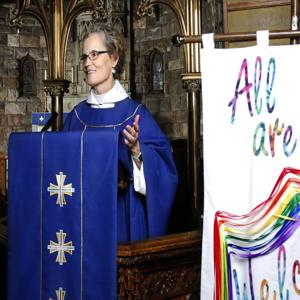

The Feast of All Saints – November 2, 2025: May God’s words be spoken, may God’s words be heard. Amen.
Today we celebrate the Feast of All Saints, when we remember those who have gone before us. Some may think that sainthood is for a select few, or just for those in what we call the Saints Triumphant, who live in eternal glory. But the fact is, any time the Christian scriptures mentions saints, they do so in the context of it being all you’all in the church – every single person, not just those we commemorate on special days.
Now when we hear that word, saint, we sometimes think it also means perfect. Lordy, no. While there are some the church holds up as models of faith, even they were not perfect, nor would they ever claim to have been. And of those we have had the privilege to love here on earth, and remember today, it is doubtful that any of us would say they were perfect people, even if they were perfect for us in their way. We loved them, and they us, but perfection isn’t really possible for humans. So, it’s a good thing that God doesn’t expect that of us.
As I remind everyone each year, All Saints isn’t about perfect people who have died, it is about recognizing that God asks ordinary people do extraordinary things. And given the context in which we all live, that’s a message we need to hear.
We are a deeply troubled and divided nation. It is a time when we can long for the Matthew version of the beatitudes, ‘Blessed are the poor in spirit, for theirs is the kingdom of heaven. ‘Blessed are those who hunger and thirst for righteousness, for they will be filled.’ But that is not what we hear today in our gospel. In fact, we don’t even hear about saints either.
In the gospel, Jesus spoke of four blessings – the poor will have the kingdom of God, the hungry will be filled, the grieving will laugh, and those who are hated will be given a great reward in heaven. Then comes the woes, something not found in the Gospel of Matthew. Woes to those who are rich because that will be all there is, those who are full will go hungry, and laughter will turn to tears. And then he tells them to love their enemies, reciprocate with goodness the evil done to you, and ends with what folks call the Golden Rule – “Do to others as you would have them do to you.”
Now, imagine hearing this for the first time. Even today, this is radical stuff. Especially that last part. I mean, we can all get behind the overturning of fortunes for the poor and rich alike, but that other bit about doing good to those who persecute you? It is a complete overturning of how the world seems to work. You can tell that Jesus grew up in his mother Mary’s household, because this is the Magnificat made present tense.
In the Magnificat, which is only in this gospel, Mary, in recognition of the promise of this child in her womb, echoes the words of Hannah, the mother of Samuel, and proclaims “He has brought down the powerful from their thrones and lifted up the lowly; he has filled the hungry with good things and sent the rich away empty.” Mary saw what this child Jesus would bring about. So, as we all know by now – yes, dang it, Mary knew, in answer to that ridiculous Christmas song.
Now, before we go further, just a very brief review about what is going on here. This is not the Sermon on the Mount we get in Matthew. This is the Lukan Jesus – who is visited by shepherds, not Kings, begins his ministry saying he has come to bring good news to the poor and set the captive free, and in this telling, he is most definitely not up on the side of a hill speaking to people below. This is the Sermon on the Plain and he isn’t talking about some other people either, as we hear in Matthew when he says “blessed are they…”. No, he is standing amidst the folks who need to hear this the most, and he is saying blessed are you, woe to you!
In the setup to what we heard today in the beatitudes, the text sets the scene: “He came down with them and stood on a level place with a great crowd of his disciples and a great multitude of people from all Judea, Jerusalem, and the coast of Tyre and Sidon. They had come to hear him and to be healed of their diseases, and those who were troubled with unclean spirits were cured. And everyone in the crowd was trying to touch him, for power came out from him and healed all of them. Then he looked up at his disciples and said…”
Jesus was among the people, a large crowd of those who were in desperate need, and he is calling for the overturning of the tables of injustice, and laying it out how to do it for his disciples. Yup – he’s Mary’s boy alright.
But what does all that have to do with us today? Everything.
For like it or not, we are standing in the midst of people who are hungry and oppressed – some of you may even be among them. These past few months have been horrific for this nation and the world, but most especially for the vulnerable – the hungry and the poor, the immigrant and the oppressed. The government months ago stopped the assistance for those in need worldwide by demolishing USAID. As of yesterday, SNAP benefits for the hungry poor in our own country has been stopped pending a court battle. And the budget passed months ago, which gave tax breaks to the rich and big corporations, also increased the cost of healthcare for the rest of us, reducing many to going without it.
SNAP helps struggling families, 1 of every 8 in our country. They live in predominantly rural areas, and SNAP helps them to make ends meet so that they will not go hungry. USAID’s work is just as impactful – stemming the rise of disease and famine, which if left unchecked, would have dire consequences worldwide, including us in the US. And Lord knows, everyone not only needs healthcare, but it should be their right to have it.
Blessed are you poor, but woe to you who are rich. Blessed are the hungry, but woe to you who are filled.
But there is more. We the people are the ones who weep as we watch the sickening images of militarized ICE units and National Guard troops sent by this President only to Democratic led cities. We have endured months of seeing tear gas and pepper balls being shot at protestors, who are exercising their constitutionally guaranteed right to stand up to this abuse of power. Clergy or members of Congress are not immune to this horrific use of weapons against citizens.
There are also more reports of boats, reportedly from Venezuela, being hit by drone strikes and blown up. Our government says, without offering any proof, that these are boats that carry drugs. These are extrajudicial killings – murders without due process – that are not only unconstitutional and criminal, they are inhumane and evil. Reportedly, some in congress actually find it all amusing.
Blessed are you who weep, but woe to you who laugh.
All of this appalling behavior by our nation’s leaders can send us to a dark place – filled with rage and a desire for revenge. That is when this gospel needs to be read over and over again.
Jesus, standing amidst so many who are in need, so many who have been oppressed, felt compassion. He looked up and tells his disciples “But I say to you that listen, love your enemies, do good to those who hate you, bless those who curse you, pray for those who abuse you.”
To be clear, Jesus isn’t telling anyone that we should allow ourselves to be abused – not at all. He is saying that we should not allow that abuse to be continued by holding tightly to our anger and desire for revenge, because that only condemns us to that deep and dark place out of which evil is given the power to destroy.
Not only that, it is also a radical response that flips the script and defeats the oppressor. It was true then, as it is for us today. We see it whenever cameras capture peaceful protestors or immigrants being violently shoved to ground or beaten. Scenes like that, just as on that Bloody Sunday back in Selma in 1965, or the photos from Kent State in 1970, can change everything, igniting the flame that will destroy the darkness of oppression.
Just look at how the people of Portland fought back – in inflatable frog, unicorn, and t-rex costumes. Why? Did they not understand the seriousness of what was happening? You bet they did. Yet this was done in part to combat the false rhetoric about the city the President was spewing. And, it made the imagery even more stark – armed militias standing against dancing unicorns, frogs, and dinosaurs. We know who looked ridiculous in that scenario, and it wasn’t the ones in costume. It also took a dangerous situation and deescalated it. Something normally left for our nation’s leaders to do, but had to instead be a lesson the people provided.
So, Jesus wasn’t telling his disciples or us to just take abuse. He was saying that the way to change the world isn’t by fighting fire with fire. That evil will always exist, but we cannot defeat it with evil. Or, as the Rev. Dr. Martin Luther King Jr. said – “Returning hate for hate multiplies hate, adding deeper darkness to a night already devoid of stars. Darkness cannot drive out darkness; only light can do that. Hate cannot drive out hate, only love can do that.” The Rev. Dr. King knew this sermon of Jesus well.
And so, this is the perfect sermon of Jesus for us to hear today, as we celebrate the saints – we who live now, and those who have gone before us. Because living as Jesus calls us to do in the Sermon on the Plain is saint work. It is not easy, to be sure, but perhaps we can take heart from the stories of some of those saints the church lifts up.
Now usually we think these saints are all old, grey bearded, men – or monastic women who lived a life of purity and austerity. Well, some are, but there are others – young and old, of many nations, and some even from ages not so long ago. Some of them are pictured on the cover of our bulletin today, but there are others too.
There is Jonathon Myrick Daniels, who, while attending an Episcopal seminary, heard the call of Dr. King to fight for the rights of people of color in the deep South. After being freed from jail, he took a shotgun blast meant for a young black girl, Ruby Sales. He was only 26 years old.
Then there are the Chaplains of the USS Dorchester, who when their ship was torpedoed during the Second World War, gave up their own life vests when the supply ran out that others might be saved, and stood on the deck of the ship, locked arm in arm, singing hymns and praying as it sank.
Frances Perkins, an Episcopalian, is another one – the first woman to serve in any Presidential cabinet. After hearing about the tragic Triangle Waist Shirt fire, where laborers were locked in their work area unable to escape, she became the primary author of the New Deal that brought about social security and worker protections.
Harriet Beecher Stowe and Frederick Douglas dedicated their lives to the abolition of slavery and the lifting up of the oppressed through their writing and witness.
There are the so-called Righteous Gentiles who risked their lives to save Jews from the Nazis.
And also Constance and Her Companions, a group of Episcopal nuns and priests who died ministering to yellow fever victims in Memphis.
From these, and so many other modern saints, we can take courage. They faced Nazis and torpedoes, the evil of slavery and the horror of labor conditions, extreme poverty, disease, and the brutality of dictators. Yet their faith led them to do what they likely never thought they would be capable of doing. Things that, believe it or not, you are capable of doing too.
So, as we do in Stewardship season, you will be given a gift blessed at the altar to remind you that you too are a saint of the church. That you have all that you need to do the work you are called to do in the name of Christ. These are little journal books with this on the cover: “You are brave. You are loved. You are kind. You are smart. You are amazing. You are strong. You are enough. You are unique.”
Take one of these, and when you get home, write this on the first page “You are a saint!” And in the rest of the pages, take a moment each day to note a response rooted in Christ’s love that you have done, or will do, in response to what you see around you. Take a look at some of the lives of the saints, or look up the people on the cover of this bulletin, and write something about them that inspires and calls you into your life in Christ.
Folks, now is not a time to turn a blind eye to what is happening, but to stand like Jesus amidst the poor and the oppressed.
Now is the time to rise up, ye saints of God, as the hymn says and fight the darkness of the evil we see with the light of Christ shining brightly within us.
Now is the time to join with other disciples and protest peacefully, bringing down hate with love.
Now is the time to be clear about what it means to follow Jesus – it isn’t a call to nationalism and earthly power, but to humble service of the poor, the outcast, and the forgotten.
And that, my friends, is saint work.
We have work to do, and you are the saints Christ needs today. You are brave. You are loved. You are kind. You are smart. You are amazing. You are strong. You are enough. You are unique.
And most of all – you are a saint!
The very saint Christ needs today.
May God, who guided the saints who walked before you, give you grace to do what you are now called to do.
Amen.
For the audio, click below, or subscribe to our iTunes Sermon Podcast by clicking here (also available on Audible):
Sermon Podcast
The Rev. Diana L. Wilcox
Christ Church in Bloomfield & Glen Ridge
November 2, 2025
Pentecost Last – Year C – All Saints Sunday
1st Reading – Daniel 7:1-3,15-18
Psalm 149
2nd Reading – Ephesians 1:11-23
Gospel – Luke 6:20-31
 View all episodes
 By The Rev. Diana L. Wilcox
5
88 ratings
The Feast of All Saints – November 2, 2025: May God’s words be spoken, may God’s words be heard. Amen.
Today we celebrate the Feast of All Saints, when we remember those who have gone before us. Some may think that sainthood is for a select few, or just for those in what we call the Saints Triumphant, who live in eternal glory. But the fact is, any time the Christian scriptures mentions saints, they do so in the context of it being all you’all in the church – every single person, not just those we commemorate on special days.
Now when we hear that word, saint, we sometimes think it also means perfect. Lordy, no. While there are some the church holds up as models of faith, even they were not perfect, nor would they ever claim to have been. And of those we have had the privilege to love here on earth, and remember today, it is doubtful that any of us would say they were perfect people, even if they were perfect for us in their way. We loved them, and they us, but perfection isn’t really possible for humans. So, it’s a good thing that God doesn’t expect that of us.
As I remind everyone each year, All Saints isn’t about perfect people who have died, it is about recognizing that God asks ordinary people do extraordinary things. And given the context in which we all live, that’s a message we need to hear.
We are a deeply troubled and divided nation. It is a time when we can long for the Matthew version of the beatitudes, ‘Blessed are the poor in spirit, for theirs is the kingdom of heaven. ‘Blessed are those who hunger and thirst for righteousness, for they will be filled.’ But that is not what we hear today in our gospel. In fact, we don’t even hear about saints either.
In the gospel, Jesus spoke of four blessings – the poor will have the kingdom of God, the hungry will be filled, the grieving will laugh, and those who are hated will be given a great reward in heaven. Then comes the woes, something not found in the Gospel of Matthew. Woes to those who are rich because that will be all there is, those who are full will go hungry, and laughter will turn to tears. And then he tells them to love their enemies, reciprocate with goodness the evil done to you, and ends with what folks call the Golden Rule – “Do to others as you would have them do to you.”
Now, imagine hearing this for the first time. Even today, this is radical stuff. Especially that last part. I mean, we can all get behind the overturning of fortunes for the poor and rich alike, but that other bit about doing good to those who persecute you? It is a complete overturning of how the world seems to work. You can tell that Jesus grew up in his mother Mary’s household, because this is the Magnificat made present tense.
In the Magnificat, which is only in this gospel, Mary, in recognition of the promise of this child in her womb, echoes the words of Hannah, the mother of Samuel, and proclaims “He has brought down the powerful from their thrones and lifted up the lowly; he has filled the hungry with good things and sent the rich away empty.” Mary saw what this child Jesus would bring about. So, as we all know by now – yes, dang it, Mary knew, in answer to that ridiculous Christmas song.
Now, before we go further, just a very brief review about what is going on here. This is not the Sermon on the Mount we get in Matthew. This is the Lukan Jesus – who is visited by shepherds, not Kings, begins his ministry saying he has come to bring good news to the poor and set the captive free, and in this telling, he is most definitely not up on the side of a hill speaking to people below. This is the Sermon on the Plain and he isn’t talking about some other people either, as we hear in Matthew when he says “blessed are they…”. No, he is standing amidst the folks who need to hear this the most, and he is saying blessed are you, woe to you!
In the setup to what we heard today in the beatitudes, the text sets the scene: “He came down with them and stood on a level place with a great crowd of his disciples and a great multitude of people from all Judea, Jerusalem, and the coast of Tyre and Sidon. They had come to hear him and to be healed of their diseases, and those who were troubled with unclean spirits were cured. And everyone in the crowd was trying to touch him, for power came out from him and healed all of them. Then he looked up at his disciples and said…”
Jesus was among the people, a large crowd of those who were in desperate need, and he is calling for the overturning of the tables of injustice, and laying it out how to do it for his disciples. Yup – he’s Mary’s boy alright.
But what does all that have to do with us today? Everything.
For like it or not, we are standing in the midst of people who are hungry and oppressed – some of you may even be among them. These past few months have been horrific for this nation and the world, but most especially for the vulnerable – the hungry and the poor, the immigrant and the oppressed. The government months ago stopped the assistance for those in need worldwide by demolishing USAID. As of yesterday, SNAP benefits for the hungry poor in our own country has been stopped pending a court battle. And the budget passed months ago, which gave tax breaks to the rich and big corporations, also increased the cost of healthcare for the rest of us, reducing many to going without it.
SNAP helps struggling families, 1 of every 8 in our country. They live in predominantly rural areas, and SNAP helps them to make ends meet so that they will not go hungry. USAID’s work is just as impactful – stemming the rise of disease and famine, which if left unchecked, would have dire consequences worldwide, including us in the US. And Lord knows, everyone not only needs healthcare, but it should be their right to have it.
Blessed are you poor, but woe to you who are rich. Blessed are the hungry, but woe to you who are filled.
But there is more. We the people are the ones who weep as we watch the sickening images of militarized ICE units and National Guard troops sent by this President only to Democratic led cities. We have endured months of seeing tear gas and pepper balls being shot at protestors, who are exercising their constitutionally guaranteed right to stand up to this abuse of power. Clergy or members of Congress are not immune to this horrific use of weapons against citizens.
There are also more reports of boats, reportedly from Venezuela, being hit by drone strikes and blown up. Our government says, without offering any proof, that these are boats that carry drugs. These are extrajudicial killings – murders without due process – that are not only unconstitutional and criminal, they are inhumane and evil. Reportedly, some in congress actually find it all amusing.
Blessed are you who weep, but woe to you who laugh.
All of this appalling behavior by our nation’s leaders can send us to a dark place – filled with rage and a desire for revenge. That is when this gospel needs to be read over and over again.
Jesus, standing amidst so many who are in need, so many who have been oppressed, felt compassion. He looked up and tells his disciples “But I say to you that listen, love your enemies, do good to those who hate you, bless those who curse you, pray for those who abuse you.”
To be clear, Jesus isn’t telling anyone that we should allow ourselves to be abused – not at all. He is saying that we should not allow that abuse to be continued by holding tightly to our anger and desire for revenge, because that only condemns us to that deep and dark place out of which evil is given the power to destroy.
Not only that, it is also a radical response that flips the script and defeats the oppressor. It was true then, as it is for us today. We see it whenever cameras capture peaceful protestors or immigrants being violently shoved to ground or beaten. Scenes like that, just as on that Bloody Sunday back in Selma in 1965, or the photos from Kent State in 1970, can change everything, igniting the flame that will destroy the darkness of oppression.
Just look at how the people of Portland fought back – in inflatable frog, unicorn, and t-rex costumes. Why? Did they not understand the seriousness of what was happening? You bet they did. Yet this was done in part to combat the false rhetoric about the city the President was spewing. And, it made the imagery even more stark – armed militias standing against dancing unicorns, frogs, and dinosaurs. We know who looked ridiculous in that scenario, and it wasn’t the ones in costume. It also took a dangerous situation and deescalated it. Something normally left for our nation’s leaders to do, but had to instead be a lesson the people provided.
So, Jesus wasn’t telling his disciples or us to just take abuse. He was saying that the way to change the world isn’t by fighting fire with fire. That evil will always exist, but we cannot defeat it with evil. Or, as the Rev. Dr. Martin Luther King Jr. said – “Returning hate for hate multiplies hate, adding deeper darkness to a night already devoid of stars. Darkness cannot drive out darkness; only light can do that. Hate cannot drive out hate, only love can do that.” The Rev. Dr. King knew this sermon of Jesus well.
And so, this is the perfect sermon of Jesus for us to hear today, as we celebrate the saints – we who live now, and those who have gone before us. Because living as Jesus calls us to do in the Sermon on the Plain is saint work. It is not easy, to be sure, but perhaps we can take heart from the stories of some of those saints the church lifts up.
Now usually we think these saints are all old, grey bearded, men – or monastic women who lived a life of purity and austerity. Well, some are, but there are others – young and old, of many nations, and some even from ages not so long ago. Some of them are pictured on the cover of our bulletin today, but there are others too.
There is Jonathon Myrick Daniels, who, while attending an Episcopal seminary, heard the call of Dr. King to fight for the rights of people of color in the deep South. After being freed from jail, he took a shotgun blast meant for a young black girl, Ruby Sales. He was only 26 years old.
Then there are the Chaplains of the USS Dorchester, who when their ship was torpedoed during the Second World War, gave up their own life vests when the supply ran out that others might be saved, and stood on the deck of the ship, locked arm in arm, singing hymns and praying as it sank.
Frances Perkins, an Episcopalian, is another one – the first woman to serve in any Presidential cabinet. After hearing about the tragic Triangle Waist Shirt fire, where laborers were locked in their work area unable to escape, she became the primary author of the New Deal that brought about social security and worker protections.
Harriet Beecher Stowe and Frederick Douglas dedicated their lives to the abolition of slavery and the lifting up of the oppressed through their writing and witness.
There are the so-called Righteous Gentiles who risked their lives to save Jews from the Nazis.
And also Constance and Her Companions, a group of Episcopal nuns and priests who died ministering to yellow fever victims in Memphis.
From these, and so many other modern saints, we can take courage. They faced Nazis and torpedoes, the evil of slavery and the horror of labor conditions, extreme poverty, disease, and the brutality of dictators. Yet their faith led them to do what they likely never thought they would be capable of doing. Things that, believe it or not, you are capable of doing too.
So, as we do in Stewardship season, you will be given a gift blessed at the altar to remind you that you too are a saint of the church. That you have all that you need to do the work you are called to do in the name of Christ. These are little journal books with this on the cover: “You are brave. You are loved. You are kind. You are smart. You are amazing. You are strong. You are enough. You are unique.”
Take one of these, and when you get home, write this on the first page “You are a saint!” And in the rest of the pages, take a moment each day to note a response rooted in Christ’s love that you have done, or will do, in response to what you see around you. Take a look at some of the lives of the saints, or look up the people on the cover of this bulletin, and write something about them that inspires and calls you into your life in Christ.
Folks, now is not a time to turn a blind eye to what is happening, but to stand like Jesus amidst the poor and the oppressed.
Now is the time to rise up, ye saints of God, as the hymn says and fight the darkness of the evil we see with the light of Christ shining brightly within us.
Now is the time to join with other disciples and protest peacefully, bringing down hate with love.
Now is the time to be clear about what it means to follow Jesus – it isn’t a call to nationalism and earthly power, but to humble service of the poor, the outcast, and the forgotten.
And that, my friends, is saint work.
We have work to do, and you are the saints Christ needs today. You are brave. You are loved. You are kind. You are smart. You are amazing. You are strong. You are enough. You are unique.
And most of all – you are a saint!
The very saint Christ needs today.
May God, who guided the saints who walked before you, give you grace to do what you are now called to do.
Amen.
For the audio, click below, or subscribe to our iTunes Sermon Podcast by clicking here (also available on Audible):
Sermon Podcast
The Rev. Diana L. Wilcox
Christ Church in Bloomfield & Glen Ridge
November 2, 2025
Pentecost Last – Year C – All Saints Sunday
1st Reading – Daniel 7:1-3,15-18
Psalm 149
2nd Reading – Ephesians 1:11-23
Gospel – Luke 6:20-31