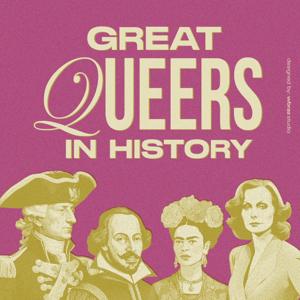
Great Queers in History

Great Queers in History

By Otto MasHistory
Download on the App Store

Great Queers in History episodes

  • S01E21: Francis Bacon, English writer, essayist, politician, and philosopher, founder of empiricism (1561-1626)
    Francis Bacon, the one studied in philosophy classes in school, was a first-rate statesman and a great philosopher, as well as a homosexual who was fortunate enough to enjoy his sexuality because the king at the time was also homosexual, and Bacon was by his side, meaning he was privileged. Eventually, he fell from grace, but it was due to financial issues, and his brother, incidentally, was also homosexual, much to the dismay of their puritanical mother, Lady Anne Bacon, who ended up without grandchildren.
    The music you are listening to can be found on this playlist: https://open.spotify.com/playlist/6sTbqqy8eOhfoWKz2GAflu?si=K7IADIIaTCStd3JVZpTcLQ
    25 min
  • S01E20: Hans Christian Andersen (1805-1875), Danish writer known for his children's fairy tales
    But how can Hans Christian Andersen be homosexual when he wrote children's tales?! Reeeeeeally? Are homosexuals not allowed to write stories? Well, Andersen's love story was quite asexually oriented, with lots of letters, diaries, and 19th-century romanticism, of course. And, hey, he had his flings and prospered in his own way. After all, someone had to be the inspiration for his story "The Ugly Duckling"! Yes, himself.
    Oh, and the music for the episode can be found here: https://open.spotify.com/playlist/03i9DgQGJHRxkdOrGkBSjM?si=VC8WvBUXSi-BGEAlUHogrw
    21 min
  • S01E19: Edward II of England, also known as Edward II of Plantagenet (1284-1327)
    Edward II, the son of Eleanor of Castile, fell head over heels in love with Piers Gaveston, and they even had a religious ceremony that resembled a marriage... well, not exactly, it was more like a religious bonding, but you know, with some intimacy, even though the Church didn't allow such things. If you want to learn more about this union that wasn't a marriage, just click. It includes very medieval content in the form of public execution and the music of their time, as always, which you can listen to in this Spotify playlist: https://open.spotify.com/playlist/6WbB0z48Coe3qfoHy7EsVL?si=VASdBSXESpS6vjpWWEgfGg
    25 min
  • S01E18: Pier Luigi Farnese, Duke of Castro and Parma (1503-1547)
    Pier Luigi Farnese was the illegitimate son of a Pope, to begin with. In addition to being a mercenary, he had an insatiable sexual appetite and left no young man untouched, willingly or not, so he was essentially a rapist. He established the Duchy of Parma, which, oddly enough, ended up in the hands of the Spanish Bourbon family through the marriage of Felipe V. Oh, and he raped a young bishop, just like that...
    The music for this episode can be found, as always, on Spotify: https://open.spotify.com/playlist/4QB9qe17xxqpbEzl6GCgcp?si=bugormTSRv6J5qkS_q9inQ
    19 min
  • S01E17: William Lygon, 7th Earl Beauchamp (1872-1938)
    William Lygon was a true English nobleman with a long lineage, complete with medieval castles and all. He prospered in British society with all the merits and titles. Married with seven children, he had his flings and boyfriends until his brother-in-law found out and reported him. A scandal erupted, but his children never abandoned him, and his story inspired Evelyn Waugh's novel "Brideshead Revisited," which ITV turned into a legendary series.
    The music featured in this episode can be found in this Spotify playlist: https://open.spotify.com/playlist/2lTtwMB1uvDX03oiGY9KEK?si=LuVPPB2MS4un8bJdnppKiw
    22 min
  • S01E16: Federico García Lorca, poet, playwright, musician, and member of the Generation of '27 (1898-1936)
    What can be said about Federico García Lorca that hasn't been said already? Well, quite a few things, such as his three boyfriends, his homosexual friends, the works in which he reflected his condition, and even the album he recorded! A fundamental figure in universal literature forever linked to his tragic execution by the Francoists for being homosexual.
    The music for this episode can be found in this playlist: https://open.spotify.com/playlist/0YfrVsZcLZOS1Bm1dc36Wi?si=PsOH-fcHRnCfsMpk70MOOA
    22 min
  • S01E15: Luis Cernuda, Spanish poet and literary critic, member of the Generation of '27 (1902-1963)
    Luis Cernuda left his native Seville to discover his homosexuality in the warm city of Malaga, and from there, he moved to Madrid, where he became very close friends with two of Spain's greatest homosexual figures in literary history, Federico García Lorca and the future Nobel laureate in literature, Vicente Aleixandre. In his poetry, Cernuda explored his sexuality, loneliness, and love, making him one of the greatest poets in the Spanish language of the 20th century. An active anti-fascist, he spent his final days in exile, like many other Spaniards, welcomed by Mexico.
    You can find the playlist accompanying this episode here: https://open.spotify.com/playlist/5meWRA8y980wJX1qeRqCxP?si=RH09tPtMTMmXTMtZbUJ70w
    20 min
  • S01E14: Philipp Friedrich Alexander, Prince of Eulenburg and Hertefeld, and Count of Sandels (1847-1921)
    Philipp von Eulenburg was the typical stuffy aristocrat, old-fashioned, classist, antisemitic, and racist, who disliked parliamentary systems. He formed the Liebenberg Circle, a clique of friends like him, meaning nobles and homosexuals, to advise, or rather, influence, Kaiser Wilhelm II. However, people were somewhat tired of nobles and, on top of that, homosexuals. The scandal made its way into the press and the courts, and overall, homophobia ran rampant in what became known as the Eulenburg Affair. Quite a drama... but it had its waltzes and all, and here's the playlist: https://open.spotify.com/playlist/0rFmKreJSz80PWgitqKcFG?si=FuPAw04SQH605_2YkSgnuA

    20 min
  • S01E13: Philip of France, Duke of Orleans, Frère unique du Roi and prince (1640-1701)
    Philip of Orleans, the younger brother of the Sun King Louis XIV, was openly homosexual, a skilled military man, and a fashion victim of his time (possibly even more so than his brother, which is saying something). He maintained a long-term romantic relationship with the Chevalier de Lorraine, although it was a rather toxic relationship because the Chevalier was a spendthrift and a royal freeloader. But well, Philip had money to spare, to be honest...
    Today's playlist features the following songs: https://open.spotify.com/playlist/6OyyLUtUOLwKJJWzDdLSdp?si=3Ei6mHIgR6qU1EexQQcIwQ
    20 min
  • S01E12: Henry III of France, king and sixth child to the great Catherine de' Medici (1551-89)
    Henry of Valois was not born to be a king, but he ended up becoming the King of Poland and later of France, all due to the twists of fate and, of course, because his brother died. The favored son of Catherine de' Medici, caught between the Huguenots and Catholics, he left no one indifferent, especially when he partied with his "mignons," dressed as a woman and heavily made up, both literally and figuratively. A fanatical Catholic monk took him down at a young age.
    The playlist with the contemporary music used in the podcast about Henry is on Spotify, as always: https://open.spotify.com/playlist/6O2MNHIshKedBwDUZ7Lydy?si=FZ9okDZGTbyL5-FgasIhsQ
    21 min

About Great Queers in History

From the publisher's feed

A laid-back approach to various historical figures whose homosexuality got lost, or was concealed, in history books because it turns out, western historiography didn't find any sexuality other than the predominant one, that is, heterosexuality, to be significant.