
Sign up to save your podcasts
Or


When studying in Palestine two years ago, my daughter Else got a tattoo on her wrist.
It simply says “bodacious.”
Now, I understand that for those of us with a certain vintage, that word primarily brings to mind an Excellent Adventure dude.
But to Else, ‘bodacious’ is the *chef’s kiss* word to describe Mary, this mother of Jesus, and as always, she is spot on.
Mary is so often portrayed to be taciturn, gentle, obedient, but even at 21 Else’s over it.
Instead, she knows that Mary was bold and audacious, the two words that when smushed together as German does on the regular but English not so much, create this glorious thing: ‘bodaciousness.’
Mary’s song, the one that we heard just two days ago, on last Sunday, it’s revolutionary, a cascade of convictions that these days get a person labeled a radical, a socialist, a Marxist, a traitor, no patriot, and certainly a trouble maker.
I mean, come on: listen to them:
“My soul magnifies the Lord, and my spirit rejoices in God my Savior,
for he has looked with favor on the lowliness of his servant.
Surely, from now on all generations will call me blessed;
for the Mighty One has done great things for me,
and holy is his name.
His mercy is for those who fear him
from generation to generation.
He has shown strength with his arm;
he has scattered the proud in the thoughts of their hearts.
He has brought down the powerful from their thrones,
and lifted up the lowly;
he has filled the hungry with good things,
and sent the rich away empty.
My daughter Else, she up and got ‘bodacious’ emblazoned on her wrist to remind her, when she’s writing, or shaking someone’s hand, or getting dressed in the morning, or any other daily garden-variety-or-bold and audacious action move to tap into her not-so-very inner Mary, and be bodacious in her engagement with the world.
I love that.
I love her.
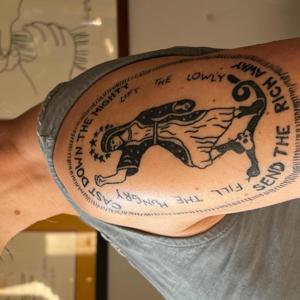
And I love Mary’s words—and my daughter’s bravery—so much that I also got a tattoo, the one you can see on my Substack and Facebook profile, inked on my left arm, to be raised as Mary’s is in the image from Ben Wildflower, so that I’m reminded to tap into my inner Mary when the time calls for it too.
Spoiler alert: the time calls for it.
It’s worth noting here that it bothers me to no end that certain Christians and Christian groups—the same ones, as an aside, which have successfully taken away a woman’s right to bodily autonomy—say that of course a woman may bear a child in her belly—Mary, bore the Word of God in hers, after all.
And of course a woman may bear down and ex-press a baby from her vagina—Mary bore down and expressed the Word of God through hers.
But hold up, hold up, a woman bearing the Word of God through her mouth from a pulpit, never mind that Mary bore the Word of God when she sang the Magnificat: we can not have that.
Oh no.
These paradoxically powerful but weak people know that a woman’s words have power, and if her capacity to speak is limited, as the Christian tradition has limited Mary’s, then they and the forces which benefit from them have a fighting chance.
And I do not digress here.
But here’s the thing, on this Christmas Eve Day.
While it’s true that Mary is filled with righteous subversiveness in the reading we had for the last Sunday in Advent, in today’s texts, we hear different words describing her, ones more contemplative: Mary was amazed at what she heard, and she treasured and pondered what she heard and saw and experienced that holy evening.
She took a moment, and she took it all in, and allowed herself to be blessed by the magic, the majesty, and the mystery of it all.
You see, there is so much wonder to behold in this holy world of ours.
It’s overwhelming to recognize all that is simultaneously liminal, both beyond us and yet present in our every day lives, and were we to take the time to notice, to be in awe, to stand in amazement at it all, we too would be compelled to stop everything and treasure it, ponder it, too.
Mary was not either/or—we see women so often depicted as virgin or vixen; obedient or abrasive; homemaker or professional, and so on and so forth with this nonsense.
But Mary was not both/and.
She did root her beliefs in a deep knowledge of and conviction about God’s salvation history—often called God’s Heilsgeschichte—of course, never losing either her commitment to the God who gives and who demands preferential treatment to the poor, the marginalized, the powerless, and the forgotten; or her clear indignation at the injustice in the world, where the rich and the powerful forsake the meek and the lowly.
She did refuse to be silent about her faithfulness to God and only to God, and in the whirlwind of fear and uncertainty she sang.
That’s what she did: she sang a defiant tune.
But Mary is not only knowledgeable, principled, and defiant.
Nope.
Mary also is imbued with a sense of wonder and of humility.
She breathed, she paused, and she took it all in with gratitude and awe.
This year, many (most?) Christians who purport to worship the very Jesus whom Mary bore most definitively did not, with their recent vote, lift up the lowly, fill the hungry, and send the rich away utterly empty.
Given that, and what is to come, I am not ashamed to say that this season, I have found myself snarkily singing, “Oh come ON, all ye faithful.”
I do believe that Mary in her Magnificat would approve.
But I also believe that tonight, without losing the identity we share with the holy heritage about which Mary bearing Jesus sang after meeting Elizabeth bearing John, I do believe that tonight we can also cherish other elements of Mary, ones which these first two chapters of Luke reveal—one oriented more to joy, to hope, to trust, to wonder, to humility, to gratitude, to pause, and to unabashed, unfettered, unlimited love.
So please do come, all ye faithful, and may you all have a very Mary Christmas.
 View all episodes
 By Anna Madsen
When studying in Palestine two years ago, my daughter Else got a tattoo on her wrist.
It simply says “bodacious.”
Now, I understand that for those of us with a certain vintage, that word primarily brings to mind an Excellent Adventure dude.
But to Else, ‘bodacious’ is the *chef’s kiss* word to describe Mary, this mother of Jesus, and as always, she is spot on.
Mary is so often portrayed to be taciturn, gentle, obedient, but even at 21 Else’s over it.
Instead, she knows that Mary was bold and audacious, the two words that when smushed together as German does on the regular but English not so much, create this glorious thing: ‘bodaciousness.’
Mary’s song, the one that we heard just two days ago, on last Sunday, it’s revolutionary, a cascade of convictions that these days get a person labeled a radical, a socialist, a Marxist, a traitor, no patriot, and certainly a trouble maker.
I mean, come on: listen to them:
“My soul magnifies the Lord, and my spirit rejoices in God my Savior,
for he has looked with favor on the lowliness of his servant.
Surely, from now on all generations will call me blessed;
for the Mighty One has done great things for me,
and holy is his name.
His mercy is for those who fear him
from generation to generation.
He has shown strength with his arm;
he has scattered the proud in the thoughts of their hearts.
He has brought down the powerful from their thrones,
and lifted up the lowly;
he has filled the hungry with good things,
and sent the rich away empty.
My daughter Else, she up and got ‘bodacious’ emblazoned on her wrist to remind her, when she’s writing, or shaking someone’s hand, or getting dressed in the morning, or any other daily garden-variety-or-bold and audacious action move to tap into her not-so-very inner Mary, and be bodacious in her engagement with the world.
I love that.
I love her.
And I love Mary’s words—and my daughter’s bravery—so much that I also got a tattoo, the one you can see on my Substack and Facebook profile, inked on my left arm, to be raised as Mary’s is in the image from Ben Wildflower, so that I’m reminded to tap into my inner Mary when the time calls for it too.
Spoiler alert: the time calls for it.
It’s worth noting here that it bothers me to no end that certain Christians and Christian groups—the same ones, as an aside, which have successfully taken away a woman’s right to bodily autonomy—say that of course a woman may bear a child in her belly—Mary, bore the Word of God in hers, after all.
And of course a woman may bear down and ex-press a baby from her vagina—Mary bore down and expressed the Word of God through hers.
But hold up, hold up, a woman bearing the Word of God through her mouth from a pulpit, never mind that Mary bore the Word of God when she sang the Magnificat: we can not have that.
Oh no.
These paradoxically powerful but weak people know that a woman’s words have power, and if her capacity to speak is limited, as the Christian tradition has limited Mary’s, then they and the forces which benefit from them have a fighting chance.
And I do not digress here.
But here’s the thing, on this Christmas Eve Day.
While it’s true that Mary is filled with righteous subversiveness in the reading we had for the last Sunday in Advent, in today’s texts, we hear different words describing her, ones more contemplative: Mary was amazed at what she heard, and she treasured and pondered what she heard and saw and experienced that holy evening.
She took a moment, and she took it all in, and allowed herself to be blessed by the magic, the majesty, and the mystery of it all.
You see, there is so much wonder to behold in this holy world of ours.
It’s overwhelming to recognize all that is simultaneously liminal, both beyond us and yet present in our every day lives, and were we to take the time to notice, to be in awe, to stand in amazement at it all, we too would be compelled to stop everything and treasure it, ponder it, too.
Mary was not either/or—we see women so often depicted as virgin or vixen; obedient or abrasive; homemaker or professional, and so on and so forth with this nonsense.
But Mary was not both/and.
She did root her beliefs in a deep knowledge of and conviction about God’s salvation history—often called God’s Heilsgeschichte—of course, never losing either her commitment to the God who gives and who demands preferential treatment to the poor, the marginalized, the powerless, and the forgotten; or her clear indignation at the injustice in the world, where the rich and the powerful forsake the meek and the lowly.
She did refuse to be silent about her faithfulness to God and only to God, and in the whirlwind of fear and uncertainty she sang.
That’s what she did: she sang a defiant tune.
But Mary is not only knowledgeable, principled, and defiant.
Nope.
Mary also is imbued with a sense of wonder and of humility.
She breathed, she paused, and she took it all in with gratitude and awe.
This year, many (most?) Christians who purport to worship the very Jesus whom Mary bore most definitively did not, with their recent vote, lift up the lowly, fill the hungry, and send the rich away utterly empty.
Given that, and what is to come, I am not ashamed to say that this season, I have found myself snarkily singing, “Oh come ON, all ye faithful.”
I do believe that Mary in her Magnificat would approve.
But I also believe that tonight, without losing the identity we share with the holy heritage about which Mary bearing Jesus sang after meeting Elizabeth bearing John, I do believe that tonight we can also cherish other elements of Mary, ones which these first two chapters of Luke reveal—one oriented more to joy, to hope, to trust, to wonder, to humility, to gratitude, to pause, and to unabashed, unfettered, unlimited love.
So please do come, all ye faithful, and may you all have a very Mary Christmas.