
Sign up to save your podcasts
Or

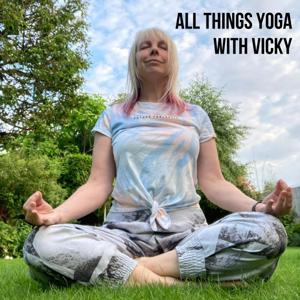

This episode gives an insight into how meditation may be a useful part of a pain management regime for chronic pain. It discusses two different types of meditation and draws on personal experience in addition to professional knowledge.
Join me at https://www.eqyoga.co.uk/
Transcript
Vicky (00:00:03) - Hi, welcome to All Things Yoga with Vicky, a podcast about all things yoga. Today we're going to consider how meditation can play a part in the management of chronic pain. If you do suffer from chronic pain, you will be fully aware that it can affect every part of your life, from work to sleep. Now I'm going to explore some ways with you that meditation could be a side effect free part of chronic pain management. Now, a few years back, just after I qualified as a yoga teacher, I suffered a herniated disc in my lower back. Now, I'd never, ever had any chronic pain before and it was a real shock. I tried lots of different methods in an attempt to get rid of it, but in addition to other methods of pain management, I found meditation was very useful. Meditation doesn't have any serious side effects like some medications, and it can be worth trying just because you have nothing to lose. However, it's worth remembering that we all experience pain differently, and therefore the efficacy of pain management methods will vary from person to person too.
Vicky (00:01:25) - So don't worry if you find these meditations aren't for you. Now, meditation can be challenging if you have a pain that never goes away. Not only does it try to grab our attention all the time, but it can also mean that finding a comfortable position to meditate is challenging. Now, the traditional seated pose for meditation might exacerbate our sensation of pain. And if this is the case, then we can choose another position to meditate. So if you try and find a posture that you feel the least discomfort, that could work for some people that might be laying on their front or their back. Maybe having your chest propped up when you lay on your front with a cushion or bolster, or even standing, leaning against a wall, or take in what's called in yoga child's pose. So it's almost like kneeling. But then you roll down, fold down your body, over your legs. All of these are possibilities. It is good to find a little stillness for the practice, but if staying still in one position for too long isn't possible for you, then you can move whenever you need.
Vicky (00:02:45) - Now, once we've found a way in which our body feels happiest, we can start our meditation practice. Now, in my experience, chronic pain management meditation can take two basic forms. The first removes our focus from the pain and the second directs our focus to the pain. Although the latter might sound counterintuitive, it was the method that I personally found most effective with either of these methods. If we find our discomfort increasing, or we'd like to stop practicing for any reason, then it's perfectly okay to stop. So let's look first at removing our focus from the pain. Resting awareness on our breath is a familiar meditation technique, and this familiar technique can be applied to pain management meditation. Bringing your focus to the natural inhale and exhale, whether that be the sensation of the breath at the nostrils or the gentle movement as the chest and belly rise and fall, that can help to redirect our attention from the pain. So if we're able to focus for maybe just 1 or 2 breaths, it may be possible to then build up to focus on more breaths over time, which could give moments of pain relief when we practice.
Vicky (00:04:22) - The second method of taking our focus to the pain can be very interesting indeed. This was my preferred method. We can begin with the familiar breath awareness to settle into the practice, but then allow our focus to be directed to the exact spot that we feel the pain in that moment.
Vicky (00:04:47) - Now when this is the focus, something intriguing might happen. The pain may start to hide as though it's becoming shy. Get in this kind of level of attention and it may shift to a different place. It could be far away. It could be just nearby. If it hides, we can keep our focus on that initial area for the meditation or if it moves, we can repeat that process of directing our focus to the exact spot of the pain once again. Now we continue with this as many times as we wish. Chasing that sensation wherever it chooses to reside at that moment. Now, if you find either of these methods useful, it could be helpful to build them into your daily routine. Even if you practice for just a few moments at a time.
Vicky (00:05:44) - While meditation is not an alternative to meditation, teaching our brains to process the sensation of pain differently may help with the management of chronic pain. Please remember to hit subscribe and if you'd like to contact me, you can through my website eqyoga.co.uk. Thank you so much for listening.
 View all episodes
 By Vicky Richings
This episode gives an insight into how meditation may be a useful part of a pain management regime for chronic pain. It discusses two different types of meditation and draws on personal experience in addition to professional knowledge.
Join me at https://www.eqyoga.co.uk/
Transcript
Vicky (00:00:03) - Hi, welcome to All Things Yoga with Vicky, a podcast about all things yoga. Today we're going to consider how meditation can play a part in the management of chronic pain. If you do suffer from chronic pain, you will be fully aware that it can affect every part of your life, from work to sleep. Now I'm going to explore some ways with you that meditation could be a side effect free part of chronic pain management. Now, a few years back, just after I qualified as a yoga teacher, I suffered a herniated disc in my lower back. Now, I'd never, ever had any chronic pain before and it was a real shock. I tried lots of different methods in an attempt to get rid of it, but in addition to other methods of pain management, I found meditation was very useful. Meditation doesn't have any serious side effects like some medications, and it can be worth trying just because you have nothing to lose. However, it's worth remembering that we all experience pain differently, and therefore the efficacy of pain management methods will vary from person to person too.
Vicky (00:01:25) - So don't worry if you find these meditations aren't for you. Now, meditation can be challenging if you have a pain that never goes away. Not only does it try to grab our attention all the time, but it can also mean that finding a comfortable position to meditate is challenging. Now, the traditional seated pose for meditation might exacerbate our sensation of pain. And if this is the case, then we can choose another position to meditate. So if you try and find a posture that you feel the least discomfort, that could work for some people that might be laying on their front or their back. Maybe having your chest propped up when you lay on your front with a cushion or bolster, or even standing, leaning against a wall, or take in what's called in yoga child's pose. So it's almost like kneeling. But then you roll down, fold down your body, over your legs. All of these are possibilities. It is good to find a little stillness for the practice, but if staying still in one position for too long isn't possible for you, then you can move whenever you need.
Vicky (00:02:45) - Now, once we've found a way in which our body feels happiest, we can start our meditation practice. Now, in my experience, chronic pain management meditation can take two basic forms. The first removes our focus from the pain and the second directs our focus to the pain. Although the latter might sound counterintuitive, it was the method that I personally found most effective with either of these methods. If we find our discomfort increasing, or we'd like to stop practicing for any reason, then it's perfectly okay to stop. So let's look first at removing our focus from the pain. Resting awareness on our breath is a familiar meditation technique, and this familiar technique can be applied to pain management meditation. Bringing your focus to the natural inhale and exhale, whether that be the sensation of the breath at the nostrils or the gentle movement as the chest and belly rise and fall, that can help to redirect our attention from the pain. So if we're able to focus for maybe just 1 or 2 breaths, it may be possible to then build up to focus on more breaths over time, which could give moments of pain relief when we practice.
Vicky (00:04:22) - The second method of taking our focus to the pain can be very interesting indeed. This was my preferred method. We can begin with the familiar breath awareness to settle into the practice, but then allow our focus to be directed to the exact spot that we feel the pain in that moment.
Vicky (00:04:47) - Now when this is the focus, something intriguing might happen. The pain may start to hide as though it's becoming shy. Get in this kind of level of attention and it may shift to a different place. It could be far away. It could be just nearby. If it hides, we can keep our focus on that initial area for the meditation or if it moves, we can repeat that process of directing our focus to the exact spot of the pain once again. Now we continue with this as many times as we wish. Chasing that sensation wherever it chooses to reside at that moment. Now, if you find either of these methods useful, it could be helpful to build them into your daily routine. Even if you practice for just a few moments at a time.
Vicky (00:05:44) - While meditation is not an alternative to meditation, teaching our brains to process the sensation of pain differently may help with the management of chronic pain. Please remember to hit subscribe and if you'd like to contact me, you can through my website eqyoga.co.uk. Thank you so much for listening.