
Sign up to save your podcasts
Or

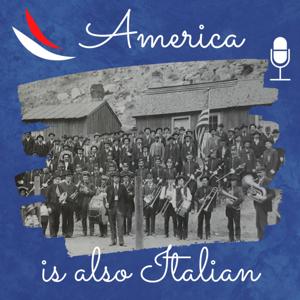

This episode explores the Immigrant's Early Arrivals
Throughout the colonial and early national periods, immigrants from the Italian peninsula maintained a small but well-established presence in the North American population. Italian craftsmen were renowned the world over, and many traveled to the New World to help build its new institutions, working as sculptors, woodworkers, and glassblowers. Thomas Jefferson had a particular affinity for Italian culture; he recruited Italian stonemasons to work on his home at Monticello, and brought musicians from Italy to form the core of the Marine Band. In addition, he invented his own hand-operated pasta machine, the designs for which are still in the Library's collections.
Italian immigration continued at a trickle throughout the middle of the 19th century. Although travelers from the peninsula continued to roam the world, most chose to settle in Argentina and Brazil. Between 1820 and 1870, fewer than 25,000 Italian immigrants came to the U.S., mostly from northern Italy. These early arrivals settled in communities all across the country, from the farm towns of New Jersey and the vineyards of California to the ports of San Francisco and New Orleans.
The impact of their contributions can still be seen today. The poet Lorenzo da Ponte built the first opera house in the U.S., became a professor of Italian at Columbia University, and almost single-handedly established Italian opera in the United States. The abolition movement received key support from the prominent Philadelphia rabbi Sabato Morais, who brought a fierce commitment to freedom and human rights from his native Tuscany. Starting in the mid-1850s, painter Constantino Brumidi spent decades creating the paintings and frescoes that adorn the U.S. Capitol, including the spectacular images on the building's great dome.
This podcast aims to explain Italian characters and behavior. A full-length portrait of my compatriots may occasionally be witty, grave, cynical, compassionate, melancholy, glittering, scholarly, and stimulating. What is important is that we share these emotions. Italians have discovered America for the Americans; taught poetry, statesmanship, and the ruses of trade to the English; military art to the Germans; cuisine to the French; acting and ballet dancing to the Russians; music to everybody. Suppose someday this world of ours should be turned into a cloud of radioactive dust in space. In that case, it will be by nuclear contrivances developed with the decisive aid of Italian scientists—{Luigi Barzini, in the Italians}.
Hosted on Acast. See acast.com/privacy for more information.
 View all episodes
 By Walter Potenza
This episode explores the Immigrant's Early Arrivals
Throughout the colonial and early national periods, immigrants from the Italian peninsula maintained a small but well-established presence in the North American population. Italian craftsmen were renowned the world over, and many traveled to the New World to help build its new institutions, working as sculptors, woodworkers, and glassblowers. Thomas Jefferson had a particular affinity for Italian culture; he recruited Italian stonemasons to work on his home at Monticello, and brought musicians from Italy to form the core of the Marine Band. In addition, he invented his own hand-operated pasta machine, the designs for which are still in the Library's collections.
Italian immigration continued at a trickle throughout the middle of the 19th century. Although travelers from the peninsula continued to roam the world, most chose to settle in Argentina and Brazil. Between 1820 and 1870, fewer than 25,000 Italian immigrants came to the U.S., mostly from northern Italy. These early arrivals settled in communities all across the country, from the farm towns of New Jersey and the vineyards of California to the ports of San Francisco and New Orleans.
The impact of their contributions can still be seen today. The poet Lorenzo da Ponte built the first opera house in the U.S., became a professor of Italian at Columbia University, and almost single-handedly established Italian opera in the United States. The abolition movement received key support from the prominent Philadelphia rabbi Sabato Morais, who brought a fierce commitment to freedom and human rights from his native Tuscany. Starting in the mid-1850s, painter Constantino Brumidi spent decades creating the paintings and frescoes that adorn the U.S. Capitol, including the spectacular images on the building's great dome.
This podcast aims to explain Italian characters and behavior. A full-length portrait of my compatriots may occasionally be witty, grave, cynical, compassionate, melancholy, glittering, scholarly, and stimulating. What is important is that we share these emotions. Italians have discovered America for the Americans; taught poetry, statesmanship, and the ruses of trade to the English; military art to the Germans; cuisine to the French; acting and ballet dancing to the Russians; music to everybody. Suppose someday this world of ours should be turned into a cloud of radioactive dust in space. In that case, it will be by nuclear contrivances developed with the decisive aid of Italian scientists—{Luigi Barzini, in the Italians}.
Hosted on Acast. See acast.com/privacy for more information.