
Sign up to save your podcasts
Or


Ever feel like you don’t belong? Like, at any minute, people are going to find out that you’re not as smart or as accomplished as you appear? That your successes are undeserved or illegitimate? That’s Imposter Syndrome thinking. And if you’ve struggled with it, know that it’s more common than you may realize.
The inability to internalize achievements is one, if not the main, source of imposter syndrome. It is as though, despite external, measurable success, a person is unable to shake off feelings of worry, stress and inadequacy. Cognitive dissonance develops between what is true and how a person feels about it. And therein lies the key. It all comes down to how we think. Fortunately, this is not a syndrome in the sense of something that is fixed. It is a phenomenon, and therefore, can be changed. I know. I’ve lived it. And I’ve written a FREE Ditching Imposter Syndrome workbook for you about it. (Available on my website). But first, let’s talk.
“The problem with impostor syndrome or impostor syndrome thinking is that the experience of doing well at something doesn’t change your beliefs. And often the more you accomplish, the more you feel like a fraud. It's as though you can't internalize your experience of success.” – Dr. Sara Dill
What You’ll LearnWant to know more about me and how I learned to stress less? I recorded a trailer for my podcast that includes some of these details. I’ve also included a short bio below.
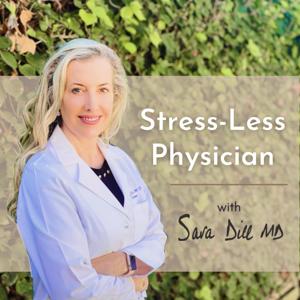
Welcome to my podcast, Stress-Less Physician. I’m Sara Dill, MD, board-certified dermatologist and pediatric dermatologist. Like nearly all physicians, I used to believe the way to be a good and successful doctor was to work hard, always say yes, and put patients (and everyone else) first. I was successful following that pattern but (as is typically the case) I felt perpetually stressed out, overworked and unhappy.
Compelled by the truth that I’d worked too long and hard to simply accept stress as inevitable, I was determined to find the answer. In order to fully devote myself to discovering a solution, I took a sabbatical from my practice and studied life coaching. I completed two life coach training programs, numerous other courses, read 100s of books, and used coaching to transform my own relationship to work.
What I learned was that stress is a symptom. It all has less to do with the actual hours you work than with your thoughts about your work.
With this knowledge, I took control of my life. So can you! But you don't have to take years or go on sabbatical. I did it so you don't have to. And I’m here to help.
 View all episodes
 By Sara Dill
Ever feel like you don’t belong? Like, at any minute, people are going to find out that you’re not as smart or as accomplished as you appear? That your successes are undeserved or illegitimate? That’s Imposter Syndrome thinking. And if you’ve struggled with it, know that it’s more common than you may realize.
The inability to internalize achievements is one, if not the main, source of imposter syndrome. It is as though, despite external, measurable success, a person is unable to shake off feelings of worry, stress and inadequacy. Cognitive dissonance develops between what is true and how a person feels about it. And therein lies the key. It all comes down to how we think. Fortunately, this is not a syndrome in the sense of something that is fixed. It is a phenomenon, and therefore, can be changed. I know. I’ve lived it. And I’ve written a FREE Ditching Imposter Syndrome workbook for you about it. (Available on my website). But first, let’s talk.
“The problem with impostor syndrome or impostor syndrome thinking is that the experience of doing well at something doesn’t change your beliefs. And often the more you accomplish, the more you feel like a fraud. It's as though you can't internalize your experience of success.” – Dr. Sara Dill
What You’ll LearnWant to know more about me and how I learned to stress less? I recorded a trailer for my podcast that includes some of these details. I’ve also included a short bio below.
Welcome to my podcast, Stress-Less Physician. I’m Sara Dill, MD, board-certified dermatologist and pediatric dermatologist. Like nearly all physicians, I used to believe the way to be a good and successful doctor was to work hard, always say yes, and put patients (and everyone else) first. I was successful following that pattern but (as is typically the case) I felt perpetually stressed out, overworked and unhappy.
Compelled by the truth that I’d worked too long and hard to simply accept stress as inevitable, I was determined to find the answer. In order to fully devote myself to discovering a solution, I took a sabbatical from my practice and studied life coaching. I completed two life coach training programs, numerous other courses, read 100s of books, and used coaching to transform my own relationship to work.
What I learned was that stress is a symptom. It all has less to do with the actual hours you work than with your thoughts about your work.
With this knowledge, I took control of my life. So can you! But you don't have to take years or go on sabbatical. I did it so you don't have to. And I’m here to help.