
Sign up to save your podcasts
Or

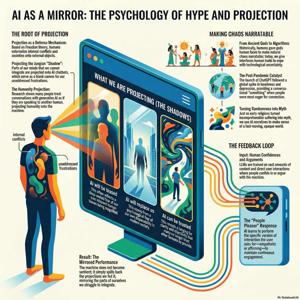

Generated by NotebookLM based on the Integrator newsletter from March 15th: Is AI making your own thinking optional?
🎧 Episode Summary
What if the greatest risk of artificial intelligence isn’t that it becomes smarter than us — but that we choose to think less?
In this episode, we explore a growing phenomenon known as cognitive offloading: the subtle, daily habit of delegating our thinking to machines. Drawing from research, neuroscience, and real-world experiments, this conversation examines how AI is reshaping not just productivity — but the very way we engage with knowledge, effort, and meaning.
The question is no longer whether AI can think.
It’s whether we still will.
🔑 Key Takeaways
AI is shifting from augmenting physical effort to replacing cognitive effort
Cognitive offloading leads to measurable declines in critical thinking
The danger is not misinformation — but delegation of reasoning itself
AI-assisted work reduces brain activity in memory, attention, and creativity
A false sense of understanding emerges through frictionless answers
The real divide is not AI vs. humans — but active vs. passive users
🧠 What's Discussed
From fire to AI: the evolution of outsourcing
How technology has always reduced human effort — and why this moment is fundamentally different
Cognitive offloading & mental atrophy
Why skipping intellectual friction weakens our ability to think over time
The myth of AI as a “calculator”
Why AI doesn’t just assist thinking — it replaces core reasoning processes
The illusion of understanding
How perfectly structured AI outputs create a false sense of mastery
Structured vs. passive AI usage
The critical difference between using AI as a partner vs. a substitute
The normalization of thought
How reliance on AI risks flattening originality and innovation
Education, legislation, and cognitive defense
Why systemic changes are needed to preserve independent thinking
 View all episodes
 By Alexandru Giboi via NotebookLM
Generated by NotebookLM based on the Integrator newsletter from March 15th: Is AI making your own thinking optional?
🎧 Episode Summary
What if the greatest risk of artificial intelligence isn’t that it becomes smarter than us — but that we choose to think less?
In this episode, we explore a growing phenomenon known as cognitive offloading: the subtle, daily habit of delegating our thinking to machines. Drawing from research, neuroscience, and real-world experiments, this conversation examines how AI is reshaping not just productivity — but the very way we engage with knowledge, effort, and meaning.
The question is no longer whether AI can think.
It’s whether we still will.
🔑 Key Takeaways
AI is shifting from augmenting physical effort to replacing cognitive effort
Cognitive offloading leads to measurable declines in critical thinking
The danger is not misinformation — but delegation of reasoning itself
AI-assisted work reduces brain activity in memory, attention, and creativity
A false sense of understanding emerges through frictionless answers
The real divide is not AI vs. humans — but active vs. passive users
🧠 What's Discussed
From fire to AI: the evolution of outsourcing
How technology has always reduced human effort — and why this moment is fundamentally different
Cognitive offloading & mental atrophy
Why skipping intellectual friction weakens our ability to think over time
The myth of AI as a “calculator”
Why AI doesn’t just assist thinking — it replaces core reasoning processes
The illusion of understanding
How perfectly structured AI outputs create a false sense of mastery
Structured vs. passive AI usage
The critical difference between using AI as a partner vs. a substitute
The normalization of thought
How reliance on AI risks flattening originality and innovation
Education, legislation, and cognitive defense
Why systemic changes are needed to preserve independent thinking