
Sign up to save your podcasts
Or



In May 1993, Trip Hawkins had successfully convinced Wall Street that 3DO represented the future of interactive entertainment. There was just one small problem. Somebody now had to build it, ship it, and persuade people to buy it.
In Part Two of our 3DO history, we follow the extraordinary sixteen months between the company's stock market flotation and the British launch of Panasonic's REAL FZ-1 in September 1994.
From the $699 American launch and its painfully thin software catalogue to Crash ’n Burn, collapsing share prices, a dramatic price reduction and a surprisingly promising Japanese debut, this is the story of a company discovering that selling a technological revolution is rather easier than delivering one.
But was the 3DO really the expensive disaster that history remembers? Or was there rather more to the story?
As someone who actually bought a 3DO on its British launch day, I revisit the excitement, the disappointments and the extraordinary ambition behind one of gaming's most misunderstood machines.
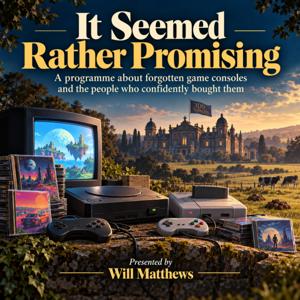
Welcome to It Seemed Rather Promising — a programme about forgotten game consoles and the people who confidently bought them.
In 1995, the videogame industry had a problem. Everyone knew platform games were enormously popular, but nobody seemed entirely sure what a next-generation platformer was supposed to look like.
Nintendo stuck with cute. Sega experimented with technology. Sony embraced polygons. And Crystal Dynamics gave us a sarcastic, television-addicted gecko called Gex.
In this episode of It Seemed Rather Promising, we revisit a peculiar moment in gaming history, when the humble platform game was caught between the 16-bit past and the 32-bit future.
Along the way, we examine Earthworm Jim, Rayman, Clockwork Knight, Jumping Flash! and the 3DO's surprisingly impressive 2D capabilities.
We also investigate an intriguing possibility: by late 1995, the once-exorbitant 3DO had become remarkably affordable. Could a stronger library of premium 2D games have given the machine a different future?
And why was Gex, of all things, one of the cleverest answers to the industry's next-generation dilemma?
A story of cartoon mascots, technological ambition, questionable marketing decisions, and a gecko who couldn't keep his mouth shut.
Before the PlayStation. Before the Saturn. And before anyone thought spending $699 on a games console was a perfectly reasonable idea, there was 3DO.
In this episode of *It Seemed Rather Promising*, we travel back to the late 1980s to explore the unlikely origins of one of gaming's most ambitious ventures.
From Electronic Arts' extraordinary success and Trip Hawkins' vision to the formation of The 3DO Company and its plans to reinvent the video games industry, this is the story of how a remarkable idea became a publicly traded company before its first console even reached shops.
There are big personalities, bold promises, enormous sums of money, and a business model that seemed almost too good to be true.
But in those early days, before the disappointments and commercial difficulties, the future looked genuinely exciting.
It seemed rather promising.
*A programme about forgotten game consoles and the people who confidently bought them.*
In December 1995, Sanyo released N.O.B. Neo Organic Bioform for the Japanese Panasonic 3DO.
It promised a disturbing science-fiction world, extraordinary computer-generated creatures, genetic experimentation and an ambitious new system of tactical combat.
It looked magnificent. It sounded sophisticated. And playing it was a deeply peculiar experience.
Armed with translated Japanese manuals, contemporary magazines and thirty years of hindsight, I set out to uncover the story behind one of the 3DO's most mysterious imports.
Was its brilliance simply concealed by the language barrier? Or had somebody created a remarkably elaborate game that wasn't actually very good?
A tale of technological ambition, dubious purchasing decisions and the eternal danger of assuming that complicated means clever.
Part of It Seemed Rather Promising, a podcast about forgotten game consoles and the people who confidently bought them.
Thirty years ago, I bought Myst for the Panasonic 3DO, admired its extraordinary graphics, played it for five minutes and declared it boring.
In 2026, I decided to give it a proper chance.
What followed was a journey through beautiful abandoned worlds, mysterious books, baffling machinery and an alarming amount of unpaid plumbing.
This episode explores the multimedia revolution of the 1990s, why Myst became a phenomenon, and what happened when I finally tried to understand a game I'd dismissed for three decades.
I discovered that I was Myst's ideal customer. I was just never its ideal player.
Part of It Seemed Rather Promising, a podcast about forgotten game consoles and the people who confidently bought them.
From the publisher's feed