
Sign up to save your podcasts
Or

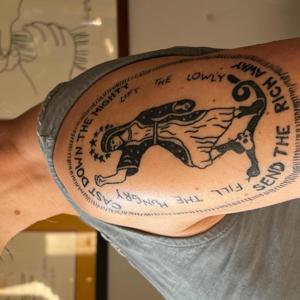

Below is a mashup of some musings I’ve shared in blog, book, sermon, and presentation form about the martyred Danish Lutheran playwright, poet, and preacher Kaj Munk.
Needless to say, he’s a hero of mine.
It’s he, as a matter of fact, who is the source of the moniker for this Substack place and podcast, “Never the Chameleon.”
Given that, and that today we celebrate Christ the King, and that we are bracing for both the anniversary of Munk’s assassination and the inauguration of Trump, a man who has threatened to quash voices and even lives which object to his rhetoric and policies—exactly as did those who killed Munk—it seems like the post is apropos.
Please allow me, then, to repurpose and reshare, albeit in new form, these words in honor of Kaj Munk: Minister, Martyr, and Mentor in the baptized faith.
~~~~~
What is, therefore, our task today? Shall I answer: “Faith, hope, and love”? That sounds beautiful. But I would say—courage. No, even that is not challenging enough to be the whole truth. Our task today is recklessness. For what we Christians lack is not psychology or literature…we lack a holy rage—the recklessness which comes from the knowledge of God and humanity. The ability to rage when justice lies prostrate on the streets, and when the lie rages across the face of the earth…a holy anger about the things that are wrong in the world. To rage against the ravaging of God’s earth, and the destruction of God’s world. To rage when little children must die of hunger, when the tables of the rich are sagging with food. To rage at the senseless killing of so many, and against the madness of militaries. To rage at the lie that calls the threat of death and the strategy of destruction peace. To rage against complacency. To restlessly seek that recklessness that will challenge and seek to change human history until it conforms to the norms of the Kingdom of God. And remember the signs of the Christian Church have been the Lion, the Lamb, the Dove, and the Fish…but never the chameleon.
Call committees, when sketching out a profile for their next pastor, are awfully drawn to words like these: kind, available, comforting, pastoral, articulate, flexible, intelligent, dynamic, wise, knowledgable, organized, trust-worthy, confident.
Good, solid, wholesome, reliable words.
‘Reckless,’ though?
Reckless never gets scratched off the brainstorm list, because it never gets on one.
Ever.
Nor does ‘rage-filled’ show up as coveted-pastor adjective, even with the word ‘holy’ tacked on.
Ever.
~~~~~~
Kaj Munk, the man who wrote the words above, he was a pastor.
He was a Danish pastor, and playwright, and martyr of the Danish resistance, and according to author Shane Claiborne, Munk wrote these words for a community newsletter not long before he was killed by the Gestapo on January 4, 1944.
On December 5, 1943, Munk preached a sermon about the complacency of the Church.
By this time, he’d stirred so many German hornets with his righteous and courageous preaching that the Nazis had declared it illegal for him to preach at all.
However, with crazy and quiet risk, the pastor of the Copenhagen Cathedral permitted Munk to preach, had him sitting incognito in the congregation, ready to slip into the pulpit when the moment to preach came, and, as soon as Munk was done with his sermon, arranged to have him spirited away before the Gestapo could get him.
Just three months before, Denmark’s government began resistance in earnest. On that morning, August 29, Germany had imposed martial law, confined the beloved Danish king and his family in the palace, and insisted upon the death penalty for any resister. In response, Denmark sunk its own ships rather than allow Germany to commandeer them.
The entire Danish government, including the king, resigned in protest of the Nazi aggressions.
Munk was exhilarated by and proud of the Danish response, and was not about to hide it under his alb. Instead, he preached regularly and openly about the threats of fascist Germany, which made him all the more a threat to the Gestapo, and therefore all the more a Gestapo target.
Although Munk was admired for his integrity and for his solidarity with the threatened Jewish Danes, not all Danes, and not all Lutherans were pleased with him.
Why?
Because Munk did what good Lutherans do, and he up and called a thing what it is.
Example?
On the day that he preached, in the Copenhagen cathedral for God’s sake, he boldly and baldly said this:
“Let’s keep politics out of the church, some say, we hear enough of politics on the radio, and we read about it in the newspapers. Let’s be free of that in the house of God…But perhaps we should hear about it in God’s house, but in a different way than we are used to. In God’s house we should hear about politics judged in relation to the word of God.”
He went on to say that if politics began to lead people in a direction that we know is against the ways and will of God, then, Munk said, “the church is not the Church of Christ if it remains silent…God forgive us if we don’t understand that the church is exactly for this: to make, at any moment, eternity relevant.”
To make eternity relevant.
It’s a funny thing, that word ‘eternity.’ People talk about eternal life on the regular, but almost always tethered to what happens after we breathe our last.
But if God’s time really is eternal, then it is happening right. this. very. moment.
We are already experiencing eternity. We are smack dab in the midst of it. We don’t have to wait for it. We’re in it.
One month after this Copenhagen cathedral sermon, on New Year’s Day, 1944, Munk stood before his tiny congregation in Jutland, along the west coast of Denmark.
It turns out that my father’s uncle and Munk were dear friends: I imagine that he sat in the pews on this day.
As it happened, the day coincided with the anniversary of the 20th year of Munk’s service to this parish.
It was all the more noteworthy, then, that contrary to custom, on this day Munk wasn’t garbed in the typical stole and collar.
Instead, he showed up in his overcoat with a scarf, wearing what anyone else on that Sunday might have worn.
It seems, from the text of this homily, that he had learned that there were Nazi collaborators in his pews.
This news in hand changed everything for him, and, he told his congregation, on this day, “I realized that I could not ascend to the pulpit.”
Instead, he stood among his people.
Straight away, in his sermon, Munk spoke out against Germany. He asserted that any Dane who helped the German cause was nothing short of a traitor to country and a traitor to God.
In the pulpit he did that.
Talk about calling a thing what it is.
Still, he didn’t come to preach hate, Munk said, not even against Hitler. It is impossible for a Christian to hate.
But he did admit he was afraid. “For months now,” Munk said, “I have not been able to sleep at night without wondering: Will they come for me tonight? That thought is not pleasant for one who loves life, and has enough to do in his calling, and loves his wife and children. And still, I cannot hate, because the Savior has taught us the prayer: Forgive them, for they know not what they do.”
With all due respect to Munk, I can’t help but think that sometimes, actually, people know exactly what they do, and then they do it—like, say, a vote.
To that point: despite the passage in the Lord’s Prayer where we proclaim that “thine is the kingdom and the power and the glory,” sometimes Christians do put some other ruler, some other power, some other loyalty over against their allegiance to Christ.
Someone else becomes their king, someone who very, very much wants to be a king.
Or a dictator.
Even for a day.
That truth devastated Munk, because he saw the devastation when Christians refuse to resist the kingdoms on earth in the name of the kingdom of heaven.
It’s mind-boggling, really, because Christians have one job, really, and it is to resist and denounce sin, death, the devil, and all its empty promises, and instead announce life in the risen Jesus.
“Today,” in the conclusion of that sermon, which would be his last, “today it is the twentieth anniversary of my first having ascended the pulpit here; and I now stand here below it…I don’t know the names of those who align with Hitler, and I don’t want to know them. I can only pray to God that these parishioners will wake up to the truth, look into their own hearts, and find their place as good Christians among us once again.”
Three days later, on January 4, 1944, Munk’s fears came true. In the dark of the night he was pulled from his bed and assassinated in a ditch.
~~~~~
I grew up hearing about Kaj Munk.
My father’s uncle Søren was a good hunting buddy of his. They, along with a mess of other men, regularly traipsed about in the land—a plantage, in Danish—of the western shores of Denmark, rifles in hand, hope in heart that each would bring home some tasty creature for their respective tables.
Munk might be best known as an author of several plays, but he also served a small parish in Vedersø, until the night of January 4, 1944, when the Gestapo broke into the parsonage, dragged him away from his wife and children, shot him, then callously tossed his body in a nearby ditch.
The body was found on January 5th.
Resolutely defying Nazi threats, 4,000 townspeople gathered for Kaj Munk’s funeral, and De Frie Danske Newspaper dedicated page after page to Kaj Munk’s life and murder.
When my father was but a schoolboy in Brookings, South Dakota, he and his parents (who had emigrated from Denmark to the US in the early 1900’s) traveled back to the homeland, back to Jutland, back to the lands near the North Sea. There they passed some time with Søren, a rugged farmer and a gentle, good-humored ox of a man, according to Dad.
One day, Søren, this man with hands as big as hocks of ham, brought my father into the beloved old hunting grounds, through the woods, and to a clearing. He had something he wanted to show this young American boy.
And finally, there it was, in the clearing: a stone, a Mindesten.
Here stood a monument that Søren and others of Kaj Munk’s hunting clan erected exactly in the sacred space where the men passed countless moments together in glad friendship, in trust, in apparent safety.
Søren, said my father (himself no small man, and his own eyes moistening just enough for this daughter to notice), Søren, this hulk of a farmer, began to sob, tears pouring onto the stone and into the ground where once walked his friend and his pastor Kaj Munk. And then they went to have lunch in the parsonage garden with Kaj Munk’s widow Lise, who told more stories to my father and his family about the courage of her late husband.
~~~~~
Munk believed with the conviction of his very life, a passion which threaded through all his sermons, that Jesus didn’t ascend to some otherworldly place, centered in the above and beyond as if a capricious and mostly MIA Zeus.
No.
The risen Jesus ascended to the future.
He is not gone.
Instead, the risen Jesus has injected the freedom and audacity and hope of the future into our present.
We all have access to it, because we are Christ-ians, believers in the very resurrection which confirms that Jesus’ earthly, earthy ministry is God’s, namely, as the late Rev. Robert Farrar Capon says, to center the least, the last, the little, the lost, and the dead.
And the resurrection also confirms the church’s calling to represent this same ministry and centering in everything that we do.
My mentor, the late Rev. Dr. Walter Bouman said of the life of the church: “The Acts of the Apostles is not the story of the community after Jesus, but rather the story of the community under Jesus.”
In contrast to the incoming president, Jesus, and his reign, and those who claim his name, are defined not by hubris but by humility.
We know now, literally in the biblical sense, deeply and intimately, that the reign of God and our allegiance to it has to do with power, yes, but the power of life and not the power of death.
It has to do with service not authoritarian might.
It has to do with an allegiance to the cross and resurrection rather than an allegiance to a flag when it flies for ways that defy the generosity of God.
It has to do with truth rather than lies sold as truth.
It has to do with forgiveness rather than spite, mercy rather than revenge, grace rather than retribution, courage rather than fear, and love rather than hate.
Hallowed be Your name, we say.
Your kingdom come.
Your will be done.
Thine is the kingdom and the power and the glory.
Proper emphasis matters, and it reminds.
Likewise, in the texts for today:
From Daniel 7:14: “To him was given dominion and glory and kingship, that all peoples, nations, and languages should serve him.”
His dominion is an everlasting dominion that shall not pass away, and his kingship is one that shall never be destroyed.
Or Psalm 93: “The Lord is king, robed in majesty and armed with strength…”
Or Revelation 1: “Jesus Christ, the faithful witness, the firstborn of the dead, is the ruler of the kings of the earth.”
Or John 18:37: “Everyone who belongs to the truth listens to my voice.”
See we know that the risen Jesus has removed the power of death, we know therefore the future, and we know therefore that Jesus is there, holding it and sharing it with us.
We know therefore not only is he the ruler of the world, he redefines what it is to rule.
As followers of this Jesus, we anticipate—a word that literally means ‘to take beforehand’—we anticipate his rule by living as if the future—eternity—is already here.
Pastor Munk had the audacity—a word which literally means ‘boldness,’ and in this case, a boldness which was born out of his belief in the freedom found in baptism—to write and preach against the danger, the lies, the intimidation, the cruelty, the threat of the German regime.
Munk had nothing but a holy rage for the Danes and the Lutherans who were complicit or remained silent.
These days, alas, Kaj Munk raises any number of questions and conversation points for us in the church, both laity and clergy, not least of all as we stand on the cusp of Donald Trump’s rule, one which he would very much like to consider his reign.
Munk’s words, which I quoted above, were clearly timely then.
But clearly, and discouragingly, they are still timely now.
Many Danish and Lutheran people took Munk’s words to heart.
For that, Munk was killed.
Because words not only have power, you see, but so do the speakers and the do-ers of words.
Kaj Munk was not oblivious to the threat: the Nazis were not known for equivocating on their principles or mandates.
Given the clear potential cost, however, of speaking up, Munk could well be forgiven had he protected his life, his station in life, his way of life.
He is remembered, of course, because he didn’t, and because he found the courage—actually, the recklessness and the holy rage of which he preached—to speak the Word of God, a Word which surely impacted his circumstance, and he hoped would impact the circumstance of his parishioners and those persecuted by the politics of the day.
~~~~~
Pastors today don’t tend to have Nazis eavesdropping on their sermons and pouring over their newsletters, but there are signs that Trump loyalists soon could.
Even before this threat looming after Inauguration Day 2025, leaders in the Church have had understandable reasons to avoid speaking directly, to not name conflictual issues, to leave for the newspapers what could be written about in parish newsletters.
Many have stayed silent.
But Munk spoke, when the threats were far heftier, as they might become here.
Preachers are called to serve the Gospel, namely to serve the living God who bids us to speak honestly, to resist, to act recklessly, to trust in grace, and to engage in holy recklessness and even rage where all but God is manifest.
Holy recklessness refuses to be tamped down by fears, by avoidance of conflict, by ducking the facts of injustice and suffering, by questions about timing or process or appropriateness.
Holy rage is a righteously indignant fury that we would feel if our own children were hungering, if our own children were floating the waters, if our own water were polluted, if our own children were shot for the color of their skin, if our own religious group were profiled, if our own parents were sleeping in boxes, if our own families were denied health insurance, if our own families were separated and deported, if our own loved ones were rejected, scorned, maligned, threatened, killed.
To say nothing is to blend into the reality that should not be.
To ignore, to tolerate, to excuse, to be silent, to blend in with the powers and the ways of the world is to be nothing other than a chameleon.
Trouble is: whatever you can say about the followers of Jesus, we are never, ever, a chameleon.
We are Christians.
 View all episodes
 By Anna Madsen
Below is a mashup of some musings I’ve shared in blog, book, sermon, and presentation form about the martyred Danish Lutheran playwright, poet, and preacher Kaj Munk.
Needless to say, he’s a hero of mine.
It’s he, as a matter of fact, who is the source of the moniker for this Substack place and podcast, “Never the Chameleon.”
Given that, and that today we celebrate Christ the King, and that we are bracing for both the anniversary of Munk’s assassination and the inauguration of Trump, a man who has threatened to quash voices and even lives which object to his rhetoric and policies—exactly as did those who killed Munk—it seems like the post is apropos.
Please allow me, then, to repurpose and reshare, albeit in new form, these words in honor of Kaj Munk: Minister, Martyr, and Mentor in the baptized faith.
~~~~~
What is, therefore, our task today? Shall I answer: “Faith, hope, and love”? That sounds beautiful. But I would say—courage. No, even that is not challenging enough to be the whole truth. Our task today is recklessness. For what we Christians lack is not psychology or literature…we lack a holy rage—the recklessness which comes from the knowledge of God and humanity. The ability to rage when justice lies prostrate on the streets, and when the lie rages across the face of the earth…a holy anger about the things that are wrong in the world. To rage against the ravaging of God’s earth, and the destruction of God’s world. To rage when little children must die of hunger, when the tables of the rich are sagging with food. To rage at the senseless killing of so many, and against the madness of militaries. To rage at the lie that calls the threat of death and the strategy of destruction peace. To rage against complacency. To restlessly seek that recklessness that will challenge and seek to change human history until it conforms to the norms of the Kingdom of God. And remember the signs of the Christian Church have been the Lion, the Lamb, the Dove, and the Fish…but never the chameleon.
Call committees, when sketching out a profile for their next pastor, are awfully drawn to words like these: kind, available, comforting, pastoral, articulate, flexible, intelligent, dynamic, wise, knowledgable, organized, trust-worthy, confident.
Good, solid, wholesome, reliable words.
‘Reckless,’ though?
Reckless never gets scratched off the brainstorm list, because it never gets on one.
Ever.
Nor does ‘rage-filled’ show up as coveted-pastor adjective, even with the word ‘holy’ tacked on.
Ever.
~~~~~~
Kaj Munk, the man who wrote the words above, he was a pastor.
He was a Danish pastor, and playwright, and martyr of the Danish resistance, and according to author Shane Claiborne, Munk wrote these words for a community newsletter not long before he was killed by the Gestapo on January 4, 1944.
On December 5, 1943, Munk preached a sermon about the complacency of the Church.
By this time, he’d stirred so many German hornets with his righteous and courageous preaching that the Nazis had declared it illegal for him to preach at all.
However, with crazy and quiet risk, the pastor of the Copenhagen Cathedral permitted Munk to preach, had him sitting incognito in the congregation, ready to slip into the pulpit when the moment to preach came, and, as soon as Munk was done with his sermon, arranged to have him spirited away before the Gestapo could get him.
Just three months before, Denmark’s government began resistance in earnest. On that morning, August 29, Germany had imposed martial law, confined the beloved Danish king and his family in the palace, and insisted upon the death penalty for any resister. In response, Denmark sunk its own ships rather than allow Germany to commandeer them.
The entire Danish government, including the king, resigned in protest of the Nazi aggressions.
Munk was exhilarated by and proud of the Danish response, and was not about to hide it under his alb. Instead, he preached regularly and openly about the threats of fascist Germany, which made him all the more a threat to the Gestapo, and therefore all the more a Gestapo target.
Although Munk was admired for his integrity and for his solidarity with the threatened Jewish Danes, not all Danes, and not all Lutherans were pleased with him.
Why?
Because Munk did what good Lutherans do, and he up and called a thing what it is.
Example?
On the day that he preached, in the Copenhagen cathedral for God’s sake, he boldly and baldly said this:
“Let’s keep politics out of the church, some say, we hear enough of politics on the radio, and we read about it in the newspapers. Let’s be free of that in the house of God…But perhaps we should hear about it in God’s house, but in a different way than we are used to. In God’s house we should hear about politics judged in relation to the word of God.”
He went on to say that if politics began to lead people in a direction that we know is against the ways and will of God, then, Munk said, “the church is not the Church of Christ if it remains silent…God forgive us if we don’t understand that the church is exactly for this: to make, at any moment, eternity relevant.”
To make eternity relevant.
It’s a funny thing, that word ‘eternity.’ People talk about eternal life on the regular, but almost always tethered to what happens after we breathe our last.
But if God’s time really is eternal, then it is happening right. this. very. moment.
We are already experiencing eternity. We are smack dab in the midst of it. We don’t have to wait for it. We’re in it.
One month after this Copenhagen cathedral sermon, on New Year’s Day, 1944, Munk stood before his tiny congregation in Jutland, along the west coast of Denmark.
It turns out that my father’s uncle and Munk were dear friends: I imagine that he sat in the pews on this day.
As it happened, the day coincided with the anniversary of the 20th year of Munk’s service to this parish.
It was all the more noteworthy, then, that contrary to custom, on this day Munk wasn’t garbed in the typical stole and collar.
Instead, he showed up in his overcoat with a scarf, wearing what anyone else on that Sunday might have worn.
It seems, from the text of this homily, that he had learned that there were Nazi collaborators in his pews.
This news in hand changed everything for him, and, he told his congregation, on this day, “I realized that I could not ascend to the pulpit.”
Instead, he stood among his people.
Straight away, in his sermon, Munk spoke out against Germany. He asserted that any Dane who helped the German cause was nothing short of a traitor to country and a traitor to God.
In the pulpit he did that.
Talk about calling a thing what it is.
Still, he didn’t come to preach hate, Munk said, not even against Hitler. It is impossible for a Christian to hate.
But he did admit he was afraid. “For months now,” Munk said, “I have not been able to sleep at night without wondering: Will they come for me tonight? That thought is not pleasant for one who loves life, and has enough to do in his calling, and loves his wife and children. And still, I cannot hate, because the Savior has taught us the prayer: Forgive them, for they know not what they do.”
With all due respect to Munk, I can’t help but think that sometimes, actually, people know exactly what they do, and then they do it—like, say, a vote.
To that point: despite the passage in the Lord’s Prayer where we proclaim that “thine is the kingdom and the power and the glory,” sometimes Christians do put some other ruler, some other power, some other loyalty over against their allegiance to Christ.
Someone else becomes their king, someone who very, very much wants to be a king.
Or a dictator.
Even for a day.
That truth devastated Munk, because he saw the devastation when Christians refuse to resist the kingdoms on earth in the name of the kingdom of heaven.
It’s mind-boggling, really, because Christians have one job, really, and it is to resist and denounce sin, death, the devil, and all its empty promises, and instead announce life in the risen Jesus.
“Today,” in the conclusion of that sermon, which would be his last, “today it is the twentieth anniversary of my first having ascended the pulpit here; and I now stand here below it…I don’t know the names of those who align with Hitler, and I don’t want to know them. I can only pray to God that these parishioners will wake up to the truth, look into their own hearts, and find their place as good Christians among us once again.”
Three days later, on January 4, 1944, Munk’s fears came true. In the dark of the night he was pulled from his bed and assassinated in a ditch.
~~~~~
I grew up hearing about Kaj Munk.
My father’s uncle Søren was a good hunting buddy of his. They, along with a mess of other men, regularly traipsed about in the land—a plantage, in Danish—of the western shores of Denmark, rifles in hand, hope in heart that each would bring home some tasty creature for their respective tables.
Munk might be best known as an author of several plays, but he also served a small parish in Vedersø, until the night of January 4, 1944, when the Gestapo broke into the parsonage, dragged him away from his wife and children, shot him, then callously tossed his body in a nearby ditch.
The body was found on January 5th.
Resolutely defying Nazi threats, 4,000 townspeople gathered for Kaj Munk’s funeral, and De Frie Danske Newspaper dedicated page after page to Kaj Munk’s life and murder.
When my father was but a schoolboy in Brookings, South Dakota, he and his parents (who had emigrated from Denmark to the US in the early 1900’s) traveled back to the homeland, back to Jutland, back to the lands near the North Sea. There they passed some time with Søren, a rugged farmer and a gentle, good-humored ox of a man, according to Dad.
One day, Søren, this man with hands as big as hocks of ham, brought my father into the beloved old hunting grounds, through the woods, and to a clearing. He had something he wanted to show this young American boy.
And finally, there it was, in the clearing: a stone, a Mindesten.
Here stood a monument that Søren and others of Kaj Munk’s hunting clan erected exactly in the sacred space where the men passed countless moments together in glad friendship, in trust, in apparent safety.
Søren, said my father (himself no small man, and his own eyes moistening just enough for this daughter to notice), Søren, this hulk of a farmer, began to sob, tears pouring onto the stone and into the ground where once walked his friend and his pastor Kaj Munk. And then they went to have lunch in the parsonage garden with Kaj Munk’s widow Lise, who told more stories to my father and his family about the courage of her late husband.
~~~~~
Munk believed with the conviction of his very life, a passion which threaded through all his sermons, that Jesus didn’t ascend to some otherworldly place, centered in the above and beyond as if a capricious and mostly MIA Zeus.
No.
The risen Jesus ascended to the future.
He is not gone.
Instead, the risen Jesus has injected the freedom and audacity and hope of the future into our present.
We all have access to it, because we are Christ-ians, believers in the very resurrection which confirms that Jesus’ earthly, earthy ministry is God’s, namely, as the late Rev. Robert Farrar Capon says, to center the least, the last, the little, the lost, and the dead.
And the resurrection also confirms the church’s calling to represent this same ministry and centering in everything that we do.
My mentor, the late Rev. Dr. Walter Bouman said of the life of the church: “The Acts of the Apostles is not the story of the community after Jesus, but rather the story of the community under Jesus.”
In contrast to the incoming president, Jesus, and his reign, and those who claim his name, are defined not by hubris but by humility.
We know now, literally in the biblical sense, deeply and intimately, that the reign of God and our allegiance to it has to do with power, yes, but the power of life and not the power of death.
It has to do with service not authoritarian might.
It has to do with an allegiance to the cross and resurrection rather than an allegiance to a flag when it flies for ways that defy the generosity of God.
It has to do with truth rather than lies sold as truth.
It has to do with forgiveness rather than spite, mercy rather than revenge, grace rather than retribution, courage rather than fear, and love rather than hate.
Hallowed be Your name, we say.
Your kingdom come.
Your will be done.
Thine is the kingdom and the power and the glory.
Proper emphasis matters, and it reminds.
Likewise, in the texts for today:
From Daniel 7:14: “To him was given dominion and glory and kingship, that all peoples, nations, and languages should serve him.”
His dominion is an everlasting dominion that shall not pass away, and his kingship is one that shall never be destroyed.
Or Psalm 93: “The Lord is king, robed in majesty and armed with strength…”
Or Revelation 1: “Jesus Christ, the faithful witness, the firstborn of the dead, is the ruler of the kings of the earth.”
Or John 18:37: “Everyone who belongs to the truth listens to my voice.”
See we know that the risen Jesus has removed the power of death, we know therefore the future, and we know therefore that Jesus is there, holding it and sharing it with us.
We know therefore not only is he the ruler of the world, he redefines what it is to rule.
As followers of this Jesus, we anticipate—a word that literally means ‘to take beforehand’—we anticipate his rule by living as if the future—eternity—is already here.
Pastor Munk had the audacity—a word which literally means ‘boldness,’ and in this case, a boldness which was born out of his belief in the freedom found in baptism—to write and preach against the danger, the lies, the intimidation, the cruelty, the threat of the German regime.
Munk had nothing but a holy rage for the Danes and the Lutherans who were complicit or remained silent.
These days, alas, Kaj Munk raises any number of questions and conversation points for us in the church, both laity and clergy, not least of all as we stand on the cusp of Donald Trump’s rule, one which he would very much like to consider his reign.
Munk’s words, which I quoted above, were clearly timely then.
But clearly, and discouragingly, they are still timely now.
Many Danish and Lutheran people took Munk’s words to heart.
For that, Munk was killed.
Because words not only have power, you see, but so do the speakers and the do-ers of words.
Kaj Munk was not oblivious to the threat: the Nazis were not known for equivocating on their principles or mandates.
Given the clear potential cost, however, of speaking up, Munk could well be forgiven had he protected his life, his station in life, his way of life.
He is remembered, of course, because he didn’t, and because he found the courage—actually, the recklessness and the holy rage of which he preached—to speak the Word of God, a Word which surely impacted his circumstance, and he hoped would impact the circumstance of his parishioners and those persecuted by the politics of the day.
~~~~~
Pastors today don’t tend to have Nazis eavesdropping on their sermons and pouring over their newsletters, but there are signs that Trump loyalists soon could.
Even before this threat looming after Inauguration Day 2025, leaders in the Church have had understandable reasons to avoid speaking directly, to not name conflictual issues, to leave for the newspapers what could be written about in parish newsletters.
Many have stayed silent.
But Munk spoke, when the threats were far heftier, as they might become here.
Preachers are called to serve the Gospel, namely to serve the living God who bids us to speak honestly, to resist, to act recklessly, to trust in grace, and to engage in holy recklessness and even rage where all but God is manifest.
Holy recklessness refuses to be tamped down by fears, by avoidance of conflict, by ducking the facts of injustice and suffering, by questions about timing or process or appropriateness.
Holy rage is a righteously indignant fury that we would feel if our own children were hungering, if our own children were floating the waters, if our own water were polluted, if our own children were shot for the color of their skin, if our own religious group were profiled, if our own parents were sleeping in boxes, if our own families were denied health insurance, if our own families were separated and deported, if our own loved ones were rejected, scorned, maligned, threatened, killed.
To say nothing is to blend into the reality that should not be.
To ignore, to tolerate, to excuse, to be silent, to blend in with the powers and the ways of the world is to be nothing other than a chameleon.
Trouble is: whatever you can say about the followers of Jesus, we are never, ever, a chameleon.
We are Christians.