
Sign up to save your podcasts
Or



If you’re the person everyone can count on, it can be easy to confuse being dependable with always being available.
In this episode of Making Space for Me, Otanthia Williams-Brady shares what it looked like when constant access to her time and attention started becoming too much, from late-night texts and nonurgent questions to errands and responsibilities filling nearly every open space.
She talks about learning that a delayed response is not the same thing as not caring, and that setting boundaries around your availability does not make you less dependable.
This episode is for women, caregivers, and anyone who is used to being the reliable one but is starting to realize that being there for everyone else should not require being available all the time.
Family caregiving comes with more than appointments, medications, and everyday tasks. It can also come with the fear of making the wrong decision—and the guilt and second-guessing that follow.
In this episode of Making Space for Me, Otanthia Williams-Brady shares personal experiences making difficult decisions for loved ones through cancer, hospice care, serious injury, and complex medical needs. She talks about the mental and emotional weight of being responsible for decisions that affect someone else’s health, safety, independence, and quality of life.
This episode explores caregiver guilt, decision fatigue, caregiver stress, and the mental load of family caregiving, especially when there is no perfect answer and no way to guarantee the outcome.
You’ll hear an important reminder: being responsible for making a decision does not mean you are responsible for controlling everything that happens afterward.
If you’ve ever found yourself replaying a caregiving decision, wondering whether you asked the right questions, made the right choice, or could have done something differently, this episode is for you.
Sometimes the best you can do is make the best decision you can with the information you have—and give yourself grace for being human.
Need a private place to talk through what you’re carrying? Learn more about Space for Me, a 1:1 support session for women balancing life and the mental and emotional load of family caregiving: otanthiawb.com/spaceforme
What happens when you finally tell the truth about how hard something is, and instead of feeling heard, you get, “It’ll be fine,” “Everything happens for a reason,” or “It could be worse”?
In this episode of Making Space for Me, Otanthia Williams-Brady talks about toxic positivity, emotional support, and the loneliness that can come from feeling like there is nowhere you can be completely honest about what you are carrying.
For women who are used to being strong, dependable, and the one everyone turns to, admitting “I’m angry,” “I’m overwhelmed,” or “I’m tired of being strong” can already be difficult. And when those feelings are immediately met with reassurance, advice, or a positive spin, it can make you want to stop talking altogether.
Otanthia shares from her own experience of navigating family responsibilities, financial pressure, exhaustion, and frustration, and what it felt like to need acknowledgment instead of another reminder that everything would eventually work out.
This episode explores the difference between being encouraged and actually feeling heard, how toxic positivity can contribute to isolation, and what meaningful support can look like when someone is going through something hard.
Sometimes people do not need you to fix it.
They do not need a lesson, a solution, or a silver lining.
Sometimes they need somewhere safe to tell the truth and someone willing to sit with them in the part that is not fine yet.
Good job, you. Seriously.
This episode is a reminder to pause, give yourself some credit, and celebrate the woman you are and all the ways you continue to show up.
Women carry a lot—the mental load of work, motherhood, caregiving, family responsibilities, relationships, and all the little things that keep life moving. Much of that work happens quietly and may never be fully seen or acknowledged by the people around you.
In this episode of Making Space for Me, Otanthia Williams-Brady shares personal stories about motherhood, work, caregiving, and the moment she stopped at the end of a long day and thought, “Good job, me.”
This isn’t about glorifying burnout, over-functioning, or carrying more than you should. You can be proud of how you’ve shown up and still recognize that some things need to change.
As you work toward better boundaries, greater capacity, and a life that supports your well-being, don’t forget to acknowledge the woman who has been carrying it all.
Sometimes self-priority simply means pausing long enough to celebrate yourself.
You deserve that too.
Burnout does not usually arrive all at once. It sneaks in through the things you keep tolerating, normalizing, and carrying.
In this episode, Otanthia Williams-Brady introduces her RISE Method for burnout recovery and prevention a practical framework for recognizing what is draining you and beginning to create a life that better supports your health, well-being, and capacity.
If you’ve been running on empty, feeling like life is heavy, or wondering why rest never seems to fix what is actually draining you, this conversation offers a clearer path forward. Otanthia shares what she learned through her own experience with burnout and explains why recovery has to go deeper than simply getting more sleep or adding another self-care routine.
You’ll discover:
Otanthia also challenges the idea that caring for yourself is selfish. Instead, she reframes self-priority as stewardship: caring for your body, mental health, capacity, joy, and life with the same seriousness you give everything else you manage.
Because survival is not the same as sustainability.
And “it is what it is” does not have to become the way you live indefinitely.
This episode is especially for women carrying the mental load, saying yes out of guilt or habit, and quietly wondering how much longer they can keep going this way.
If burnout has started to feel normal, start with one honest question:
What have you accepted as normal that is actually draining you?
Sometimes, there is no good option. If you have ever been stuck between two hard choices, this episode will help you stop asking, “Which path avoids the problem?” and start asking, “Which problem moves me forward?”
Otanthia Williams-Brady speaks directly to women carrying heavy responsibilities, especially caregivers who are exhausted by the hidden cost of keeping the peace. One more appointment, one more task, one more compromise can quietly steal hours, energy, and emotional bandwidth until “doing nothing” becomes its own painful decision.
She explores why impossible seasons can make us freeze, why inaction is still a choice, and why the real cost is often paid in lost time, resentment, depleted well-being, and a life that keeps shrinking while we wait for the perfect moment.
You’ll hear a reframing of what it means to prioritize yourself without pretending that life, responsibility, or caregiving is simple.
Sometimes self-care and real-life responsibility just do not mix.
You may know you need more sleep, better food, movement, rest, and stress reduction — but what happens when the responsibility in front of you is real and cannot simply be eliminated, delegated, or put on hold?
In this episode, Otanthia shares from her own caregiving experience and talks honestly about what it means to care for yourself when life is demanding more than usual.
This conversation is not about perfect routines. It is about protective stewardship — small, realistic ways to care for your body, mind, and spirit when the ideal version of wellness is not available.
What happens when the demands of your life keep increasing, but your opportunities to recover keep disappearing?
In this episode of Making Space for Me, Otanthia Williams-Brady explores what it means to live at the edge of your capacity—and why capable, responsible women can appear to be functioning well while privately feeling exhausted, overwhelmed, mentally foggy, or unable to handle one more request.
You’ll learn the difference between a time-management problem and a capacity problem, how chronic stress and invisible responsibilities drain your physical energy and emotional bandwidth, and why recovery, support, and margin are essential to your well-being.
Otanthia also shares how to identify what is depleting you, determine what may need to be released, reduced, changed, or supported, and begin making practical adjustments that help you manage your responsibilities more sustainably.
You do not have to wait until burnout forces you to stop.
You are capable—but you are not a limitless resource.
If you recognize that you have been living at the edge of your capacity and need help identifying what needs to change, learn more about the Clarity & Capacity Reset through the link in the show notes.
https://www.otanthiawb.com/reset
When life feels busy, heavy, or overwhelming, connection is often one of the first things responsible women push aside. But the people who help you breathe, laugh, process, and feel less alone can also be part of what supports your health.
In this episode, we explore social connection as a genuine part of health and self-priority, why busyness and responsibility can cause us to disconnect, and why reaching out is not always extra — sometimes it is part of tending to yourself.
You do not have to wait until everything is handled to connect. Sometimes a text, a call, a laugh, or a safe space to let it out is part of what helps you keep going.
https://www.otanthiawb.com/reset
Sometimes the exhaustion is not only from what people asked of you. Sometimes it comes from the responsibilities you placed on yourself.
In this episode of Making Space for Me, Otanthia Williams-Brady, Nurse Practitioner and Certified Life Coach, talks about why responsible women often feel drained from stepping in, offering help, fixing problems, or carrying responsibilities before anyone even asks.
This conversation explores the difference between compassion and compulsion, how helping from guilt can lead to resentment and burnout, and why self-priority sometimes begins with practicing the pause. If you often feel responsible for rescuing, supporting, or showing up for everyone else, this episode will help you check your capacity before assigning yourself to something that was never yours to carry.
5nB61AICncGk4e0x2BBW
From the publisher's feed
There is a cost to consistently putting yourself last.
Making Space for Me is for women who spend so much of their lives showing up for everyone and everything else…
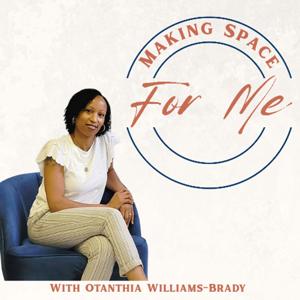
Hosted by Board-Certified Nurse Practitioner, Certified Life Coach, and caregiver Otanthia Williams-Brady, this podcast explores what happens when being capable, dependable, and committed begins to come at the expense of your own health and well-being.
Each episode unpacks the realities that can leave women living at the edge of their capacity and explores what it looks like to recognize what is taking the most out of you, challenge the beliefs and expectations that keep you overextended, and make room for your own needs without walking away from the responsibilities that matter to you.
Otanthia speaks from lived experience, not from the other side of it, offering honest reflection and practical tools you can actually use to support your physical, mental, and emotional well-being.
At the heart of the podcast is a simple philosophy:
Self-priority isn’t selfish—it’s stewardship.
Making Space for Me is an invitation to stop treating your own needs as optional, because you are one of your responsibilities too.