
Sign up to save your podcasts
Or

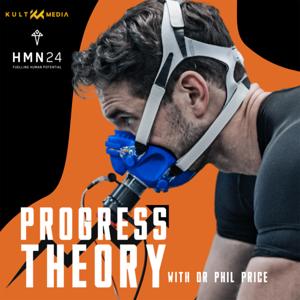

Welcome to another episode of The Progress Theory, where we explore the latest scientific principles to help you optimise your performance. In this episode, Dr Phil Price sits down with Jem Arnold—a physiologist, physiotherapist, and PhD candidate at the University of British Columbia with a fascinating dual focus on high-performance sport and clinical research.
Jem’s work dives deep into individual responses to training and the use of Near Infrared Spectroscopy (NIRS), a cutting-edge wearable technology that measures muscle oxygenation both in the lab and out in the real world.
In this episode, Jem breaks down what NIRS is, how it works, and why its ability to capture local muscle oxygenation is so useful for endurance athletes, hybrid competitors, and anyone interested in interpreting the body’s signals during exercise. Drawing from both his research and personal experience with vascular conditions affecting elite cyclists, Jem shares insights on programming, individual variability, and how blending subjective feedback with objective tech can revolutionise our approach to training.
Whether you’re curious about the next frontier of monitoring tools, want to understand performance plateaus, or just love to geek out on physiology, you’ll find plenty to stimulate your thinking in this conversation. As always, don’t forget to follow The Progress Theory for more episodes and resources. Let’s dive in!
In this episode, we discuss:
NIRS for Real-World Monitoring: Wearable NIRS devices provide invaluable real-time insight into local muscle oxygenation, allowing coaches and athletes to better understand individual physiological responses during both training and competition.
Individual Variability is Key: Jem emphasised that group-level sports science research doesn’t always translate directly to individual athletes. NIRS can help tailor interventions and programming by capturing each athlete’s unique response, especially when combined with subjective reports.
Practical Application Requires Context: Having all the gadgets is great, but Jem highlighted the importance of integrating NIRS data with athlete sensations, performance metrics, and expert guidance. It’s about turning data into tailored, actionable information—don’t let the numbers overwhelm the athlete or the process!
FOLLOW OUR PODCASTFollow our Host / GuestFor all our other episodes and to get in touch, please visit www.theprogresstheory.com.
Thanks for listening!
This podcast is hosted by Captivate, try it yourself for free.
KULT Media 2023
Mentioned in this episode:
Progress Theory Newsletter
The Progress Theory newsletter. If you want the latest information and recommendations on how to optimise your physical and mental performance, then subscribe to the free Progress Theory newsletter on Substack today.
Substack
Podcast Produced By KULT Media
Before we wrap up, I want to give a shout-out and my thanks to my production partner, Kult Media. If you are thinking of launching a podcast or want to grow your audience, head to www.kult.media to get started today.
Kult Media
The Science of Hybrid Training
It was originally thought that you could not effectively train for both strength and endurance at the same time because they required different adaptations which were not compatible with each other. It was claimed that ‘an interference effect’, blunted the adaptations for strength if you simultaneously trained for endurance.
Book
 View all episodes
 By The Progress Theory
5
11 ratings
Welcome to another episode of The Progress Theory, where we explore the latest scientific principles to help you optimise your performance. In this episode, Dr Phil Price sits down with Jem Arnold—a physiologist, physiotherapist, and PhD candidate at the University of British Columbia with a fascinating dual focus on high-performance sport and clinical research.
Jem’s work dives deep into individual responses to training and the use of Near Infrared Spectroscopy (NIRS), a cutting-edge wearable technology that measures muscle oxygenation both in the lab and out in the real world.
In this episode, Jem breaks down what NIRS is, how it works, and why its ability to capture local muscle oxygenation is so useful for endurance athletes, hybrid competitors, and anyone interested in interpreting the body’s signals during exercise. Drawing from both his research and personal experience with vascular conditions affecting elite cyclists, Jem shares insights on programming, individual variability, and how blending subjective feedback with objective tech can revolutionise our approach to training.
Whether you’re curious about the next frontier of monitoring tools, want to understand performance plateaus, or just love to geek out on physiology, you’ll find plenty to stimulate your thinking in this conversation. As always, don’t forget to follow The Progress Theory for more episodes and resources. Let’s dive in!
In this episode, we discuss:
NIRS for Real-World Monitoring: Wearable NIRS devices provide invaluable real-time insight into local muscle oxygenation, allowing coaches and athletes to better understand individual physiological responses during both training and competition.
Individual Variability is Key: Jem emphasised that group-level sports science research doesn’t always translate directly to individual athletes. NIRS can help tailor interventions and programming by capturing each athlete’s unique response, especially when combined with subjective reports.
Practical Application Requires Context: Having all the gadgets is great, but Jem highlighted the importance of integrating NIRS data with athlete sensations, performance metrics, and expert guidance. It’s about turning data into tailored, actionable information—don’t let the numbers overwhelm the athlete or the process!
FOLLOW OUR PODCASTFollow our Host / GuestFor all our other episodes and to get in touch, please visit www.theprogresstheory.com.
Thanks for listening!
This podcast is hosted by Captivate, try it yourself for free.
KULT Media 2023
Mentioned in this episode:
Progress Theory Newsletter
The Progress Theory newsletter. If you want the latest information and recommendations on how to optimise your physical and mental performance, then subscribe to the free Progress Theory newsletter on Substack today.
Substack
Podcast Produced By KULT Media
Before we wrap up, I want to give a shout-out and my thanks to my production partner, Kult Media. If you are thinking of launching a podcast or want to grow your audience, head to www.kult.media to get started today.
Kult Media
The Science of Hybrid Training
It was originally thought that you could not effectively train for both strength and endurance at the same time because they required different adaptations which were not compatible with each other. It was claimed that ‘an interference effect’, blunted the adaptations for strength if you simultaneously trained for endurance.
Book