
Sign up to save your podcasts
Or

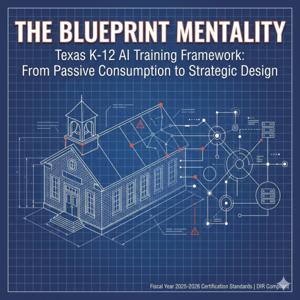

The introduction of Artificial Intelligence (AI) into Texas public education represents a fundamental shift in the educator's relationship with technology. We are moving away from a passive "Consumption" mindset, where teachers react to tools and let software dictate the workflow, toward a "Blueprint Mentality." In this paradigm, the educator is the Architect of the learning experience. This strategic repositioning is essential for instructional sustainability; by establishing governance, clear problem identification, and pedagogical intent before implementation, the Architect uses AI as a tool to unearth the unique genius of every student. This transition is not about working harder, but about designing "shortcuts" for repetitive tasks to reinvest time into human relationships.
 View all episodes
 By Jerry N. Allen, M. Ed.
The introduction of Artificial Intelligence (AI) into Texas public education represents a fundamental shift in the educator's relationship with technology. We are moving away from a passive "Consumption" mindset, where teachers react to tools and let software dictate the workflow, toward a "Blueprint Mentality." In this paradigm, the educator is the Architect of the learning experience. This strategic repositioning is essential for instructional sustainability; by establishing governance, clear problem identification, and pedagogical intent before implementation, the Architect uses AI as a tool to unearth the unique genius of every student. This transition is not about working harder, but about designing "shortcuts" for repetitive tasks to reinvest time into human relationships.