
Sign up to save your podcasts
Or



Based on Podcast App listening data
The decision of OnlyFans and Instagram to ban the porn star Bonnie Blue, who engaged in sequential sex with more than a thousand men in 12 hours, indicates the strength of the backlash of disapproval to the stunt. The reaction of many people has been what the psychologist Jonathan Haidt calls 'moral bafflement', the idea that most of us instinctively condemn some behaviours without being able to say why they are wrong. Western morality says, “don’t hurt other people”, but Bonnie Blue arguably hurt nobody. This was understood to be safe sex between consenting adults (although the psychological or social impact is harder to determine). Others might form their judgments based on values within sacred texts, but religion is no longer the moral and cultural force it once was.
How much attention should we pay to our knee-jerk sense of right and wrong when judging the actions of other people? Evolutionary psychologists describe how the emotion of disgust was a survival mechanism against the spread of disease. Thus, ritual purity, enforced by religious edict, was vital for the moral and spiritual life of our ancestors. But does disgust still carry moral weight in a modern, secular, and technologically advanced society, or is it merely an evolutionary hangover?
Just because we think something is wrong, how do we know that it is? And do we have the right, as a society, to translate our instinctive disapproval into prohibition? What is the moral value of disgust?
Panellists: Ash Sarkar, Tim Stanley, Anne McElvoy and Matthew Taylor.
Witnesses: Stacey Clare, Julie Bindel, Jussi Suikkanen, John Haldane.
Producer: Dan Tierney
The Bank of England has been accused of being the 'Bank of Wokeness' after proposing to cut historical figures from banknotes. Images of Winston Churchill, Jane Austen and Alan Turing could be replaced by images of themes such as nature, innovation, or key events in history. It raises the possibility of British birds, bridges, or bangers and mash featuring on the next series of £5, £10, £20 and £50 notes and would take us down the route favoured by the Euro which feature many an imaginary structure or window. But what do we lose when we potentially erase these historical figures from a place in our pocket? Are they problematic figures who are essentially divisive? Or are we discarding important figures who achieved greatness and still embody moral values? Is the concept of heroism one we need to reject altogether or do stories of human endeavour still represent the best way to promote culture and identity?
PANEL: Anne McElvoy, Ash Sarkar, Matthew Taylor, Tim Stanley
WITNESSES:
Paul Lay, Historian
CHAIR Michael Buerk
Are we at risk of becoming “an island of strangers”? The Prime Minister, backtracking on many fronts, has apologised for the phrase - he says he hadn’t read it properly before he said it – but he’s backed a grand-sounding Independent Commission that’s now at work to fix a society it says is a “tinderbox of division”.
PANELLISTS: INAYA FOLARIN-IMAN, LORD JONATHAN SUMPTION, PROF MONA SIDDIQUI, SONIA SODHA
PRODUCER: Catherine Murray
ID cards are back on the political agenda, digital this time, being pushed by an influential group of Labour MPs, and – surveys suggest – public opinion, which is increasingly worried about illegal immigration and benefit fraud. Time was, when privacy was a free-born Briton’s birthright and a policeman asking for your papers anathema, the mark of foreign dictatorships. We live in a different world now where even your household gadgets are capable of gathering information on you. Is privacy out of date, or a moral good that’s the basis of freedom? Can we no longer tell the state – or Big Tech – to mind their own business, and does it matter?
WITNESSES:
PANELLISTS:
Chaired by Michael Buerk
The National Health Service is at a crossroads. Systemic pressures are lengthening hospital waiting times. Resources are finite. That’s why the government is coming up with a 10 year plan to make the NHS ‘fit for purpose’. But what is the ethical purpose of the NHS?
Michael Buerk chairs a special debate at the Nuffield Trust Summit 2025.
Producer: Dan Tierney
Panel:
Witnesses:
Self-defence, as a justification for war, is much more difficult to argue if you strike the first blow. The Israelis say their devastating pre-emptive strike on Iran is a special, truly existential, case. A regime, long committed to their destruction was, according to Israel, within weeks of developing nuclear weapons, just one of which could effectively wipe out their state and most of its citizens.
Witnesses:
Panellists:
Presenter: Michael Buerk
There’s been a fair amount of focus on the concept of pronatalism recently and debate over whether it is left or right wing for governments to introduce policies that encourage women to have more babies. Others argue that the matter is too big to be consumed by the culture wars.
This week, the United Nations Population Fund issued its strongest statement yet on fertility decline, warning that hundreds of millions of people are not able to have the number of children they want, citing the prohibitive cost of parenthood and the lack of a suitable partner as some of the reasons affecting birth rates across the world.
For a country in the developed world to increase or maintain its population, it needs a birth rate of 2.1 children per woman on average. Last year in the UK, it fell to 1.4. Like many developed nations, women are having fewer babies, which poses economic problems as countries face the impact of both aging and declining populations, and a smaller workforce in relation to the number of pensioners.
Why are people in richer nations choosing to have fewer babies? Has parenthood had a bad press? Is it too expensive to have kids or do people just wait too long to tick off life goals before they realise their fertility window has closed?
And is it manipulative for governments to encourage women to have more children? For some, a low birth rate is the sign of a civilised society where women have reproductive autonomy. Is there a moral duty to have children?
PRESENTER Michael Buerk
Almost the first thing the newly chosen Pope Leo XIV did was to warn of the dangers of Artificial intelligence, of technological advance outstripping human wisdom. AI promises unapparelled efficiency, streamlined lives, complex problems solved in milliseconds. But will it make humans redundant literally and metaphorically? Will it hijack creativity? Will it imprison us in our prejudices? Will it destroy the concept of objective truth? AI: Promise or Peril? was recorded at The Hay Literary Festival
Witnesses:
Panellists:
Producers: Catherine Murray & Peter Everett
President Trump has imposed tariffs on all America’s trade; China has hit back; other nations, including our own, are working out how to cope with what Sir Keir Starmer has called a “new world” governed by “deals and alliances” rather than rules. In this crisis, we have turned to the economists, who argue about percentages. But shouldn't we be asking – what is the moral thing to do?
Trump’s ‘MAGA’ project always said it wanted tariff barriers to revive US industry and rebalance world trade; the American voters chose that strong medicine; now they – and the rest of the world – must swallow it. The first question is not whether it will work; time will tell. The first question is: given the consequences for the whole world, does Trump have a moral right to exercise that mandate?
The second question is the one that confronts Britain, and all the other nations that have been reliant (perhaps too reliant) on trade and co-operation with America. It is not about numbers but about morality. The three most influential economic philosophers in history – Adam Smith, Karl Marx and J.M.Keynes – reached different conclusions about it.
Is free trade a moral good?
Chair: Michael Buerk
Panel:
Witnesses:
The Netflix drama ‘Adolescence’ has prompted a national conversation about a ‘crisis of masculinity’. In a society where gender roles are changing, progressive attitudes are in tension with traditional ideas about male behaviour.
Studies suggest Gen Z men and women are more divided than those of any other generation on questions about feminism, gender roles and women’s rights. Meanwhile, teachers highlight the alarming prevalence of misogyny in schools, influencers can be influential than parents, and social media algorithms amplify misogynistic content to teens. This is happening at the same time as rising rates of depression, anxiety, and a higher likelihood of suicide among young men.
Traditional ideas about ‘manliness’ - strength, dominance, independence, and emotional stoicism - are seen in many contexts as inappropriate and harmful – both to men and women. While the feminist movement and women’s advances in education and the workplace, for example, are a mark of social progress, some believe they have also challenged men’s sense of purpose in a way that has perhaps been overlooked. Others think this analysis is dangerous because it doesn’t apply to all men, it sets up men's mental health and wellbeing in opposition to the opportunities of women, and denies some men the agency to make the right choices. At the same time, it can be uncomfortable to discuss how men and women are different – physically and psychologically – and how they might have different and complementary roles.
Do we need to re-define or reclaim masculinity? What’s wrong with men?
Chair: Michael Buerk
Panel:
Witnesses:
From the publisher's feed
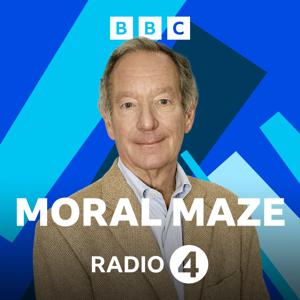
Combative, provocative and engaging live debate examining the moral issues behind one of the week's news stories. #moralmaze
Ranked by our users in the last 21 days

7,624 Listeners
873 Listeners
1,050 Listeners

157 Listeners

5,486 Listeners

1,798 Listeners

1,811 Listeners
1,036 Listeners
2,104 Listeners

1,903 Listeners
28 Listeners
34 Listeners

372 Listeners

161 Listeners
41 Listeners
59 Listeners
107 Listeners

690 Listeners
3,219 Listeners

724 Listeners
1,004 Listeners

3,041 Listeners

1,109 Listeners
775 Listeners
30 Listeners