
Sign up to save your podcasts
Or

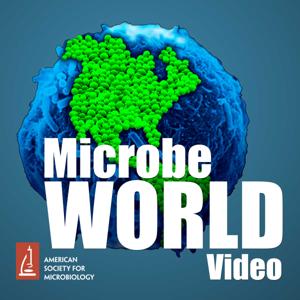

In MicrobeWorld Video episode 66 Dr. Stan Maloy talks with Curtis Suttle, Professor of Earth & Ocean Sciences, Microbiology & Immunology, and Botany, and Associate Dean of Science University of British Columbia.
Dr. Suttle is one of the World's leading marine virologists, and is among a small group of researchers that is credited with launching the field of marine virology. Dr. Maloy talks with Dr. Suttle about the incredible diversity of the ocean's microscopic inhabitants that have long been overlooked.
The oceans are mostly microbial, 98% by weight, which means most of what is going on in the oceans is unseen and until recently largely unknown. Dr. Suttle explains the large role that ocean viruses play in keeping our planet alive. In fact, Dr. Suttle points out that viruses do more to create life than take it away. If you were to take the viruses out of the ocean much of the planet's life-cycle would stop, there would be no more photosynthesis. Viral replication drives the major bio-geochemical cycles on Earth.
Dr. Suttle also discusses transposons, "the world's first immune system," phage and using genomic sequencing to do ecology outside of the lab environment.
This episode was recorded at the American Association for the Advancement of Science Meeting in Vancouver, British Columbia on February 17, 2012.
 View all episodes
 By American Society for Microbiology

4.8
44 ratings
In MicrobeWorld Video episode 66 Dr. Stan Maloy talks with Curtis Suttle, Professor of Earth & Ocean Sciences, Microbiology & Immunology, and Botany, and Associate Dean of Science University of British Columbia.
Dr. Suttle is one of the World's leading marine virologists, and is among a small group of researchers that is credited with launching the field of marine virology. Dr. Maloy talks with Dr. Suttle about the incredible diversity of the ocean's microscopic inhabitants that have long been overlooked.
The oceans are mostly microbial, 98% by weight, which means most of what is going on in the oceans is unseen and until recently largely unknown. Dr. Suttle explains the large role that ocean viruses play in keeping our planet alive. In fact, Dr. Suttle points out that viruses do more to create life than take it away. If you were to take the viruses out of the ocean much of the planet's life-cycle would stop, there would be no more photosynthesis. Viral replication drives the major bio-geochemical cycles on Earth.
Dr. Suttle also discusses transposons, "the world's first immune system," phage and using genomic sequencing to do ecology outside of the lab environment.
This episode was recorded at the American Association for the Advancement of Science Meeting in Vancouver, British Columbia on February 17, 2012.

63,929 Listeners

11,437 Listeners

1,083 Listeners

1,226 Listeners
943 Listeners

3,828 Listeners
901 Listeners

2,882 Listeners
1,535 Listeners
8,304 Listeners