
Sign up to save your podcasts
Or

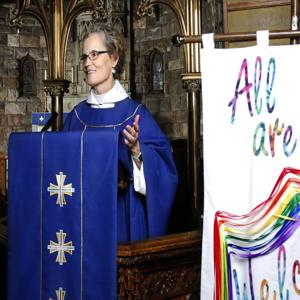

Palm Sunday – March 29, 2026 – May God’s words be spoken, may God’s words be heard. Amen.
Now, if you’ve been coming here awhile, than you already know that this should just be Palm Sunday, with the passion being our Holy Week journey. Still, we do include it because Easter without the passion is an empty experience, and some will not be able to attend on Maundy Thursday & Good Friday.
And as in past years, the Dzieci Theatre company will push our imaginations, engage our senses, and challenge our assumptions in the second half of our service as they envelope us in the experience of Christ’s passion. But, let’s not go there yet. Let’s give the reading from Matthew, about the entry of Jesus into Jerusalem, its due.
It’s a rather odd telling of this moment. There are cloaks and branches, not palms. Which was also almost our experience too, as these palms we have today got sidetracked by FedEx. And, unlike in the other gospels, Jesus doesn’t mount one animal, but two. I mean, you can almost imagine it looking like one of those rodeo tricks – the cowgirl on with a foot on each animal? How the heck is he doing that, and even more to the point – why on earth is he doing that?
Well, the short answer is that it ties Jesus directly to messianic prophesy – found not only in Zechariah, as quoted here (and as we heard earlier in the service before the procession), but also in Genesis 49. The author Matthew is making it clear that Jesus is the Messiah whose reign would not end until he drew all people to himself.
But this author is also telling us that the people who greet him with praise, did not understand who he is, and the moment they were in. When some asked “Who is this?” Others answered that Jesus was a prophet from Galilee. This sets the stage for what will happen to Jesus.
But there is another part to this gospel, something we will see if we read Matthew through the crucifixion to the resurrection. The text says “the whole city was in turmoil asking about him.” Yet the word turmoil is not exactly describing it. The Greek word here is σεισμός, which means earthquake, shaking, big commotion. It occurs again just after his death on the cross, and again as the women get to the tomb. Things aren’t just a bit puzzling, everything was moving chaotically. That’ll get your attention, just like it did the guards at the cross and the women at the tomb.
Does it get ours?
Because even while the people in Jerusalem didn’t quite get it, the question they ask is one being asked today – of each one of us.
The church is being asked to declare who we are as the body of Christ in this earthquake moment in which we together live, where empire crushes the vulnerable. What will be the crowds response if asked about us? Will we show them who we are, as Jesus did, even if they don’t understand, even if they turn against us?
These are questions for us today on this Palm Sunday, as much as they were for those there in Jerusalem so long ago.
Jesus knew this would happen to him – he entered into this city, at this tense moment, opposite the powerful Roman military – and he knew that, while the people in the crowds may not fully understand, his disciples needed to.
So, after he enters into the city, Jesus teaches his disciples a number of things, both in word and in deed. First, Jesus goes to the temple, overturns some tables, and heals the sick. Then, he offers them perhaps the most important lesson they, or we, will receive. It was about who he is. Maybe he heard the crowds, or maybe he thought his disciples still didn’t understand, so he answered the crowd’s question.
Using the setting of a final judgement, he said about those who will be declared righteous, “…for I was hungry and you gave me food, I was thirsty and you gave me something to drink, I was a stranger and you welcomed me, I was naked and you gave me clothing, I was sick and you took care of me, I was in prison and you visited me.” When perplexed as to how they had done that, the answer came, “Truly I tell you, just as you did it to one of the least of these who are members of my family, you did it to me.”
And finally, Jesus takes it a step further, washing the feet of his disciples as a model of servant ministry, a symbol of his commandment to love one another as he loved us.
“Who is this?” the crowd asked.
“Who is Jesus?” we need to understand the answer to, and it is this: Jesus is the stranger, the imprisoned, the hungry, the sick – the one who overturns the tables of injustice – who heals the broken ones – the loving servant – the crucified one.
Why then would he be crucified – how could a government do that to another human being., or how could the people allow it to happen?
It is questions like these that make this Passion we will experience here today by Dzieci is so powerful, because it is set – not in the ancient near east – but in the Warsaw ghetto of our 20th century. A Nazi created neighborhood prison, where the death toll among the Jewish inhabitants of is estimated to have been at least 400,000. This setting is a reminder to us of what can happen when we fail to understand who Jesus is as his followers. This is what can happen when we turn our backs on the crosses being erected outside our city walls. When we look at another as being “them” rather than “Him.” When we think – “that’ll never happen here – not in the US, not in my neighborhood.”
But, the passion sadly isn’t something that just happened over 2,000 years ago. The passion is a story happening through the centuries up to this very moment, because Jesus is being crucified all over the world, not only by governments, but by our own greed, hatred, and neglect. The crucifixion of Jesus, is happening today, because today – Jesus is Alex Pretti, Renee Good, Liam Ramos, Lumos Campos, Ruben Ray Martinez, and all the other people killed, injured, unlawfully deported or detained. Jesus is the 150 Iranian girls and other civilians, killed by our bombs, and the US Servicemen and women killed in our unjustified war with Iran. Jesus is the farmer struggling to make ends meet, the mother with no food for her children, and the homeless veteran. Jesus is the LGBTQ+ person rejected by others. Jesus is the Epstein victim and all other women or girls trafficked. Jesus is the person of color afraid to grocery shop or go to school in our country for fear of being disappeared by masked Federal Agents. Jesus is the prisoner, the hungry poor, the neglected, and the oppressed.
But on this Palm Sunday, Jesus is also the one who enters into the public sphere with authority and overturns tables, even as empire threatens all around, even as he can see the cross looming ahead for him. What can we learn from all of this?
During Lent, a few of us have been reading together a book, “For Such A Time As This: An Emergency Devotional,” by Hanna Reichel. In it, the author writes this: “As a scholar, I have closely studied this nation. It prided itself in its influence in the world, its intellectual leadership, its technological innovation, its economic prowess. But as global orders shifted, its social and political system, built for simpler times, crumbled… Polarization increased and made coalition building ever less feasible. Widening gaps led to social unrest economic instability and even violence in the streets. The nation was overwhelmed and disoriented… Special leaders claiming for themselves special powers rode waves of public disgruntlement against immigrants, intellectuals, and those visibly “other.” Democratic processes were manipulated, checks and balances hollowed out. Executive overreach became the order of the day.
The nation I am talking about is Germany; the time is roughly a century ago. But maybe my description sounded familiar to you today. Maybe, like me, you find yourself thinking: we have been here before…We’ve been here before. You won’t like what happens next.” Reichel then asks: “What should the church’s response be?”
Or, as Matthew might put it: “Who are you?”
There were many in the church who complied with the Nazi’s, even siding with them. In the decades since, many in Christendom have had to atone for this sinful inhumanity and shameful lack of courage. But there were others – those in what was called the Confessing Church – some of whom came late to it, others who resisted from the start. Deitrich Bonhoeffer is one of the more famous examples, but there were far more. But something Bonhoeffer was very clear about, “…the church is not a building, but is also not a people. It is the body of Christ.”[1]
And as the body of Christ in the world, we too need to enter our proverbial Jerusalem – not on military horses with weapons, but as Jesus did – with a message of hope, healing, grace, and love – and some righteous anger to topple the tables of injustice too.
And that is what many of us were a part of yesterday in the latest “No Kings” march – the largest single day of protest in the history of the United States – with 8 million people and rising in every state, and nearly every single county across our country. Joining with others of different faiths, or none at all, we were proclaiming that might does not make right – that we will not bend the knee to any President. In signs and voice, we said we will not turn our backs on our neighbors – immigrants, people of color, LGBTQ+, women, children, the poor. We will not allow them to be crucified. We will protect them, love them, and stand by their side. Because in them, we see Jesus, and we are called to love and serve him – not any imagined earthly “King.”
And for me and many other parts of the body of Christ, we also proclaimed emphatically that Christian Nationalism is a heresy. Jesus did not enter Jerusalem to cooperate with Rome, or align himself with Pilate – and neither will we allow him to be used as a tool of the powerful to oppress the vulnerable.
We didn’t create the σεισμός – we WERE the earthquake!
Did we do this weapons or violence? No. We did this the same way Jesus did and for the same reason too. Mercy and love is what shakes the city to its core, not abusive power. Think of how our own empire today wanted protestors to become violent – doing all they could to provoke them so the Insurrection Act could be brought out., and the people subdued by violence. But, Portland Oregon showed us the way – they came in inflatable frog costumes.
Why? Maybe for the same reason Jesus enters Jerusalem on two animals. Not because this isn’t a serious moment. No. Instead to meet the moment – to meet violence and hostility with love and joy. In protests since Portland, violence and power have been met with shouts of kindness, songs, and peaceful opposition. And you know what? That is the scariest thing any dictator could ever see.
Jesus knew that too.
And so, as the body of Christ today, many of us met that moment yesterday, and have been for many, many years. And we will keep doing it too. We must, because if we do not, then we are as clueless as those in Jerusalem so long ago as to who Jesus is, and who we are as his followers.
Reichel in that same book ,when talking about what we do here on Sundays, said “There is no gathering without sending. The miracle of real community is a special blessing that strengthens us for everyday existence…The cross is a part of Christian life. Where we try to avoid it, we just end up putting others on it…The Christian belongs out in the world. Blessing turns into temptation when we use community to escape the world…”
Or, as I have said for years – going to church on Sunday is not the destination, it is where we get strength for the journey – the journey to Jerusalem.
And so we have a question to ask ourselves this Palm Sunday – the same one asked about Jesus. Who are we as the body of Christ?
In this time of empire and oppression, when Christ is being crucified will we head to Jerusalem to overturn the tables of injustice?
In this time of σεισμός, where it seems the world we knew is falling apart, will we move into the danger with grace and humility, love and righteous anger?
Because make no mistake about it – The cross IS a part of the Christian life. The Christian belongs out in the world – and each and every one of you – every follower of Jesus – was made for such a time as this.
Amen.
[1] “For Such A Time,” Reichel.
For the audio, click below, or subscribe to our iTunes Sermon Podcast by clicking here (also available on Audible):
Sermon Podcast
Rev. Diana L. Wilcox
Christ Church in Bloomfield & Glen Ridge
March 29, 2026
Palm Sunday
1st Reading – Isaiah 50:4-9a
Psalm 31:9-16
2nd Reading – Philippians 2:5-11
Gospel – Matthew 21:1-11
 View all episodes
 By The Rev. Diana L. Wilcox
5
88 ratings
Palm Sunday – March 29, 2026 – May God’s words be spoken, may God’s words be heard. Amen.
Now, if you’ve been coming here awhile, than you already know that this should just be Palm Sunday, with the passion being our Holy Week journey. Still, we do include it because Easter without the passion is an empty experience, and some will not be able to attend on Maundy Thursday & Good Friday.
And as in past years, the Dzieci Theatre company will push our imaginations, engage our senses, and challenge our assumptions in the second half of our service as they envelope us in the experience of Christ’s passion. But, let’s not go there yet. Let’s give the reading from Matthew, about the entry of Jesus into Jerusalem, its due.
It’s a rather odd telling of this moment. There are cloaks and branches, not palms. Which was also almost our experience too, as these palms we have today got sidetracked by FedEx. And, unlike in the other gospels, Jesus doesn’t mount one animal, but two. I mean, you can almost imagine it looking like one of those rodeo tricks – the cowgirl on with a foot on each animal? How the heck is he doing that, and even more to the point – why on earth is he doing that?
Well, the short answer is that it ties Jesus directly to messianic prophesy – found not only in Zechariah, as quoted here (and as we heard earlier in the service before the procession), but also in Genesis 49. The author Matthew is making it clear that Jesus is the Messiah whose reign would not end until he drew all people to himself.
But this author is also telling us that the people who greet him with praise, did not understand who he is, and the moment they were in. When some asked “Who is this?” Others answered that Jesus was a prophet from Galilee. This sets the stage for what will happen to Jesus.
But there is another part to this gospel, something we will see if we read Matthew through the crucifixion to the resurrection. The text says “the whole city was in turmoil asking about him.” Yet the word turmoil is not exactly describing it. The Greek word here is σεισμός, which means earthquake, shaking, big commotion. It occurs again just after his death on the cross, and again as the women get to the tomb. Things aren’t just a bit puzzling, everything was moving chaotically. That’ll get your attention, just like it did the guards at the cross and the women at the tomb.
Does it get ours?
Because even while the people in Jerusalem didn’t quite get it, the question they ask is one being asked today – of each one of us.
The church is being asked to declare who we are as the body of Christ in this earthquake moment in which we together live, where empire crushes the vulnerable. What will be the crowds response if asked about us? Will we show them who we are, as Jesus did, even if they don’t understand, even if they turn against us?
These are questions for us today on this Palm Sunday, as much as they were for those there in Jerusalem so long ago.
Jesus knew this would happen to him – he entered into this city, at this tense moment, opposite the powerful Roman military – and he knew that, while the people in the crowds may not fully understand, his disciples needed to.
So, after he enters into the city, Jesus teaches his disciples a number of things, both in word and in deed. First, Jesus goes to the temple, overturns some tables, and heals the sick. Then, he offers them perhaps the most important lesson they, or we, will receive. It was about who he is. Maybe he heard the crowds, or maybe he thought his disciples still didn’t understand, so he answered the crowd’s question.
Using the setting of a final judgement, he said about those who will be declared righteous, “…for I was hungry and you gave me food, I was thirsty and you gave me something to drink, I was a stranger and you welcomed me, I was naked and you gave me clothing, I was sick and you took care of me, I was in prison and you visited me.” When perplexed as to how they had done that, the answer came, “Truly I tell you, just as you did it to one of the least of these who are members of my family, you did it to me.”
And finally, Jesus takes it a step further, washing the feet of his disciples as a model of servant ministry, a symbol of his commandment to love one another as he loved us.
“Who is this?” the crowd asked.
“Who is Jesus?” we need to understand the answer to, and it is this: Jesus is the stranger, the imprisoned, the hungry, the sick – the one who overturns the tables of injustice – who heals the broken ones – the loving servant – the crucified one.
Why then would he be crucified – how could a government do that to another human being., or how could the people allow it to happen?
It is questions like these that make this Passion we will experience here today by Dzieci is so powerful, because it is set – not in the ancient near east – but in the Warsaw ghetto of our 20th century. A Nazi created neighborhood prison, where the death toll among the Jewish inhabitants of is estimated to have been at least 400,000. This setting is a reminder to us of what can happen when we fail to understand who Jesus is as his followers. This is what can happen when we turn our backs on the crosses being erected outside our city walls. When we look at another as being “them” rather than “Him.” When we think – “that’ll never happen here – not in the US, not in my neighborhood.”
But, the passion sadly isn’t something that just happened over 2,000 years ago. The passion is a story happening through the centuries up to this very moment, because Jesus is being crucified all over the world, not only by governments, but by our own greed, hatred, and neglect. The crucifixion of Jesus, is happening today, because today – Jesus is Alex Pretti, Renee Good, Liam Ramos, Lumos Campos, Ruben Ray Martinez, and all the other people killed, injured, unlawfully deported or detained. Jesus is the 150 Iranian girls and other civilians, killed by our bombs, and the US Servicemen and women killed in our unjustified war with Iran. Jesus is the farmer struggling to make ends meet, the mother with no food for her children, and the homeless veteran. Jesus is the LGBTQ+ person rejected by others. Jesus is the Epstein victim and all other women or girls trafficked. Jesus is the person of color afraid to grocery shop or go to school in our country for fear of being disappeared by masked Federal Agents. Jesus is the prisoner, the hungry poor, the neglected, and the oppressed.
But on this Palm Sunday, Jesus is also the one who enters into the public sphere with authority and overturns tables, even as empire threatens all around, even as he can see the cross looming ahead for him. What can we learn from all of this?
During Lent, a few of us have been reading together a book, “For Such A Time As This: An Emergency Devotional,” by Hanna Reichel. In it, the author writes this: “As a scholar, I have closely studied this nation. It prided itself in its influence in the world, its intellectual leadership, its technological innovation, its economic prowess. But as global orders shifted, its social and political system, built for simpler times, crumbled… Polarization increased and made coalition building ever less feasible. Widening gaps led to social unrest economic instability and even violence in the streets. The nation was overwhelmed and disoriented… Special leaders claiming for themselves special powers rode waves of public disgruntlement against immigrants, intellectuals, and those visibly “other.” Democratic processes were manipulated, checks and balances hollowed out. Executive overreach became the order of the day.
The nation I am talking about is Germany; the time is roughly a century ago. But maybe my description sounded familiar to you today. Maybe, like me, you find yourself thinking: we have been here before…We’ve been here before. You won’t like what happens next.” Reichel then asks: “What should the church’s response be?”
Or, as Matthew might put it: “Who are you?”
There were many in the church who complied with the Nazi’s, even siding with them. In the decades since, many in Christendom have had to atone for this sinful inhumanity and shameful lack of courage. But there were others – those in what was called the Confessing Church – some of whom came late to it, others who resisted from the start. Deitrich Bonhoeffer is one of the more famous examples, but there were far more. But something Bonhoeffer was very clear about, “…the church is not a building, but is also not a people. It is the body of Christ.”[1]
And as the body of Christ in the world, we too need to enter our proverbial Jerusalem – not on military horses with weapons, but as Jesus did – with a message of hope, healing, grace, and love – and some righteous anger to topple the tables of injustice too.
And that is what many of us were a part of yesterday in the latest “No Kings” march – the largest single day of protest in the history of the United States – with 8 million people and rising in every state, and nearly every single county across our country. Joining with others of different faiths, or none at all, we were proclaiming that might does not make right – that we will not bend the knee to any President. In signs and voice, we said we will not turn our backs on our neighbors – immigrants, people of color, LGBTQ+, women, children, the poor. We will not allow them to be crucified. We will protect them, love them, and stand by their side. Because in them, we see Jesus, and we are called to love and serve him – not any imagined earthly “King.”
And for me and many other parts of the body of Christ, we also proclaimed emphatically that Christian Nationalism is a heresy. Jesus did not enter Jerusalem to cooperate with Rome, or align himself with Pilate – and neither will we allow him to be used as a tool of the powerful to oppress the vulnerable.
We didn’t create the σεισμός – we WERE the earthquake!
Did we do this weapons or violence? No. We did this the same way Jesus did and for the same reason too. Mercy and love is what shakes the city to its core, not abusive power. Think of how our own empire today wanted protestors to become violent – doing all they could to provoke them so the Insurrection Act could be brought out., and the people subdued by violence. But, Portland Oregon showed us the way – they came in inflatable frog costumes.
Why? Maybe for the same reason Jesus enters Jerusalem on two animals. Not because this isn’t a serious moment. No. Instead to meet the moment – to meet violence and hostility with love and joy. In protests since Portland, violence and power have been met with shouts of kindness, songs, and peaceful opposition. And you know what? That is the scariest thing any dictator could ever see.
Jesus knew that too.
And so, as the body of Christ today, many of us met that moment yesterday, and have been for many, many years. And we will keep doing it too. We must, because if we do not, then we are as clueless as those in Jerusalem so long ago as to who Jesus is, and who we are as his followers.
Reichel in that same book ,when talking about what we do here on Sundays, said “There is no gathering without sending. The miracle of real community is a special blessing that strengthens us for everyday existence…The cross is a part of Christian life. Where we try to avoid it, we just end up putting others on it…The Christian belongs out in the world. Blessing turns into temptation when we use community to escape the world…”
Or, as I have said for years – going to church on Sunday is not the destination, it is where we get strength for the journey – the journey to Jerusalem.
And so we have a question to ask ourselves this Palm Sunday – the same one asked about Jesus. Who are we as the body of Christ?
In this time of empire and oppression, when Christ is being crucified will we head to Jerusalem to overturn the tables of injustice?
In this time of σεισμός, where it seems the world we knew is falling apart, will we move into the danger with grace and humility, love and righteous anger?
Because make no mistake about it – The cross IS a part of the Christian life. The Christian belongs out in the world – and each and every one of you – every follower of Jesus – was made for such a time as this.
Amen.
[1] “For Such A Time,” Reichel.
For the audio, click below, or subscribe to our iTunes Sermon Podcast by clicking here (also available on Audible):
Sermon Podcast
Rev. Diana L. Wilcox
Christ Church in Bloomfield & Glen Ridge
March 29, 2026
Palm Sunday
1st Reading – Isaiah 50:4-9a
Psalm 31:9-16
2nd Reading – Philippians 2:5-11
Gospel – Matthew 21:1-11