Host: Peter Wagner, Executive Director, Prison Policy Initiative
Guests:
Sarah Walker and Mark Haase of the Minnesota Second Chance Coalition
June, 2010
Transcript:
Peter Wagner:
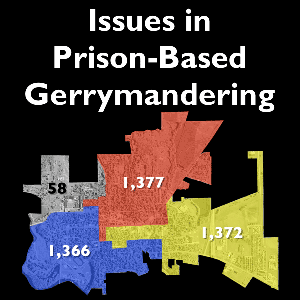
Welcome to Issues in Prison-Based Gerrymandering, a podcast about keeping the Census Bureau’s prison count from harming our democracy. The Census Bureau counts people in prison as if they were actual residents of their prison cells, even though most state laws say that people in prison are residents of their homes. When prison counts are used to pad legislative districts, the weight of a vote starts to differ. If you live next to a large prison, your vote is worth more than one cast in a district without prisons. Prison-based gerrymandering distorts state legislative districts and has been known to create county legislative districts that contain more prisoners than voters.
On each episode, we’ll talk with different voting rights experts about ways in which state and local governments can change the census and avoid prison-based gerrymandering.
Our guests today are Sarah Walker and Mark Haase of the Minnesota Second Chance Coalition. Welcome Sarah and Mark.
Sarah Walker:
Thank you.
Mark Haase:
Thanks Peter, glad to be here.
Peter Wagner:
Can you tell us about the Minnesota Second Chance Coalition?
Sarah Walker:
Sure, the Minnesota Second Chance Coalition started in 2007 after a group of non-profit leaders came together and decided that we needed a lobbying day on justice reform issues to advocate for people with criminal records, and also a way to incorporate their voices because Minnesota, which is highly participatory, has many lobbying days, but there was a glaring omission at the time. We came together and had a lobbying day, and after that first lobbying day in 2008, actually, we realized that we needed a more concerted legislative focus with clear policy goals. From that point we’ve been meeting at least once a month since then to address policy issues, and we support other organizations’ policy agendas and help push other organizations to address justice reform issues.
Mark Haase:
I would just add to that that our current membership is over 45 diverse organizations that work on these issues together.
Sarah Walker:
They range from everything from mental health service providers to peer advocacy organizations to corrections service providers and state agencies. Again it’s just in the acknowledgement of the fact that the justice system has unintentionally touched basically every area of this social service and civic engagement world.
Peter Wagner:
So I understand that the Minnesota Second Chance Coalition has taken up prison-based gerrymandering as one of its issues. Can you tell our audience a little bit about why, because for some people who know that Minnesota has a relatively small prison population they might be surprised to hear about your work.
Sarah Walker:
Well, yes, I think that prison-based gerrymandering is relevant to an organization looking for fair and responsible policies and practices because it recognizes that the justice system has expanded and in its expansion there have been many unintended consequences. Prison-based gerrymandering is one amongst many. But it’s also about the fact that the justice system is related to civic participation and civil society, and that, increasingly, the justice system is touching on all aspects on civil society. It’s intruding into areas that I think people didn’t anticipate.
Mark Haase:



 View all episodes
