
Sign up to save your podcasts
Or

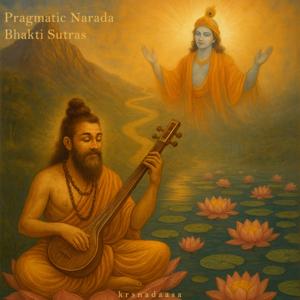

nāradaḥ-tu tad-arpitākhilācāratā tad-vismaraṇe parama-vyākulateti.
नारदःतु - to Devarṣi Nārada indeed; तद्-अर्पित-अखिल-आचारता - dedication of all actions at the altar of the Lord; तद्-विस्मरणे - at all occasions of forgetfulness of the Lord; परम-व्याकुलता - excruciating pang; इति - thus; (is true devotion)
According to Sage Narada, when all thoughts, all words, and all deeds are given up to the Lord, and when the least forgetfulness of God makes one intensely miserable, then we can be said to be experiencing divine bhakti.
After explaining the opinions of Ved Vyasa, Shandilya, and Garga Muni, Narad Ji explains his own opinion of divine love or bhakti. Narad Ji emphasizes complete self-surrender as bhakti.
Narad Ji says that a person in deep bhakti will always offer all their actions as a sacrifice to God. This is very similar to the concept of "renunciation in action" that we learned from the Bhagavad-Gita.
श्रीभगवानुवाच |
अनाश्रित: कर्मफलं कार्यं कर्म करोति य: |
स संन्यासी च योगी च न निरग्निर्न चाक्रिय: ||6.1||
śhrī bhagavān uvācha
anāśhritaḥ karma-phalaṁ kāryaṁ karma karoti yaḥ
sa sannyāsī cha yogī cha na niragnir na chākriyaḥ
One who performs one’s duties and rightful actions without depending upon the fruit of action, is a true sannyasi (renouncer) and of steadfast mind. Not the one who does not handle fire nor the one who performs no action.
The term niragnir means “the one who does not handle fire”, and it refers to renounced beings who depend on alms for their living and do not cook their own food.
Lord Krishna reiterates that the best path towards liberation and spiritual growth lies in action without expectation and not in inaction.
Georg Feuerstein beautifully summarizes this as follows:
“This stanza epitomizes the ideal of inner or symbolic renunciation. i.e, renunciation IN action rather than renunciation OF action.”
Spirituality is not some unique thing that we do. Spirituality is more about how we do whatever we do in our day-to-day lives.
A great example is Raja Janak, who was a great king who ruled the kingdom very effectively and although he had access to enormous wealth, he was not attached to anything and he did everything as an offering to God. Even when he performed his kingly duties, he performed them as an offering and sacrifice to God.
As taught by Shri Krishna in the Bhagavad Gita, 'Jnana' and ‘Karma’ should lead us towards ‘Bhakti’. Jnana is the eyes of Karma. We need to use our eyes to see and work safely. Without Jnana, we cannot perform the right action( Karma). When we perform karma with the guidance of Jnana, it becomes ‘Nishkama Karma’ and the practice of Nishkama Karma yoga leads us towards Bhakti.
So, to grow in bhakti, we are not expected to give up our day to day duties. Instead, we should perform our day to day duties in such a manner (nishkama karma) that it helps us grow in bhakti.
In the 9th chapter of the Bhagavad Gita, Shri Krishna has said:
यत्करोषि यदश्नासि यज्जुहोषि ददासि यत् |
यत्तपस्यसि कौन्तेय तत्कुरुष्व मदर्पणम् ||9.27||
yat karoṣhi yad aśhnāsi yaj juhoṣhi dadāsi yat
yat tapasyasi kaunteya tat kuruṣhva mad-arpaṇam
Whatever you do, whatever you eat, whatever you offer as oblation to the sacred fire, whatever you bestow as a gift, and whatever austerities you perform, O son of Kunti, do them as an offering to Me.
 View all episodes
 By krsnadaasa
nāradaḥ-tu tad-arpitākhilācāratā tad-vismaraṇe parama-vyākulateti.
नारदःतु - to Devarṣi Nārada indeed; तद्-अर्पित-अखिल-आचारता - dedication of all actions at the altar of the Lord; तद्-विस्मरणे - at all occasions of forgetfulness of the Lord; परम-व्याकुलता - excruciating pang; इति - thus; (is true devotion)
According to Sage Narada, when all thoughts, all words, and all deeds are given up to the Lord, and when the least forgetfulness of God makes one intensely miserable, then we can be said to be experiencing divine bhakti.
After explaining the opinions of Ved Vyasa, Shandilya, and Garga Muni, Narad Ji explains his own opinion of divine love or bhakti. Narad Ji emphasizes complete self-surrender as bhakti.
Narad Ji says that a person in deep bhakti will always offer all their actions as a sacrifice to God. This is very similar to the concept of "renunciation in action" that we learned from the Bhagavad-Gita.
श्रीभगवानुवाच |
अनाश्रित: कर्मफलं कार्यं कर्म करोति य: |
स संन्यासी च योगी च न निरग्निर्न चाक्रिय: ||6.1||
śhrī bhagavān uvācha
anāśhritaḥ karma-phalaṁ kāryaṁ karma karoti yaḥ
sa sannyāsī cha yogī cha na niragnir na chākriyaḥ
One who performs one’s duties and rightful actions without depending upon the fruit of action, is a true sannyasi (renouncer) and of steadfast mind. Not the one who does not handle fire nor the one who performs no action.
The term niragnir means “the one who does not handle fire”, and it refers to renounced beings who depend on alms for their living and do not cook their own food.
Lord Krishna reiterates that the best path towards liberation and spiritual growth lies in action without expectation and not in inaction.
Georg Feuerstein beautifully summarizes this as follows:
“This stanza epitomizes the ideal of inner or symbolic renunciation. i.e, renunciation IN action rather than renunciation OF action.”
Spirituality is not some unique thing that we do. Spirituality is more about how we do whatever we do in our day-to-day lives.
A great example is Raja Janak, who was a great king who ruled the kingdom very effectively and although he had access to enormous wealth, he was not attached to anything and he did everything as an offering to God. Even when he performed his kingly duties, he performed them as an offering and sacrifice to God.
As taught by Shri Krishna in the Bhagavad Gita, 'Jnana' and ‘Karma’ should lead us towards ‘Bhakti’. Jnana is the eyes of Karma. We need to use our eyes to see and work safely. Without Jnana, we cannot perform the right action( Karma). When we perform karma with the guidance of Jnana, it becomes ‘Nishkama Karma’ and the practice of Nishkama Karma yoga leads us towards Bhakti.
So, to grow in bhakti, we are not expected to give up our day to day duties. Instead, we should perform our day to day duties in such a manner (nishkama karma) that it helps us grow in bhakti.
In the 9th chapter of the Bhagavad Gita, Shri Krishna has said:
यत्करोषि यदश्नासि यज्जुहोषि ददासि यत् |
यत्तपस्यसि कौन्तेय तत्कुरुष्व मदर्पणम् ||9.27||
yat karoṣhi yad aśhnāsi yaj juhoṣhi dadāsi yat
yat tapasyasi kaunteya tat kuruṣhva mad-arpaṇam
Whatever you do, whatever you eat, whatever you offer as oblation to the sacred fire, whatever you bestow as a gift, and whatever austerities you perform, O son of Kunti, do them as an offering to Me.