
Sign up to save your podcasts
Or

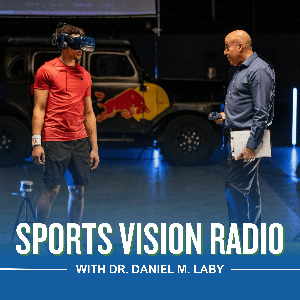

This episode of Sports Visio Radio takes listeners to the iconic Fenway Park, weaving together legendary baseball history with groundbreaking sports vision science. From Ted Williams’ towering home run to Manny Ramirez’s unusual batting focus, the show unravels how elite athletes harness vision in ways far beyond ordinary “20/20 eyesight.”
At the center of the conversation is Dr. Daniel Laby, an ophthalmologist, sports vision specialist, and TEDx speaker at Fenway Park. With decades of experience working with elite athletes, Dr. Laby reveals why hitting a baseball—often called the hardest task in sports—is less about raw reflexes and more about prediction. He explains that a batter has only 100–150 milliseconds to process a pitch, less time than a blink of the eye, making vision and brain processing the ultimate differentiators.
The discussion highlights the limitations of traditional eye exams like the Snellen chart, which fail to replicate real-world, high-speed conditions. Dr. Laby’s innovative vision tests—smaller, lower-contrast targets flashed for fractions of a second—measure how athletes truly perform under game-like stress. His research has shown that MLB players typically see at 20/12, far sharper than average human vision, offering them a measurable edge.
Real-world stories bring this science to life: Stephen Drew’s postseason slump reversed after a simple contact lens prescription identified through advanced testing, and Manny Ramirez’s custom visual training drills, which helped him sharpen his pitch recognition and contributed to his World Series MVP performance. These examples underscore that vision isn’t just an accessory to athletic skill—it can be a game-changing factor when properly measured and trained.
Ultimately, the episode challenges how we think about vision in sports and life. True performance comes not just from clarity of sight but from optimizing the entire perception-to-action loop: seeing, processing, predicting, and executing. Whether at Fenway Park or in everyday challenges, the science of vision reveals there’s always more going on than meets the eye.
Learning Points👉 Don’t forget to subscribe to Sports Vision Radio so you never miss an episode on the science of peak performance.
 View all episodes
 By Daniel M. Laby
This episode of Sports Visio Radio takes listeners to the iconic Fenway Park, weaving together legendary baseball history with groundbreaking sports vision science. From Ted Williams’ towering home run to Manny Ramirez’s unusual batting focus, the show unravels how elite athletes harness vision in ways far beyond ordinary “20/20 eyesight.”
At the center of the conversation is Dr. Daniel Laby, an ophthalmologist, sports vision specialist, and TEDx speaker at Fenway Park. With decades of experience working with elite athletes, Dr. Laby reveals why hitting a baseball—often called the hardest task in sports—is less about raw reflexes and more about prediction. He explains that a batter has only 100–150 milliseconds to process a pitch, less time than a blink of the eye, making vision and brain processing the ultimate differentiators.
The discussion highlights the limitations of traditional eye exams like the Snellen chart, which fail to replicate real-world, high-speed conditions. Dr. Laby’s innovative vision tests—smaller, lower-contrast targets flashed for fractions of a second—measure how athletes truly perform under game-like stress. His research has shown that MLB players typically see at 20/12, far sharper than average human vision, offering them a measurable edge.
Real-world stories bring this science to life: Stephen Drew’s postseason slump reversed after a simple contact lens prescription identified through advanced testing, and Manny Ramirez’s custom visual training drills, which helped him sharpen his pitch recognition and contributed to his World Series MVP performance. These examples underscore that vision isn’t just an accessory to athletic skill—it can be a game-changing factor when properly measured and trained.
Ultimately, the episode challenges how we think about vision in sports and life. True performance comes not just from clarity of sight but from optimizing the entire perception-to-action loop: seeing, processing, predicting, and executing. Whether at Fenway Park or in everyday challenges, the science of vision reveals there’s always more going on than meets the eye.
Learning Points👉 Don’t forget to subscribe to Sports Vision Radio so you never miss an episode on the science of peak performance.