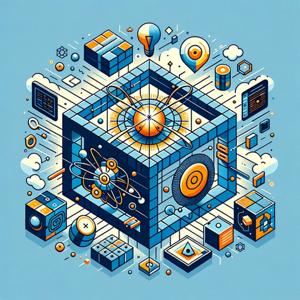
Quantum Computing 101

Quantum-Classical Fusion: Hybrid Computing Redefines Possibility


Listen Later

This is your Quantum Computing 101 podcast.

Today, I want to take you inside the pulse of quantum computing—right where the classical and quantum worlds collide and spark new possibility. Just days ago, D-Wave Quantum declared an achievement that sent a jolt through the field: their quantum annealing processor has reportedly outpaced one of the world’s most powerful classical supercomputers on a complex materials simulation—a demonstration of quantum supremacy that matters for real-world science, not just contrived benchmark problems. The details stagger the mind: what took the classical supercomputer an almost geological epoch—nearly a million years—was completed by D-Wave’s quantum system in mere minutes, using a fraction of the energy. Imagine compressing the labor of entire civilizations into a morning’s work. That’s not hype; that’s the new reality, as published in their recent peer-reviewed work.

I’m Leo, the Learning Enhanced Operator. For years, I’ve studied how the elegance of quantum mechanics can be harnessed to solve problems left untouched by classical computation alone. But today, I want to show you how hybrid quantum-classical solutions—the true fusion reactors of our digital age—are rapidly redefining the very idea of what can be computed.

Let’s get dramatic: picture the MIT labs, still humming after midnight, coaxing superconducting qubits cooled near absolute zero, each bathed in a faint glow of microwave photons. The quarton coupler—a triumph of engineering and imagination—links qubits to microwave resonators an order of magnitude stronger than ever before, enabling faster, cleaner reads of quantum information. To a physicist, this is as momentous as watching DNA being copied for the first time. Faster readout means more operations before decoherence—the quantum equivalent of forgetfulness—creeps in. With these advances, quantum and classical hardware are becoming co-conspirators, orchestrating fault-tolerant computations that could solve molecular mysteries, optimize supply chains, or even accelerate new medicine discovery with dazzling efficiency.

Now, let’s step back—and see how these hybrid systems draw on the strengths of both worlds. Classical computers excel at handling enormous datasets, intricate control logic, and user interfaces. Quantum machines, meanwhile, thrive in domains where entanglement and superposition give that exponential edge—for example, simulating quantum materials or cracking optimization puzzles that are intractable for standard computers. In the past few days, Microsoft Azure and others have doubled down on supporting hybrid approaches, offering platforms where classical processors handle the heavy data load and workflow, while quantum chips take on the “hard quantum core” of a problem. The result? Systems that are greater than the sum of their parts, able to tackle problems neither could approach alone.

Let’s make this vivid. Imagine you’re starting a global logistics company in a world strained by climate challenges. Classical algorithms can optimize routes to a degree—sorting through possibilities like searching for a lost earring in a city. But introduce a hybrid quantum-classical algorithm, and suddenly you’re searching the whole city at once, finding not just one solution but the best solution, with quantum speedups that echo through the supply chain in real time.

What makes today’s breakthroughs so electrifying is the leap beyond theory into tangible results—patents filed, infrastructure built, standards shaped. As I walk through these labs, the buzz isn’t just from the helium compressors keeping qubits chilled, but from teams who sense that the quantum era isn’t just coming—it’s already begun.

And, as always in this field, I see quantum parallels everywhere. Just as superposition allows a quantum bit to be in multiple states at once, the world itself now lives in overlapping realities: what was impossible yesterday has become mandatory today. Those who harness the hybrid—leveraging the best of both quantum and classical—have the power to reshape entire industries, and maybe even the very way we understand information, energy, and intelligence.

So, as we leave today’s episode, let’s remember: the most interesting solutions aren’t purely quantum, or purely classical, but bravely hybrid—standing right at the crossroads, making use of every tool in the universe’s digital toolbox. If you have questions, or if there’s a topic you want me to dive into, send an email to [email protected]. Don’t forget to subscribe to Quantum Computing 101, and remember this has been a Quiet Please Production. For more information, visit quietplease.ai. Until next time—keep thinking quantum.

For more http://www.quietplease.ai


Get the best deals https://amzn.to/3ODvOta

This content was created in partnership and with the help of Artificial Intelligence AI
...more
View all episodesView all episodes
Download on the App Store

Quantum Computing 101By Inception Point Ai

  • 2.3
  • 2.3
  • 2.3
  • 2.3
  • 2.3

2.3

3 ratings


More shows like Quantum Computing 101

View all
TED Talks Daily by TED

TED Talks Daily

11,037 Listeners

StarTalk Radio by Neil deGrasse Tyson

StarTalk Radio

14,322 Listeners

Odd Lots by Bloomberg

Odd Lots

1,936 Listeners

WSJ Tech News Briefing by The Wall Street Journal

WSJ Tech News Briefing

1,644 Listeners

Uncanny Valley | WIRED by WIRED

Uncanny Valley | WIRED

502 Listeners

Science Friday by Science Friday and WNYC Studios

Science Friday

6,401 Listeners

Heavyweight by Pushkin Industries

Heavyweight

17,744 Listeners

The Daily by The New York Times

The Daily

112,408 Listeners

Stupid Qubit - Quantum Computing for the Clueless by Jim Mortleman & Stuart Houghton

Stupid Qubit - Quantum Computing for the Clueless

13 Listeners

All-In with Chamath, Jason, Sacks & Friedberg by All-In Podcast, LLC

All-In with Chamath, Jason, Sacks & Friedberg

9,927 Listeners

Hard Fork by The New York Times

Hard Fork

5,512 Listeners

Forwards & Backwards: A History of Quantum Computing by Sebastian Hassinger

Forwards & Backwards: A History of Quantum Computing

13 Listeners

The New Quantum Era - innovation in quantum computing, science and technology by Sebastian Hassinger

The New Quantum Era - innovation in quantum computing, science and technology

41 Listeners

The AI Daily Brief: Artificial Intelligence News and Analysis by Nathaniel Whittemore

The AI Daily Brief: Artificial Intelligence News and Analysis

610 Listeners

Prof G Markets by Vox Media Podcast Network

Prof G Markets

1,427 Listeners