After the Uniform: Why Veterans Keep Struggling (And the System That Breaks the Pattern)TAP class prepared you to write a résumé. It didn't prepare you for the moment you realized the résumé is the first time in your career you've had to explain to someone else why you matter.For 10, 15, 20 years, you never had to answer the identity question. Your rank answered it. Your rate answered it. Your unit patch, your chain of command, your fitness report — all of it told you exactly who you were, what you were worth, and where you stood. The military is one of the most sophisticated identity-formation systems ever built. It works because it's total. And it works right up until the day you separate.Then you walk out the gate. And quietly, without anyone naming it, your reference point for identity walks out with it.What follows isn't just a career transition. It's an identity vacuum. And into that vacuum, a story moves in. A story about who you are without the uniform. Whether your leadership translates. Whether you belong in the civilian world. Whether the last 20 years were about the character underneath — or just the costume on top.That story, left unexamined, becomes the engine behind every hard conversation you're either avoiding or mishandling. At work: the clarity you're not providing your civilian team because the internal story says if they don't hit the mark, it reflects on you — and if it reflects on you, maybe you're only effective inside a system. At home: the "I'm fine" that shuts down every conversation before it starts, because that's the phrase that kept you functional in a berthing compartment, on deployment, in every environment where processing emotion was a liability. It worked there. In your marriage, it's an avoidance pattern.In this episode of The Tension Lab, 25-year Navy veteran and leadership coach Rudy Swigart maps the full loop — the feedback circuit running between your internal story and your external conversations and gives you the two-tool system that breaks it.Tool 1: The Story Audit. Think of it as your interior intel brief. Before you step into any hard conversation, you gather ground truth on what's actually happening inside. What story are you telling about the situation? What are you telling yourself about yourself because of it? What are the confirmed facts — not what you're inferring, not what you suspect — just facts? Where are the assumptions? What else could be true? And how do you want to show up regardless? That last question is the one that reveals character. Short-timer syndrome — checking out mentally before the actual exit — is a choice. So is showing up fully. Which one represents who you are?Tool 2: The Conversation Clarity Grid. Once the story is audited and you're grounded, this is your op order for the hard conversation. Define the objective: is this a clarity conversation, a correction conversation, or a connection conversation? Set the tone — because in the military you were trained on the what, and the civilian gap is almost always the how. And define the end state before you initiate, because you don't execute without a defined objective.Internal before external. Every time. You wouldn't walk into a complex operation without an intel brief and an op order. Don't walk into a hard conversation without them either.This episode also goes to the conversation most veterans are not having with themselves — the identity conversation that no transition assistance program ever facilitates. Who are you when you're not defined by rank, rate, unit, mission, or chain of command? That question, left unaddressed, is the source of every other avoidance pattern in the transition. And answering it isn't weakness. It's the most important mission debrief of your career.The leadership that echoes through your home, your team, and your community isn't the rank you used to carry. It's the character that was underneath the rank all along. The mission continues. The uniform just changed.
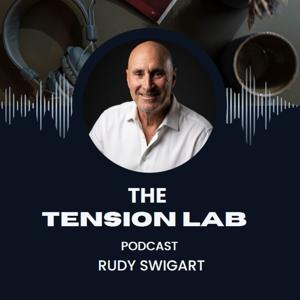
The Tension Lab with Rudy Swigart Most leaders are running on empty — but nobody's talking about it. The Tension Lab is the podcast for high-capacity leaders who are tired of performing fine while quietly burning out. Hosted by Rudy Swigart — burnout prevention coach, organizational consultant, and founder of the Relational Impact Institute — each episode goes beneath the surface to explore what it actually costs to lead at this level, and what it takes to sustain it. Rudy brings a rare combination of clinical insight, business acumen, and personal faith to conversations about identity, relational health, emotional resilience, and the pressure that high-capacity people too often carry alone. Whether you lead a corporation, a nonprofit, or a faith community, this show is your permission to stop white-knuckling it — and start stewarding the tension instead. Episodes feature honest conversations, practical frameworks, and the kind of truth-telling that most leadership content is too polished to offer. You don't have to be broken to get better. You just have to be willing. The Tension Lab — because the most important work happens under pressure.



 View all episodes
