This is your Silicon Siege: China's Tech Offensive podcast.
I’m Ting, and listeners, let’s jack straight into Silicon Siege, because the last two weeks of China-versus-US cyber is basically a live‑fire R&D warzone.
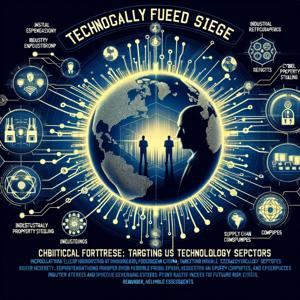
Picture this: in the span of days, US semiconductor, cloud, and telecom firms got hit with what CISA officials quietly describe as “multi‑vector, China‑nexus campaigns” aimed at vacuuming up AI and chip IP while also slipping into the supply chain of the very networks we rely on. According to recent advisories cited in the Federal Register, US communications providers uncovered long‑dwell intrusions abusing common VPN and router flaws to stage a “massive espionage campaign” across dozens of countries, with US backbone carriers squarely in the blast radius. That’s not script‑kiddie stuff; that’s Ministry of State Security tradecraft.
On the industrial espionage front, FBI counterintelligence sources quoted in The Bulwark say China’s “thousand grains of sand” model has gone into overdrive against AI chip leaders, defense cloud contractors, and advanced biotech startups. Think engineers pressured to siphon model weights, EDA tool configs, even foundry process tweaks—each sliver worthless alone, but a gold mine when reassembled in Beijing. One recent FBI arrest, flagged as involving smuggled AI technology, is being read by industry insiders as the visible tip of a much larger MSS campaign against US frontier‑model labs.
Intellectual property theft is no longer just “steal the PDF”; it’s “steal the roadmap.” Reviewers of the book Inside China’s Secret War for American Technology describe how Chinese services now go after entire research pathways—source code repos, experiment logs, even HR data to poach key staff—precisely what security teams at major cloud and chip firms say they’ve seen in the last two weeks: credential‑stuffing waves and OAuth abuse targeting internal Git, Jira, and model registries, all fingerprinted to China‑linked infrastructure.
Supply chain? That’s where it gets spicy. Telecom operators, citing Commerce and FCC briefings, report renewed probing of Chinese‑made edge devices—cameras, IoT boxes, even drones—as covert collection nodes inside US data centers and logistics hubs. The Bulwark relays experts’ concern that data from these devices can be funneled back under China’s intelligence laws, giving Beijing near‑real‑time visibility into where critical US tech is built, shipped, and deployed.
Strategically, former DIA officers quoted in that same “secret war” analysis argue this isn’t random looting; it’s a deliberate push to shortcut “Made in China 2025” goals in AI, aerospace, and quantum by cannibalizing US innovation. If export rules on advanced GPUs tighten again, China won’t just buy less—they’ll double down on stealing more.
Looking ahead, threat analysts warn of three big risks: first, stealth pre‑positioning in 5G and cloud supply chains for future sabotage; second, AI‑assisted targeting that uses US‑sou
This content was created in partnership and with the help of Artificial Intelligence AI.



 View all episodes
