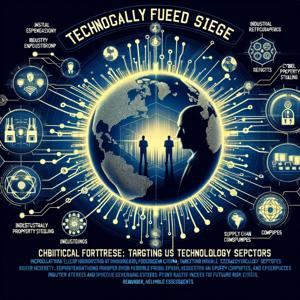
This is your Silicon Siege: China's Tech Offensive podcast.
Let’s not waste a single millisecond—my name is Ting, your cyber-sleuth and resident source of snark, wit, and all things China, hacking, and digital skullduggery. Silicon Siege is on, and oh boy, the last couple of weeks have been a non-stop parade of what I’d call high-stakes tech espionage with a healthy dose of supply chain sabotage and classic cyber-espionage drama. Buckle up, listeners.
First, if you thought your fancy drones were made in America and safe from foreign hands, think again. This week alone, the U.S. government blacklisted 16 Chinese companies, including Easy Fly Intelligent Technology, Shanghai Bitconn, and Shanghai Langqing, after parts from their supply chains were found in drones used by Iranian proxies like Hamas and the Houthis. According to the Federal Register, these companies allegedly facilitated the purchase of U.S.-origin electronics that ended up weaponized on the wrong side of the world. I mean, I love drones, but not ones smuggled into a proxy war—talk about taking global trade a little too literally. The entity list just grew by 29, and the export controls are getting ruthless.
Now, if you're trying to ship a boatload of soybeans down the Mississippi, you better keep one eye on Chinese cyber activity. FBI special agent Benjamin Dreessen warned the Louisiana District Export Council that Chinese actors are targeting U.S. ports like New Orleans, aiming to disrupt the river system and, by extension, our entire supply chain backbone. Their five-year plan? Cozy up to key industry nodes—from St. Louis to Chicago—to pilfer intellectual property and gain strategic control over what and when goods move through America. Congress and the White House see this as more than just business; it’s a digital chess match where the prize is industrial dominance and, if Dreessen is right, leverage over everything from commodities to critical minerals.
Now let’s talk about the new cyber flavor of the month: the use of generative AI for cyber offensives. Security firm Truesec reports a China-nexus group using AI tools like ChatGPT to create convincing phishing emails and craft ever-evolving malware. The buzzword? Quantity over quality. AI helps attackers—let’s call them the UTA0388 crew—churn out attack lures faster than I can finish a bubble tea, using spear-phishing, LLM-crafted fake addresses, and something called GOVERNshell malware. Yes, mistakes happen—like porn in zip files or obviously fake contact info—but most people still fall for it, especially in languages they don’t speak. The criminals adapt faster because AI lets them multiply attacks, even if the sophistication isn’t quite blockbuster-movie level yet.
If that wasn’t enough, Chinese threat group Storm-2603 has been abusing Velociraptor, a legitimate forensics tool, to stay hidden inside U.S. networks, sometimes during ransomware campaigns. Think of it as hiding behind your adversary’s own digital couch—comf
This content was created in partnership and with the help of Artificial Intelligence AI.



 View all episodes
