This is your Silicon Siege: China's Tech Offensive podcast.
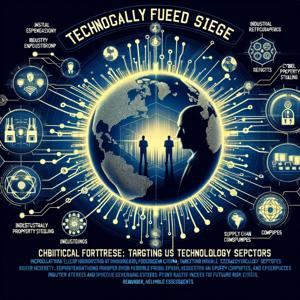
Hey listeners, I'm Alexandra Reeves, diving straight into the Silicon Siege—China's relentless tech offensive that's hitting U.S. sectors hard over the past two weeks. Picture this: I'm hunkered down in my San Francisco apartment, screens glowing with alerts from the Progressive Policy Institute's bombshell report dropped on April 16, 2026. It exposes how Chinese provincial governments poured 844 billion yuan into science and tech in 2024 alone—double their central government's spend—targeting semiconductors, electric vehicles, satellites, biotech, and carbon fiber. While U.S. states and localities have stalled for two decades, places like Guangdong and Shanghai are outpacing us, funneling cash into AI data centers and advanced manufacturing that directly threatens Silicon Valley's edge.
But it's not just investments; it's cyber shadows creeping in. Just days ago, echoes of the Volt Typhoon hacks resurfaced—Microsoft's 2024 warnings about this Chinese state-sponsored group surveilling critical infrastructure in Guam and the U.S. mainland. Now, with China's 2021 law forcing companies to hand over unpatched vulnerabilities to hacking-linked ministries, experts like European analyst dos Santos are sounding alarms on solar inverters. China's dominance there? A potential "kill-switch" Trojan horse, ripe for industrial espionage or supply chain sabotage against U.S. energy grids and tech firms.
Fast-forward to semiconductor espionage: U.S.-led export controls have supercharged China's self-sufficiency drive. IDC reports Chinese domestic AI chips hit 41% market share in 2025, half from Huawei's Ascend series, with Cambricon gearing up for 500,000 units in 2026 using homegrown fabs like SMIC. They're hacking yields from older DUV tools despite no ASML EUV access, per Brookings Institution analysis. This isn't theoretical—it's intellectual property grabs via algorithmic tricks compensating for compute shortages, infiltrating supply chains from batteries to sensors.
Brookings details China's full-stack AI push under the 2017 New Generation AI Development Plan and AI Plus Initiative, embedding it into manufacturing, EVs, drones, and embodied AI robotics—a $138 billion venture fund priority. Their latest five-year plan demands "extraordinary measures" to bust U.S. controls, turning our restrictions into their rocket fuel. Industry voices like PPI's Michael Mandel warn governors and mayors must counter with AI training, space bonds, and biosciences investments, or risk strategic irrelevance.
Future risks? A Brookings expert assesses China won't match Nvidia single-chip performance soon, but scaled production means U.S. tech faces relentless efficiency plays, hybrid cyber-physical threats, and supply chain compromises that could cascade into blackouts or IP hemorrhages. We're in a reindustrialization war—China's building the future in plain sight, piece by silicon piece, while we scramble.
Thank
This content was created in partnership and with the help of Artificial Intelligence AI.



 View all episodes
