This is your Silicon Siege: China's Tech Offensive podcast.
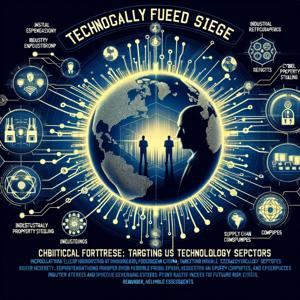
Hey listeners, it’s Ting—your go-to cyber sleuth, chronicling a fortnight that would make even Sun Tzu blush. Fasten your seatbelts, because the Silicon Siege is real, and China’s digital warriors have been busier than Beijing traffic at rush hour.
Let’s start with the headline-grabber: F5 Networks, the Seattle-based backbone of so many critical networks. Just this week, F5 revealed what US officials privately called a “catastrophic” breach. Hackers believed to be linked to China siphoned off select source code and, crucially, vulnerability data from F5’s BIG-IP infrastructure. Here’s why that’s more than just embarrassing: if you run the cloud or security stack for a Fortune 500—or, say, 15 cabinet-level US agencies—F5 probably sits between your data and the abyss. According to the Cybersecurity and Infrastructure Security Agency, if those vulnerabilities had reached the wild, attackers could have exfiltrated credentials, seized APIs, and “established persistent system access”—that’s code for ‘owning your network’ in cyber-speak. Nick Andersen at CISA said thousands of government systems were at risk, with agencies ordered to patch F5 products pronto. The takeaway? US supply chain security is like a house with too many unlocked doors, and everyone from the VA to the Marine Corps is on high alert.
Talk about unlocked doors—how about academic research as a front for intellectual property heist? Fox News spotlighted rising panic at Capitol Hill after reports surfaced that over 500 US universities and institutes collaborated with Chinese military-linked researchers recently. Strider Technologies documented nearly 2,500 joint STEM publications in 2024 alone, many touching on hypersonics and anti-jamming comms. Some members of Congress, like Senator Tom Cotton, are now scrambling to restrict these academic partnerships, fearing they represent a direct pipeline into US innovation. James Cangialosi at the National Counterintelligence and Security Center warned that hacking a university server or poaching talent is sometimes all it takes for an adversary to leapfrog years of research.
Supply chain compromises? Enter the Nexperia saga—a 21st-century spy thriller, as Stephen Innes at SPI Asset Management put it. The Dutch government seized effective control of Nexperia, a Chinese-owned chipmaker, after suspicions that its CEO’s behavior bordered on recklessness—with US pressure cited as a key accelerant. Nexperia’s erratic procurement and links to Beijing fueled Western fears: if the integrity of advanced chip fabrication goes, so does technological sovereignty in the modern world. Washington DC, by the way, made it clear to The Hague that CEO replacement was likely “the price of admission” to stay off the dreaded entity list.
One more wildcard: the Jewelbug group, also traced by the Symantec Threat Hunter Team, expanded its cloud-fueled cyber espionage outside just Asia-Pacific. Most recentl
This content was created in partnership and with the help of Artificial Intelligence AI.



 View all episodes
