
Sign up to save your podcasts
Or

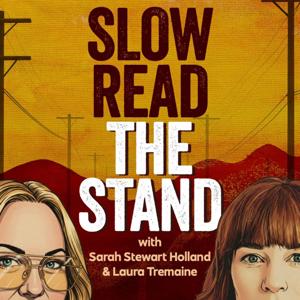

Welcome to SLOW READ, where we tackle the books you’ve always wanted to read at a pace you can handle.
Hosted by Sarah Stewart Holland and Laura Tremaine
We are currently reading The Stand by Stephen King (unabridged version)
You can find our full Reading Schedule here
Join the SLOW READ community on Substack for bonus episodes, book club meetings, and Side Quests with Sarah & Laura
____
Mentioned in this episode:
The Wire
The Sopranos
American Revolution by Ken Burns
The City We Became by MK Jamison
Stephen King books mentioned:
Mr Mercedes
Billy Summers
If you prefer to read instead of listen, below is a cleaned up transcript of the episodes as well as links to all the books and Substacks we mentioned in this episode…and several fun bonus links and videos!
____
Laura: Today we’re talking about Chapters 16 through 25, where the Captain Tripp’s super flu pandemic rages on. Two gangsters have a shootout in a gas station in Arizona, and our deaf-mute character, Nick Andros, basically becomes the sheriff in Arkansas.
Sarah: The sheriff of nobody.
Laura: And Larry Underwood takes care of his sick mom in New York City. And then we finally get a little more backstory to the origins and architects of this virus and of Project Blue.
Sarah: Shit’s getting dark. I don’t know how to say it any other way.
Laura: Do you think so? Because I felt like this section, with the exception of one chapter which is one of my favorites, felt a little slow to me.
Sarah: What are you talking about? We got so many villains! We got some real murderous, scary people showing up. It feels like things are starting to fall apart. This is going to be fertile ground for dark people, dark energy, dark acts. I was kind of ready for people to start dying in bigger numbers... and now that it’s started, I’m like: Oh, no.
Chapter 16: Poke, Lloyd, and the Crime Spree
Laura: Chapter 16.
Sarah: This section comes in hot.
Laura: We meet Poke and Lloyd. These are two criminals.
Sarah: I need to say this first off: In my head, I pronounced it “Poke” like a poke bowl the whole time.
Laura: I know. It’s because I’m from Oklahoma, so I was like, yeah. To poke around, to be a poke... that’s definitely a rural nickname.
Sarah: No, a poke is like a cowboy. Like “Go Pokes.” See, look at these regional differences. Meanwhile, I’m pronouncing it like I live in California and eat poke bowls all the time. Anyway, they kill a bunch of people really fast. They killed six people in the last six days.
Laura: He calls it “pokerizing,” meaning he’s killing them, which is pretty intense. Not as bad as “gobble,” but it’s up there.
Sarah: These dudes have gotten out of prison. I understand that they need money, but the immediate killing left and right... I’m like, how did you think this was going to go? The part with Gorgeous George... that is a real common situation in crime fiction. You get a lower level guy who’s protecting the kitty or whatever. But then the prolific killing? I’m like, you people want to go to jail.
Laura: I don’t know how realistic it is, but it felt like glimmers into kind of what Stephen King has always wanted to write about. He’s known for his horror, but as you can tell, there has been very little supernatural elements so far. What has been scary about this story is the violence. In the last decade plus, he has taken a real turn to crime fiction.
Sarah: I don’t mind the violence—The Sopranos is one of my favorite shows of all time—but I want the portraits of the criminals to be complex. And this felt a little one-note.
Laura: To me, it felt like every other storyline has had a touch of the flu in it. And other than maybe the arresting cop having the sniffles, this has nothing to do with anything else we have read thus far. So you’re kind of asking yourself: What does this have to do with anything?
Sarah: It’s kind of a weird wash to listen to this and be like, well, yeah, that’s a violent, terrible way to die... but you might have just drowned in your own snot like everybody else is right now.
Laura: You’re kind of zooming out. Like, well, they don’t know it, but we know it.
Chapter 17: Starkey, Project Blue, and the “Miserable Worm”
Laura: Chapter 17. We are back to Starkey, the head of Project Blue. And we finally sort of get a little bit of the backstory to not just the origins of Project Blue, but maybe the decades-long corruption that might be happening here.
Sarah: That there are these figures so deep underneath the public’s knowledge that are actually controlling everything. Starkey has known the man that’s now the president since college.
Sarah: Here’s my first question: I don’t understand the centrifuge. I thought a centrifuge is just a really big fan thing. Are they running out of air?
Laura: Starkey is in an admin building watching the monitors. But then he goes into the cafeteria and cleans the guy’s face off. He had to kind of bust through the gates to get back in there and everybody’s dead.
Laura: I’m skipping ahead because right now all we get is that he calls the command “Troy,” which basically means: Don’t let the story get out. That also doesn’t make a lot of sense to me. At this point, I’m like: You guys know it’s out and everybody’s going to die. What exactly do you think you’re containing here?
Sarah: Do you think they’re just trying to keep public panic at bay? They just need everybody to die without panic on the airwaves? Here is also a funny thing that I did reading this chapter. When he says: “And one of their number, a man who could now dial directly to the miserable worm who had been masquerading as a chief executive...”I read “Worm” as “Woman”. I thought the president was a woman! I thought that was going to be such an interesting choice. But no, the president is a man.
Laura: Starkey is thinking back on this quote: “If you find your mother raped or your father beaten and robbed before you call the police... you cover their nakedness because you love them.” He’s justifying to himself telling them to murder the journalists. Because what we’re learning about Starkey is that he would cover himself and the government and the country above all else.
Sarah: That is how people justify things like murdering journalists and quarantining whole towns. Because it’s not about the people anymore. It’s about the institution.
Laura: But when you see it framed as love... that is such dark nationalist territory to me. That in 2025, when you’re just like “country above all else”... it gives me a pit in my stomach. Because the institution is going to be left when everyone’s dead. What are you worried about? People are not stupid. They are starting to figure it out.
Chapter 18: Nick Andros, The Sheriff of Shoyo
Laura: Chapter 18. We’re with poor Nick in Arkansas. And everybody’s dead but him.
Sarah: Including the soldiers trying to block the road.
Laura: Nick basically becomes the sheriff because Sheriff Baker is so sick. And Nick decides to write down and fill in some of the holes of his backstory. We learn that he becomes an orphan early and is sent to a foster care system where the state provides a deaf-mute man, Rudy, to teach this kid how to read and write.
Sarah: I really like that part. But before we get there, I have to call out a hilarious moment. Nick is with the Bakers and he says: “Nick, watching them, wondered how two people of such radically different size got along in bed.” I was like, oh goody, it’s not just me.
Laura: I have definitely thought that about people. Just have some logistical questions.
Sarah: I really liked the backstory with Rudy because we’re in the age of positive parenting, and Rudy... well, he slapped Nick. It was a very physical learning. I just thought that was a very accurate portrayal of how a man taught him. He slapped him across the face to get his attention, but he was very kind and taught him everything he needed.
Laura: I got spanked growing up. I’m not traumatized. But getting slapped across the face... it is a humiliation. But it didn’t feel that way with Rudy. It was different than with Carla and Franny.
Sarah: I think what was impactful to me is that Nick was checked out. He was cynical and didn’t trust anybody. And when Rudy shows up and uses that physicality to pull him back... to say, “Oh, come back here with me.”
Laura: I also underlined this part: “It’s going to be a great day for the deaf mutes of the world when the telephone view screens the science fiction novels were always predicting finally came into general use.” Oh my God. Now we’re reading it and being like: Yep, we FaceTime each other every day.
Sarah: We also learn in this chapter that Nick is starting to have vivid dreams. He is dreaming about endless rows of green corn looking for something and terribly afraid of something else that seemed to be behind him.
Laura: Also in Chapter 18, Sheriff Baker actually dies. And one of the prisoners dies. So things are progressing.
Sarah: The most important part to me is when Dr. Soames gives Nick a little speech. He says: “I repeat, someone made a mistake and now they’re trying to cover it up.” He is right. But he also alludes to like... educated people are not supposed to believe these stupid theories, and we get to the end of our life and we’re like, Oh shoot, maybe all of that paranoia was the right thing.
Laura: It’s the paradox of conspiracy theories. There is often something there that doesn’t make sense. But people want to turn it into something organized with a central villain.
Sarah: I think it’s interesting that Nick is such a young character amidst all these old people who are praising him or trusting him. They see something in him. He’s sort of like an old soul.
Laura: He doesn’t have loyalty to anything. He’s been failed in a lot of ways. Born with a birth defect. Parents died. Never adopted. Out on his own since 16. He has no loyalty to anything... which is interesting as the story is going to go on.
Chapter 19: Larry Underwood
Sarah: Nick is in such sharp contrast to Larry, who we go back to in the next chapter. Larry’s mom, Alice, is sick as a dog in New York City. And he’s like, Hey, I’m going to go walk around Times Square.
Sarah: I underlined this: “Her idea of nutrition was vague, but all encompassing.” Same. That’s 100% me. Also, why do we think this is the first one we get a picture of? There’s a random illustration.
Laura: Here’s the part where I thought the contrast between Larry and Nick was intense. He’s thinking: “Why did it have to happen after I got the good news? And most despicable of all, how bad is this going to screw up my plans?”
Sarah: That was relatable to me. Am I a narcissist?
Laura: No. I think there’s always that voice.
Sarah: When my child was diagnosed with Type 1 diabetes, the first thing I thought about was our upcoming vacation. I’m not even playing. I was like, Oh my God, are we still going to go? How bad is that? But I think everybody has that.
Sarah: I also wonder if as Enneagram Ones, the way that our brains work is like: This is the way. And when a wrench has been thrown to the way, we’re like: Wait. That is not what I had planned.
Chapter 20: Franny, Maine, and The Pie
Laura: Chapter 20. We check in on Franny in Maine. She has decamped to a hotel. She is trying to write a letter to a childhood friend.
Sarah: This chapter felt a little filler to me. But her trying to write a cheery letter without revealing her pregnancy... it was giving Instagram captions 2025.
Laura: I underlined where she says she felt like “that bug” that swelled up when it felt threatened. “The gestalt was maybe even a better word.” That’s the second time he’s used gestalt. I had an old school therapist in his 70s who was really into gestalt. It’s just another little flicker of the 70s.
Sarah: We’ve been signing off our episodes with “See You on the Other Side,” but do we need to change it to her sign-off: “Believe in me and I’ll believe in you”?
Laura: I thought that was such a funny way to end a letter. Why would you write that to a friend? I don’t know if I’ve ever said anything like that in my whole life.
Sarah: At the end of the chapter, she gets a call from her daddy that Carla is sick as a dog. And she thinks: “Responsibility is a pie... You’re only kidding if you think you’re not going to have a cut a big, juicy, bitter piece for yourself and eat every bite.”
Laura: Did not love that metaphor.
Sarah: This kind of gets at what we were talking about... Franny’s trying to figure it out. If you take the whole super flu away from it, she is at a real crossroads in her life.
Chapter 21: Stu Redman was Frightened
Laura: Chapter 21 starts out with: “Stu Redman was frightened.” And he’s like a tough guy. So if he’s scared, we shall be scared, too.
Sarah: My quibble with this chapter is they have moved him from the Atlanta CDC to a facility in Vermont. And I have questions. How did that happen logistically? Everybody’s sick. What’s going on?
Chapter 22: The Face in the Soup
Laura: Chapter 22. You guys, Chapter 22 is one of my favorites.
Sarah: This is the one that’s your favorite? Why do you like every time the dude with the face in the soup shows up?
Laura: Because that imagery is strong. When the whole thing is over, I’m still going to remember the guy who died in the cafeteria with his face in the soup.
Sarah: Starkey has been fired by the president. And he goes back into the facility. He’s quoting Yeats—but he calls him “Yeet.”
Laura: I thought that was such a funny little detail. He’s trying to be intellectual and philosophical and he’s just butchering it a little bit.
Sarah: And then he watches Frank D. Bruce’s soup head on the monitor. “The soup congealing in Frank D. Bruce’s eyebrows worried him more, much more.”
Laura: Everything before he sits down on the floor and puts the gun in his mouth is fascinating to me. Because you’re getting the smallest glimpse of these people who work in this facility who absolutely know what’s coming. Two of them decide to copulate right there. A group of them run for the elevator. There’s the man who has time to make a sign to put around his neck: Now you know it works. Any questions?
Sarah: That’s stark. A last gasp of sort of protest or defiance.
Laura: I love this scene because it tells you so much about human nature. It reminds me of the 9/11 documentaries... the people who choose to shoot themselves or the people who choose to sit and eat their soup until it gets them.
Chapter 23: Randall Flagg
Laura: Chapter 23. We meet Randall Flagg. I underlined so many things in this chapter. He is one of literature’s greatest all-time villains. I actually will probably do a bonus thing just about Randall Flagg.
Sarah: Is he just the devil? It feels like he’s just the devil.
Sarah: “There was a dark hilarity in his face... It was the face of a hateful, happy man... a face to make small children crash their trikes into board fences and then run wailing to their mommies with steak-shaped splinters sticking out of their knees.” Yee! So scary!
Laura: I felt very scared reading this chapter. But in the iteration of Randall Flagg as we’re meeting him now, he is a man. He doesn’t have much memory before his current iteration. But he also levitates off the ground.
Sarah: It’s awkward to make parallels to Jesus because it’s the opposite... but evil made man is the opposite of good made man.
Laura: I also find it fascinating that Randall Flagg is a big reader. “Flagg was an equal opportunity reader.”He read all the pamphlets.
Chapter 24: Lloyd’s Lawyer
Sarah: Chapter 24. Lloyd has a very long talk with his lawyer. And everybody don’t panic. This is where I will dust off my legal degree and say: This is not a thing. Lawyers do not tell their clients what to say like that. That is so illegal and a massive ethical violation.
Laura: You don’t think that happens?
Sarah: No. Of course, I think it happens sometimes. But this is pretty overt. Lawyers usually want just enough doubt. They’re not going to layer on the doubt to where point it becomes unbelievable.
Chapter 25: The End of Shoyo
Sarah: Chapter 25. Listen. I like Nick, but this chapter was entirely too long.
Laura: We’re getting a lot of detail on what happens when everybody’s dead. How are you going to feed yourself? What happens next? Nick is 22 years old and no one has any context for what is happening. This is so bizarre.
Sarah: There were elements of this chapter that bubbled up for me some of the trauma of those early days of COVID-19. Like: It is so surreal that this is actually happening. Nick is in that same sort of denial.
Laura: He watches the TV and notices the newscasters are giving skewed information. No weather report. No sports reporting. I loved that part.
Sarah: I want to know what everybody else thinks. Is it scarier if Randall Flagg shows up after everybody’s dead or in your everyday life?
Laura: I feel like when everybody’s dead... who gives a fuck?
Sarah: No, because when everything is upside down... if he showed up in everyday life, there are more tools available to you. There’s more people to help you. I’m better in a group. The idea that this monstrous presence shows up and you’re by yourself... that’s rough.
Next Week:
We are covering Chapters 26 through 34. It is 94 pages. We can do hard things.
See you on the other side.
 View all episodes
 By Sarah Stewart Holland & Laura Tremaine
Welcome to SLOW READ, where we tackle the books you’ve always wanted to read at a pace you can handle.
Hosted by Sarah Stewart Holland and Laura Tremaine
We are currently reading The Stand by Stephen King (unabridged version)
You can find our full Reading Schedule here
Join the SLOW READ community on Substack for bonus episodes, book club meetings, and Side Quests with Sarah & Laura
____
Mentioned in this episode:
The Wire
The Sopranos
American Revolution by Ken Burns
The City We Became by MK Jamison
Stephen King books mentioned:
Mr Mercedes
Billy Summers
If you prefer to read instead of listen, below is a cleaned up transcript of the episodes as well as links to all the books and Substacks we mentioned in this episode…and several fun bonus links and videos!
____
Laura: Today we’re talking about Chapters 16 through 25, where the Captain Tripp’s super flu pandemic rages on. Two gangsters have a shootout in a gas station in Arizona, and our deaf-mute character, Nick Andros, basically becomes the sheriff in Arkansas.
Sarah: The sheriff of nobody.
Laura: And Larry Underwood takes care of his sick mom in New York City. And then we finally get a little more backstory to the origins and architects of this virus and of Project Blue.
Sarah: Shit’s getting dark. I don’t know how to say it any other way.
Laura: Do you think so? Because I felt like this section, with the exception of one chapter which is one of my favorites, felt a little slow to me.
Sarah: What are you talking about? We got so many villains! We got some real murderous, scary people showing up. It feels like things are starting to fall apart. This is going to be fertile ground for dark people, dark energy, dark acts. I was kind of ready for people to start dying in bigger numbers... and now that it’s started, I’m like: Oh, no.
Chapter 16: Poke, Lloyd, and the Crime Spree
Laura: Chapter 16.
Sarah: This section comes in hot.
Laura: We meet Poke and Lloyd. These are two criminals.
Sarah: I need to say this first off: In my head, I pronounced it “Poke” like a poke bowl the whole time.
Laura: I know. It’s because I’m from Oklahoma, so I was like, yeah. To poke around, to be a poke... that’s definitely a rural nickname.
Sarah: No, a poke is like a cowboy. Like “Go Pokes.” See, look at these regional differences. Meanwhile, I’m pronouncing it like I live in California and eat poke bowls all the time. Anyway, they kill a bunch of people really fast. They killed six people in the last six days.
Laura: He calls it “pokerizing,” meaning he’s killing them, which is pretty intense. Not as bad as “gobble,” but it’s up there.
Sarah: These dudes have gotten out of prison. I understand that they need money, but the immediate killing left and right... I’m like, how did you think this was going to go? The part with Gorgeous George... that is a real common situation in crime fiction. You get a lower level guy who’s protecting the kitty or whatever. But then the prolific killing? I’m like, you people want to go to jail.
Laura: I don’t know how realistic it is, but it felt like glimmers into kind of what Stephen King has always wanted to write about. He’s known for his horror, but as you can tell, there has been very little supernatural elements so far. What has been scary about this story is the violence. In the last decade plus, he has taken a real turn to crime fiction.
Sarah: I don’t mind the violence—The Sopranos is one of my favorite shows of all time—but I want the portraits of the criminals to be complex. And this felt a little one-note.
Laura: To me, it felt like every other storyline has had a touch of the flu in it. And other than maybe the arresting cop having the sniffles, this has nothing to do with anything else we have read thus far. So you’re kind of asking yourself: What does this have to do with anything?
Sarah: It’s kind of a weird wash to listen to this and be like, well, yeah, that’s a violent, terrible way to die... but you might have just drowned in your own snot like everybody else is right now.
Laura: You’re kind of zooming out. Like, well, they don’t know it, but we know it.
Chapter 17: Starkey, Project Blue, and the “Miserable Worm”
Laura: Chapter 17. We are back to Starkey, the head of Project Blue. And we finally sort of get a little bit of the backstory to not just the origins of Project Blue, but maybe the decades-long corruption that might be happening here.
Sarah: That there are these figures so deep underneath the public’s knowledge that are actually controlling everything. Starkey has known the man that’s now the president since college.
Sarah: Here’s my first question: I don’t understand the centrifuge. I thought a centrifuge is just a really big fan thing. Are they running out of air?
Laura: Starkey is in an admin building watching the monitors. But then he goes into the cafeteria and cleans the guy’s face off. He had to kind of bust through the gates to get back in there and everybody’s dead.
Laura: I’m skipping ahead because right now all we get is that he calls the command “Troy,” which basically means: Don’t let the story get out. That also doesn’t make a lot of sense to me. At this point, I’m like: You guys know it’s out and everybody’s going to die. What exactly do you think you’re containing here?
Sarah: Do you think they’re just trying to keep public panic at bay? They just need everybody to die without panic on the airwaves? Here is also a funny thing that I did reading this chapter. When he says: “And one of their number, a man who could now dial directly to the miserable worm who had been masquerading as a chief executive...”I read “Worm” as “Woman”. I thought the president was a woman! I thought that was going to be such an interesting choice. But no, the president is a man.
Laura: Starkey is thinking back on this quote: “If you find your mother raped or your father beaten and robbed before you call the police... you cover their nakedness because you love them.” He’s justifying to himself telling them to murder the journalists. Because what we’re learning about Starkey is that he would cover himself and the government and the country above all else.
Sarah: That is how people justify things like murdering journalists and quarantining whole towns. Because it’s not about the people anymore. It’s about the institution.
Laura: But when you see it framed as love... that is such dark nationalist territory to me. That in 2025, when you’re just like “country above all else”... it gives me a pit in my stomach. Because the institution is going to be left when everyone’s dead. What are you worried about? People are not stupid. They are starting to figure it out.
Chapter 18: Nick Andros, The Sheriff of Shoyo
Laura: Chapter 18. We’re with poor Nick in Arkansas. And everybody’s dead but him.
Sarah: Including the soldiers trying to block the road.
Laura: Nick basically becomes the sheriff because Sheriff Baker is so sick. And Nick decides to write down and fill in some of the holes of his backstory. We learn that he becomes an orphan early and is sent to a foster care system where the state provides a deaf-mute man, Rudy, to teach this kid how to read and write.
Sarah: I really like that part. But before we get there, I have to call out a hilarious moment. Nick is with the Bakers and he says: “Nick, watching them, wondered how two people of such radically different size got along in bed.” I was like, oh goody, it’s not just me.
Laura: I have definitely thought that about people. Just have some logistical questions.
Sarah: I really liked the backstory with Rudy because we’re in the age of positive parenting, and Rudy... well, he slapped Nick. It was a very physical learning. I just thought that was a very accurate portrayal of how a man taught him. He slapped him across the face to get his attention, but he was very kind and taught him everything he needed.
Laura: I got spanked growing up. I’m not traumatized. But getting slapped across the face... it is a humiliation. But it didn’t feel that way with Rudy. It was different than with Carla and Franny.
Sarah: I think what was impactful to me is that Nick was checked out. He was cynical and didn’t trust anybody. And when Rudy shows up and uses that physicality to pull him back... to say, “Oh, come back here with me.”
Laura: I also underlined this part: “It’s going to be a great day for the deaf mutes of the world when the telephone view screens the science fiction novels were always predicting finally came into general use.” Oh my God. Now we’re reading it and being like: Yep, we FaceTime each other every day.
Sarah: We also learn in this chapter that Nick is starting to have vivid dreams. He is dreaming about endless rows of green corn looking for something and terribly afraid of something else that seemed to be behind him.
Laura: Also in Chapter 18, Sheriff Baker actually dies. And one of the prisoners dies. So things are progressing.
Sarah: The most important part to me is when Dr. Soames gives Nick a little speech. He says: “I repeat, someone made a mistake and now they’re trying to cover it up.” He is right. But he also alludes to like... educated people are not supposed to believe these stupid theories, and we get to the end of our life and we’re like, Oh shoot, maybe all of that paranoia was the right thing.
Laura: It’s the paradox of conspiracy theories. There is often something there that doesn’t make sense. But people want to turn it into something organized with a central villain.
Sarah: I think it’s interesting that Nick is such a young character amidst all these old people who are praising him or trusting him. They see something in him. He’s sort of like an old soul.
Laura: He doesn’t have loyalty to anything. He’s been failed in a lot of ways. Born with a birth defect. Parents died. Never adopted. Out on his own since 16. He has no loyalty to anything... which is interesting as the story is going to go on.
Chapter 19: Larry Underwood
Sarah: Nick is in such sharp contrast to Larry, who we go back to in the next chapter. Larry’s mom, Alice, is sick as a dog in New York City. And he’s like, Hey, I’m going to go walk around Times Square.
Sarah: I underlined this: “Her idea of nutrition was vague, but all encompassing.” Same. That’s 100% me. Also, why do we think this is the first one we get a picture of? There’s a random illustration.
Laura: Here’s the part where I thought the contrast between Larry and Nick was intense. He’s thinking: “Why did it have to happen after I got the good news? And most despicable of all, how bad is this going to screw up my plans?”
Sarah: That was relatable to me. Am I a narcissist?
Laura: No. I think there’s always that voice.
Sarah: When my child was diagnosed with Type 1 diabetes, the first thing I thought about was our upcoming vacation. I’m not even playing. I was like, Oh my God, are we still going to go? How bad is that? But I think everybody has that.
Sarah: I also wonder if as Enneagram Ones, the way that our brains work is like: This is the way. And when a wrench has been thrown to the way, we’re like: Wait. That is not what I had planned.
Chapter 20: Franny, Maine, and The Pie
Laura: Chapter 20. We check in on Franny in Maine. She has decamped to a hotel. She is trying to write a letter to a childhood friend.
Sarah: This chapter felt a little filler to me. But her trying to write a cheery letter without revealing her pregnancy... it was giving Instagram captions 2025.
Laura: I underlined where she says she felt like “that bug” that swelled up when it felt threatened. “The gestalt was maybe even a better word.” That’s the second time he’s used gestalt. I had an old school therapist in his 70s who was really into gestalt. It’s just another little flicker of the 70s.
Sarah: We’ve been signing off our episodes with “See You on the Other Side,” but do we need to change it to her sign-off: “Believe in me and I’ll believe in you”?
Laura: I thought that was such a funny way to end a letter. Why would you write that to a friend? I don’t know if I’ve ever said anything like that in my whole life.
Sarah: At the end of the chapter, she gets a call from her daddy that Carla is sick as a dog. And she thinks: “Responsibility is a pie... You’re only kidding if you think you’re not going to have a cut a big, juicy, bitter piece for yourself and eat every bite.”
Laura: Did not love that metaphor.
Sarah: This kind of gets at what we were talking about... Franny’s trying to figure it out. If you take the whole super flu away from it, she is at a real crossroads in her life.
Chapter 21: Stu Redman was Frightened
Laura: Chapter 21 starts out with: “Stu Redman was frightened.” And he’s like a tough guy. So if he’s scared, we shall be scared, too.
Sarah: My quibble with this chapter is they have moved him from the Atlanta CDC to a facility in Vermont. And I have questions. How did that happen logistically? Everybody’s sick. What’s going on?
Chapter 22: The Face in the Soup
Laura: Chapter 22. You guys, Chapter 22 is one of my favorites.
Sarah: This is the one that’s your favorite? Why do you like every time the dude with the face in the soup shows up?
Laura: Because that imagery is strong. When the whole thing is over, I’m still going to remember the guy who died in the cafeteria with his face in the soup.
Sarah: Starkey has been fired by the president. And he goes back into the facility. He’s quoting Yeats—but he calls him “Yeet.”
Laura: I thought that was such a funny little detail. He’s trying to be intellectual and philosophical and he’s just butchering it a little bit.
Sarah: And then he watches Frank D. Bruce’s soup head on the monitor. “The soup congealing in Frank D. Bruce’s eyebrows worried him more, much more.”
Laura: Everything before he sits down on the floor and puts the gun in his mouth is fascinating to me. Because you’re getting the smallest glimpse of these people who work in this facility who absolutely know what’s coming. Two of them decide to copulate right there. A group of them run for the elevator. There’s the man who has time to make a sign to put around his neck: Now you know it works. Any questions?
Sarah: That’s stark. A last gasp of sort of protest or defiance.
Laura: I love this scene because it tells you so much about human nature. It reminds me of the 9/11 documentaries... the people who choose to shoot themselves or the people who choose to sit and eat their soup until it gets them.
Chapter 23: Randall Flagg
Laura: Chapter 23. We meet Randall Flagg. I underlined so many things in this chapter. He is one of literature’s greatest all-time villains. I actually will probably do a bonus thing just about Randall Flagg.
Sarah: Is he just the devil? It feels like he’s just the devil.
Sarah: “There was a dark hilarity in his face... It was the face of a hateful, happy man... a face to make small children crash their trikes into board fences and then run wailing to their mommies with steak-shaped splinters sticking out of their knees.” Yee! So scary!
Laura: I felt very scared reading this chapter. But in the iteration of Randall Flagg as we’re meeting him now, he is a man. He doesn’t have much memory before his current iteration. But he also levitates off the ground.
Sarah: It’s awkward to make parallels to Jesus because it’s the opposite... but evil made man is the opposite of good made man.
Laura: I also find it fascinating that Randall Flagg is a big reader. “Flagg was an equal opportunity reader.”He read all the pamphlets.
Chapter 24: Lloyd’s Lawyer
Sarah: Chapter 24. Lloyd has a very long talk with his lawyer. And everybody don’t panic. This is where I will dust off my legal degree and say: This is not a thing. Lawyers do not tell their clients what to say like that. That is so illegal and a massive ethical violation.
Laura: You don’t think that happens?
Sarah: No. Of course, I think it happens sometimes. But this is pretty overt. Lawyers usually want just enough doubt. They’re not going to layer on the doubt to where point it becomes unbelievable.
Chapter 25: The End of Shoyo
Sarah: Chapter 25. Listen. I like Nick, but this chapter was entirely too long.
Laura: We’re getting a lot of detail on what happens when everybody’s dead. How are you going to feed yourself? What happens next? Nick is 22 years old and no one has any context for what is happening. This is so bizarre.
Sarah: There were elements of this chapter that bubbled up for me some of the trauma of those early days of COVID-19. Like: It is so surreal that this is actually happening. Nick is in that same sort of denial.
Laura: He watches the TV and notices the newscasters are giving skewed information. No weather report. No sports reporting. I loved that part.
Sarah: I want to know what everybody else thinks. Is it scarier if Randall Flagg shows up after everybody’s dead or in your everyday life?
Laura: I feel like when everybody’s dead... who gives a fuck?
Sarah: No, because when everything is upside down... if he showed up in everyday life, there are more tools available to you. There’s more people to help you. I’m better in a group. The idea that this monstrous presence shows up and you’re by yourself... that’s rough.
Next Week:
We are covering Chapters 26 through 34. It is 94 pages. We can do hard things.
See you on the other side.