
Sign up to save your podcasts
Or

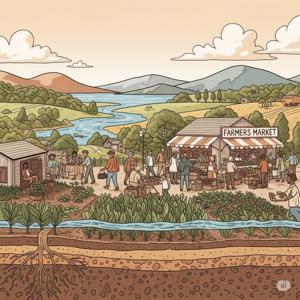

Soil carbon sequestration is real, but it’s not limitless, and the “how” matters. This episode breaks down the mechanistic constraints that determine whether carbon inputs become stable SOC or return to the atmosphere as CO₂.
Using a recent mechanistic review as the backbone, we walk through five limitation domains that set the ceiling on SOC gains:
Biotic limits (photosynthesis, root architecture, rhizosphere interactions, microbial carbon-use efficiency)
Abiotic controls (temperature, moisture variability, nutrient constraints, elevated CO₂ effects)
Structural/physical limits (texture, aggregation, pore architecture that governs protection)
Chemical/mineral constraints (stabilization kinetics, MAOM formation, and mineral surface saturation)
Human dimension (management, policy, MRV, and why scalability depends on incentives and verification)
Key takeaway: soils store enormous carbon (often cited at ~1500–2400 Pg globally), but the practical sequestration potential depends on site-specific mechanisms and finite stabilization capacity, so expectations and MRV need to be grounded in process, not slogans.
Reference Material:
Soil C Sequestration Limitations and Possibilities
 View all episodes
 By Saurav Das
Soil carbon sequestration is real, but it’s not limitless, and the “how” matters. This episode breaks down the mechanistic constraints that determine whether carbon inputs become stable SOC or return to the atmosphere as CO₂.
Using a recent mechanistic review as the backbone, we walk through five limitation domains that set the ceiling on SOC gains:
Biotic limits (photosynthesis, root architecture, rhizosphere interactions, microbial carbon-use efficiency)
Abiotic controls (temperature, moisture variability, nutrient constraints, elevated CO₂ effects)
Structural/physical limits (texture, aggregation, pore architecture that governs protection)
Chemical/mineral constraints (stabilization kinetics, MAOM formation, and mineral surface saturation)
Human dimension (management, policy, MRV, and why scalability depends on incentives and verification)
Key takeaway: soils store enormous carbon (often cited at ~1500–2400 Pg globally), but the practical sequestration potential depends on site-specific mechanisms and finite stabilization capacity, so expectations and MRV need to be grounded in process, not slogans.
Reference Material:
Soil C Sequestration Limitations and Possibilities